The easiest way to flatten The Thirty-Nine Steps is to read it as a rough draft of Alfred Hitchcock's film. The second easiest is to race John Buchan's Richard Hannay toward the solution promised by the title.
Try another entrance. Read its ten short chapters as a sequence of auditions. Hannay survives by noticing what each room, road, and stranger expects him to be, then filling the part before anyone examines him twice. The coded notebook supplies clues, but role-playing supplies the pleasure. Once you see that, a milkman's cans, a political platform, a road worker's spectacles, and a suburban tennis lawn become parts of one design.
This route also makes the adaptations more useful. Hitchcock did not simply improve or betray Buchan; he shifted more of the novel's self-narrated performances into camera-visible public scenes. The later four-actor stage comedy exposed the changes in full view. Read the book first, in two brisk sittings, and let those afterlives test what you noticed rather than decide what the novel ought to be.
Before Chapter I, keep 1915 at the edge of the page
Buchan called the book a “shocker.” It was serialized under the pseudonym H. de V. in Blackwood's Magazine during the summer of 1915, then appeared under his name that October. The National Library of Scotland records sales of more than 25,000 copies in its first three months.[2] The book was built to move, and its first readers encountered a chase set in the weeks before a conflict they were already living through.
Its action sits precisely in May and June 1914. Hannay, newly returned from years in southern Africa, discovers a German plot against British military security. That frame carries imperial confidence, xenophobia, and antisemitic conspiracy language that should not be waved away as neutral period color.[1] Note whose freedom of movement the story treats as natural, which officials it assumes will eventually cooperate, and which people it reduces to threatening types. The chase is entertaining; its idea of the ordinary British hero is not politically innocent.
Then keep the context at the edge rather than letting it cover every sentence. Chapter I introduces Hannay as “the best bored man in the United Kingdom.”[1] He has money, strength, and no purpose. What wakes him is not patriotism in the abstract but the demand to pay attention: a stranger at his door, a body in his flat, a notebook that resists reading. The first useful question is therefore not Will he save Britain? It is What does danger teach him to notice?
Read the chapter titles as a costume rail
The contents page looks like a collection of turns in a variety show, moving from a milkman and literary innkeeper through a radical candidate, spectacled roadman, and bald archaeologist.[1] Those labels are a reading aid. Each chapter gives Hannay a new social type to recognize, borrow, or confront.
In Chapter II, he escapes his London building in a milkman's cap and overall. The disguise works because he carries the cans, whistles, and imitates the milkman's jaunty swing just long enough to pass the porter and street watchers. In Chapter IV, a young Liberal candidate assumes that this stranded colonial stranger can rescue a public meeting. The chairman promptly upgrades Hannay into a “trusted leader of Australian thought,” and Hannay speaks to about five hundred people despite having almost no politics ready.[1]
Chapter V turns the method into close-up craft. To replace a road worker too drunk to face the new surveyor, Hannay opens his collar, powders his boots and trouser legs with road dust, damages his fingernails, borrows a foul pipe, and pushes grit into his eyes. More important, he imagines the man's cottage, work, sleep, and whisky until his heavy step feels habitual. He does not merely look like a road worker. For the duration of the scene, he stops looking like someone who has arrived from another story.
Mark every moment when a setting supplies the disguise. Clothing matters, but “atmosphere” matters more: a milkman belongs beside cans, a road worker beside a stone pile, an English gentleman at a bridge table. Buchan's deepest suspense comes when person and background agree so completely that inspection seems rude.
Pause at the political speech
The public meeting in Chapter IV can seem like comic rest between escapes. Slow down there. It is the book's cleanest demonstration that identity is granted by other people before it is proven by the self.
Hannay does not invent his authority alone. Sir Harry needs a replacement speaker; the chairman supplies a grand credential; the audience wants colonial testimony. Three expectations assemble a person who did not exist before Hannay entered the hall. He responds by talking about what he remembers of Australia and the Empire, avoiding the Free Trade argument he was asked to make. His success depends less on accuracy than on satisfying the room's desire for confidence.[1]
Immediately afterward, in Sir Harry's house, Hannay tells the full story of the murder and conspiracy for the first time. Speaking truth, he says, straightens the affair in his own mind.[1] Put the two speeches beside each other. The false public address earns a cheer because the room has already authorized him; the truthful private account wins support because Sir Harry trusts his own judgment of Hannay's character, not because he verifies the plot. Both speeches need a receptive listener, though for very different reasons.
This is also the passage to remember when you later encounter Hitchcock's political rally. The film does not invent Hannay as an accidental orator. It removes his advance understanding of the bargain. Its Hannay, fleeing his pursuers, is mistaken for the missing speaker and ushered onto the platform, learning the assigned identity from the chairman's introduction. Adaptation sharpens a mechanism the novel has taught us how to see.[8]
Keep a second column for watchers
Alongside Hannay's roles, track the people looking at him: the porter in his building, railway passengers, an aeroplane observer, policemen, the road surveyor, political listeners, secret agents, servants, and officials. A disguise succeeds differently for each one. Some see only uniform; some see class; some are distracted by the story they hope is true.
This column also reveals the book's narrow social field. It contains women, but no significant female character; Hannay's consequential exchanges are overwhelmingly with men who lend him clothes, shelter, information, or institutional access.[1][3] Do not silently import Madeleine Carroll's Pamela from the film. Without an attached skeptic who must be persuaded over time, the novel lets Hannay narrate his own success and move on. He performs for brief audiences, then recovers the lone hand.
That absence is both a historical limitation and a formal clue. Hannay rarely has to sustain an identity before an equal companion who cannot be left at the next station. His most demanding opponents are therefore mirror images: male performers who know the same rules of camouflage. The book grows most interesting when watching becomes mutual.
Do not solve the title ahead of Hannay
Scudder's coded notebook repeats the phrase “thirty-nine steps” and links it to a precise high tide. It is tempting to treat the rest of the novel as packaging around that answer. Resist. The phrase first works as a hard verbal object: concrete enough to promise a place, too bare to picture one.[1][2]
When Hannay finally tackles it in Chapter IX, the process is pleasing because it is imperfect. He consults tide tables and sailing times, separates what seems certain from what he is guessing, and admits he is no Sherlock Holmes. Steps slowly changes meaning: not stages in a plan, not dock stairs, but one identifiable staircase among several on a piece of coast. Language becomes geography by constraint rather than inspiration.[1]
Read this chapter with a pencil, but do not turn it into a logic exam. The pleasure here is not proving that every reader could independently locate the villains. It is watching Hannay learn to keep incomplete observations in play. The man who began by yawning at everything can now distinguish a useful number, a tide, a timetable, and a likely route from a notebook full of noise.
The literal answer also prepares a subtler one. The final staircase leads to men whose greatest protection is not the coast but their ability to look as though they have always belonged above it.
Read Chapter X twice: once for action, once for atmosphere
On the first pass, follow the convergence. Hannay reaches the right villa, watches two respectable-looking men play tennis as a third arrives with golf clubs, confronts all three at the end of dinner, joins them at bridge, recognizes a remembered gesture, and signals the waiting officers before they can escape by yacht.[1]
On the second pass, begin where Hannay recalls the old scout Peter Pienaar's theory of disguise. Physical alteration alone is childish, Pienaar argues; a performer must enter the surroundings so fully that the part becomes natural. Buchan compresses the method into a paradox: “a clever man looks the same and is different.”[1]
Now reconsider the tennis. The suspected men do not know Hannay is hidden nearby, so why keep acting? That is precisely the source of his doubt. They are not presenting a mask to a known audience; they have made English suburban ease continuous with themselves. They play, joke, drink, and discuss golf with such unforced particularity that the spy story appears to be happening somewhere else.
Hannay's full recognition begins with the old man's fingers tapping on his knees; the hawk-like fall of the eyelids confirms it a little later. A chosen atmosphere is defeated by gestures the body does not know it is repeating. That makes the ending richer than a simple unmasking. Hero and villains use the same formal skill—living inside a part—and Hannay wins because he has learned where performance ends.
Only after the last page, let Hitchcock interrupt
The 1935 film is most illuminating when used as a contrast, not a replacement memory. Make two columns: what moves outward, and what disappears.
The coded notebook, tide tables, and long private deductions disappear. Hitchcock replaces Scudder with a female agent and adds Pamela, handcuffs, the Forth Bridge, and Mr Memory.[2][3][5][8] The film opens and closes in theaters; as film scholar Marian Keane observes, its climax breaks the boundary between stage and audience.[4][8] Buchan already has an impostor posing as the First Sea Lord memorize the secret plans; Hitchcock recasts that mnemonic feat in a professional performer and exposes it in public.[1][4][5][8] The title no longer leads to a literal staircase: in the film, asking what the Thirty-Nine Steps are helps force espionage into a public answer.[8]
Pamela changes the test. She first helps expose Hannay to the police, then is physically chained to him and must decide whether his story can be trusted. The BFI is right to emphasize how radically this differs from a novel without a substantial female role.[3][8] Hannay can no longer shed every witness after a successful scene. Identity becomes a claim another person may doubt, test, and eventually accept.
The film also removes the safety of retrospective voice. It sends Hannay through a music hall, train carriage, kitchen, political platform, inn, and theater before any role can settle. Michael Wilmington quotes Hitchcock praising the film's “swift transitions” and singles out the cut in which the charwoman's unheard scream becomes the shriek of a train whistle.[5][8] Buchan lets Hannay stop and explain how an impersonation worked; Hitchcock makes the next setting answer before he can.
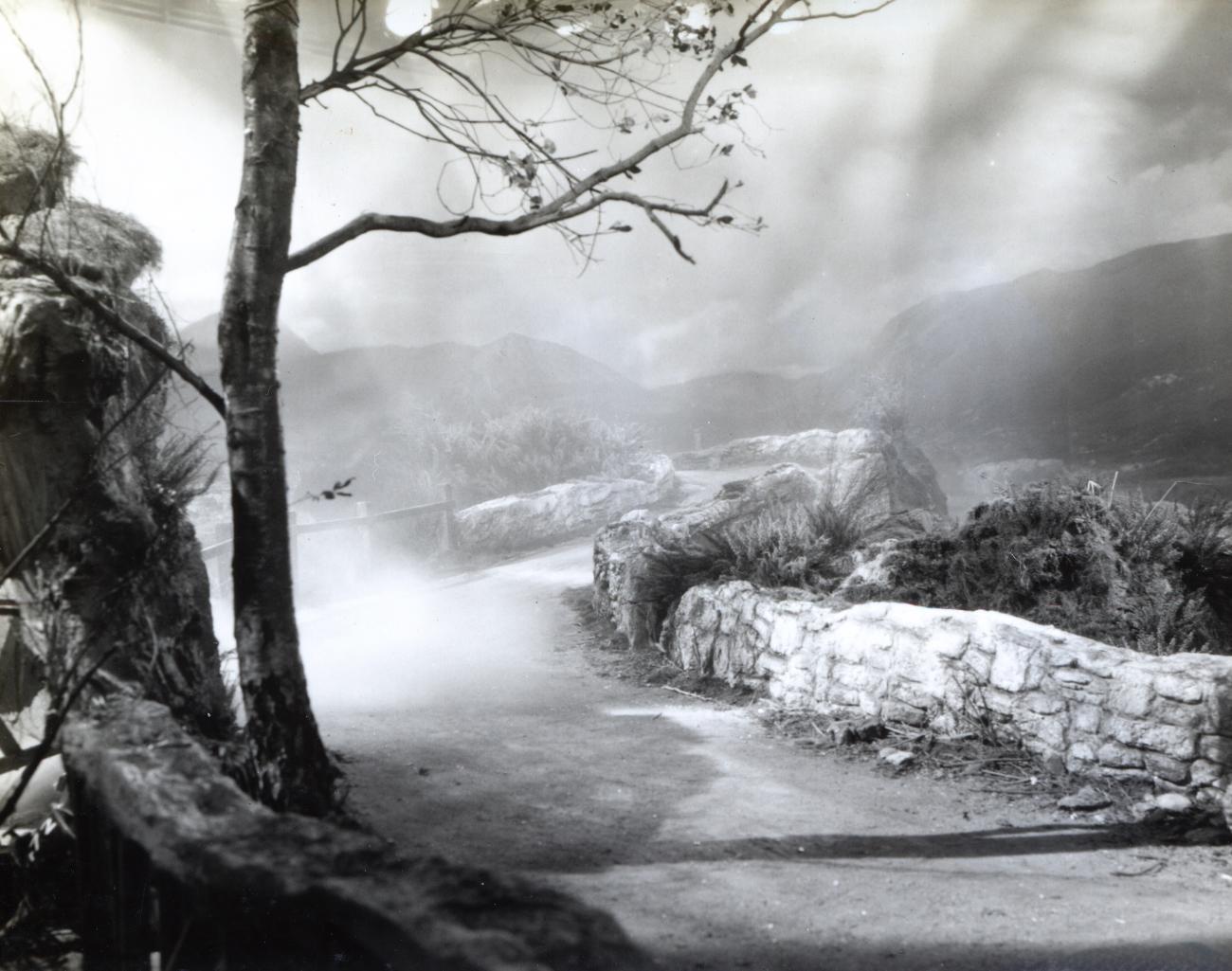
Wilfrid Newton's archival set photograph above offers an unusually good bridge back to the book. The BFI identifies built rocks, walls, planted material, and painted backings in the Highland sets created under art director Oscar Werndorff.[7] The road is real enough for a body to run along and artificial enough to be shaped around an entrance. It visualizes the reading rule already present in Chapter V: every environment is also a role, waiting for someone who can move as though he belongs there.
Use the four-actor play as a stress test
The story's later stage life tests whether this account of performance is more than a metaphor. Simon Corble and Nobby Dimon devised a four-actor version in the 1990s, and Patrick Barlow rewrote it in 2005. The official production history assigns one performer to Hannay, one to his three female entanglements, and two to everyone else—including, occasionally, inanimate objects. Quick changes happen at lightning speed, and the two ensemble performers sometimes play multiple characters at once.[6]
This production adapts Hitchcock's film as well as Buchan's book. Cinema had already turned inward explanation into visible transitions; the stage makes the labor of those transitions visible too. A coat, accent, posture, or prop produces a new social fact while the audience watches it being assembled.
If you encounter the play, notice where the laughter lands. It does not merely mock an old thriller. It releases the comedy inside Buchan's instruction to inhabit a part completely. Spectators see the actor change and the fictional characters fail to see it. We enjoy the disguise and its transparent construction at the same time.
That is the best check on this reading. If the plot still works when four bodies openly manufacture its crowds, trains, villains, and weather, then scenery was never the deepest continuity. The portable element is the agreement between actor and room.
A two-sitting route
Read Chapters I–V in the first sitting. Underline the moment each new environment assigns Hannay an identity, and stop after the road-worker episode. By then you have the book's whole practical vocabulary: costume, audience, atmosphere, improvisation.
Read Chapters VI–X in the second. This time mark acts of recognition: who looks, what they expect, which detail survives a disguise, and when Hannay moves from observation to guess. In Chapter IX, keep the title clues separate from his assumptions. In Chapter X, read the opening pages again after the arrests; the tennis match will feel less like delay and more like the adversary's finest performance.
Then return to two passages: the political speech in Chapter IV and the discussion of disguise in Chapter X. They connect the chase's broad comedy to its sharpest idea. Only after that compare Hitchcock's first and last theater scenes, or look at the four-actor staging. The useful question is not Was the adaptation faithful? Ask instead: Where has this version placed the audience that judges the part?
The stairs do matter, and the riddle gives a clean click of satisfaction. But the book lasts because the route to them is crowded with temporary selves. Read for those roles and The Thirty-Nine Steps becomes more than a fast antique. It becomes a compact study of how identity forms between a body, a background, and someone willing to believe they belong together.
Sources
- John Buchan, The Thirty-Nine Steps. Project Gutenberg HTML text—primary source used for chapter references and short quotations.
- National Library of Scotland, “John Buchan and ‘The Thirty-Nine Steps’”—publication history, literary context, title riddle, locations, and adaptation overview.
- Jamie Dunn, “10 great Scottish romances.” British Film Institute—comparison of Buchan's novel with Hitchcock's added women, Pamela, and the handcuffed passage.
- Marian Keane, “The 39 Steps.” The Criterion Collection—analysis of point of view, theatrical framing, and the film's collapsing of stage and audience.
- Michael Wilmington, “The 39 Steps.” The Criterion Collection—critical account of the film's transitions, wrong-man pattern, romantic reversals, and influence within Hitchcock's later work.
- The 39 Steps, “Show History”—official production chronology for the Corble–Dimon concept, Patrick Barlow rewrite, four-actor design, and major transfers.
- Nathalie Morris, “Object of the week: Haunting photos of empty sets for Hitchcock's The 39 Steps.” British Film Institute—Wilfrid Newton photographs and BFI National Archive provenance.
- British Film Institute, The 39 Steps (1935)—official film viewing page used as the primary screen reference for the rally, theater frame, Mr Memory, and Pamela.