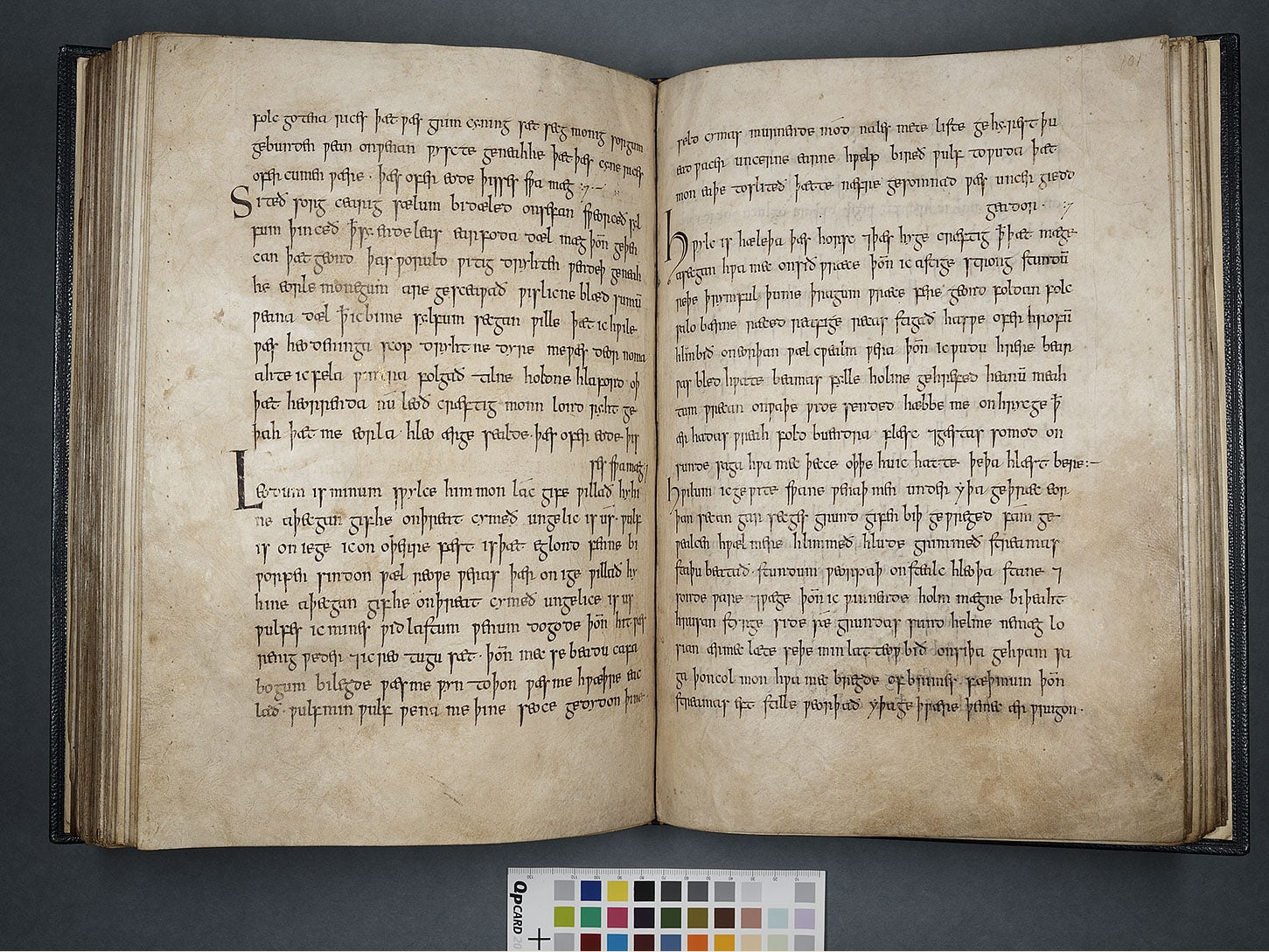
At nineteen lines, Wulf and Eadwacer looks small enough to hold in the hand. Most English versions make it smaller still. They give us a woman separated from Wulf, her outlawed lover; Eadwacer, her husband or captor; hostile islanders; a stolen child; and a relationship finally torn apart. It is a compelling miniature tragedy. It is also, point by point, more definite than the surviving poem.
The Old English never calls either man husband, lover, or captor. It never straightforwardly calls the “whelp” a child. The warrior whose arms enclose the speaker is not named. Even the familiar title joins Wulf and Eadwacer with an “and” that does not occur in the manuscript. What survives on folios 100v–101r of the Exeter Book is a voice, copied around the late tenth century, whose grammar is sometimes exact and whose story remains radically underexplained.[1][7]
That combination—not mere obscurity—is the translator’s real problem. English cannot avoid interpretation: it must supply a subject here, choose a sense there, and replace grammatical distinctions it no longer possesses. But it can refuse to disguise those choices as recovered plot. A faithful translation of Wulf and Eadwacer should be readable sentence by sentence and unsettled relationship by relationship.
The title has already chosen a cast
The manuscript supplies no title. The short lyric follows Deor and stands immediately before a sequence of riddles, a position that helped shape its first printed reception. In 1842, Benjamin Thorpe labeled it “Riddle I,” left it untranslated, and admitted: “Of this I can make no sense, nor am I able to arrange the verses.”[8] Later editors detached it from the riddle sequence and named it after the two words readers now treat as male characters.
That change is useful; a poem needs something to be called. Yet Wulf and Eadwacer quietly behaves like its first translation. The title promotes two uncertain terms into proper names, makes them a pair, and encourages the reader to look for a triangle completed by the speaker. By the time the first line begins, a cast list is already waiting.
Only one part of that cast is grammatically secure. An adjective describing the sorrowing speaker, rēotugu, has a feminine ending, so the speaking voice is female.[3][4] Almost everything else is relation by inference. The conventional love-triangle reading may be persuasive, but “conventional” is not the same as “written down.” Peter S. Baker’s classic study separates genuine Old English difficulties from ambiguities created by later dictionaries and critics, then shows how much uncertainty still remains.[3]
The translator therefore starts with a paradox. Calling the work Wulf and Eadwacer makes it findable. Reading as though the title were a stage direction makes it smaller.
A gift that may consume its recipient
The opening does not ease a reader into the situation:
Lēodum is mīnum swylce him mon lāc gife;
willað hȳ hine āþecgan gif hē on þrēat cymeð.
Three pressure points arrive before any island or embrace. Lāc can carry the sense of a gift or offering, though scholars have also debated sacrificial and martial color. The rare verb āþecgan has been rendered along a spectrum from receiving or serving to consuming or killing. Þreat can indicate a troop or crowd, while the surrounding action makes force and threat hard to keep out of the English.[3][4]
A translator has to build a sentence from those possibilities. The Old English Poetry Project takes an aggressively colloquial route: the people are handed a “present” and will “chew him up.”[2] Other versions make the social logic cleaner: to the speaker’s people, Wulf’s arrival would be like a gift, because they intend to kill him. Either approach produces a vivid welcome that is also an ambush.
What matters is not displaying every dictionary option with a row of slashes. That would transfer the translator’s labor to the reader without making a poem. The more useful choice is to preserve the opening’s crossed signals: giving and destruction occupy the same social act. Whoever “he” is, these people can imagine his arrival as benefit and his body as something to receive, consume, or eliminate.
The line does not yet tell us why. English versions often spend certainty borrowed from the later plot—they hate her lover—to pay off an earlier debt. The Old English makes us experience the threat before it gives us anyone’s role.
“It is different for us” keeps changing its us
After that threat comes a three-word refrain:
Ungelīc is ūs.
A serviceable gloss is “It is different for us.” The recent Rutgers version snaps it into speech: “Us? We’re not like that.”[2] The second is livelier, but it also chooses what kind of difference the line names. Are “we” unlike the murderous people? Is the speaker’s position unlike Wulf’s? Are circumstances unequal, or are loyalties divided?
The poem returns to the refrain after locating Wulf on one island and the speaker on another, with fens around him and fierce men there. This time the manuscript has ungelīce rather than ungelīc, a slight adjective-to-adverb variation that may be scribal and changes little semantically.[3][4] The near-repeat now absorbs geography. On its first appearance, “different” follows a hostile welcome; on its second, it follows separation. Baker argues that this delayed context and repetition are part of the poem’s art: a recognizable verbal frame persists while its emotional reference moves.[3]
The pronoun makes the movement harder to pin down. Ūs has plural form, but late Old English writers could also use a plural form for two people; it does not prove a larger group.[3] Later the poem will use uncer, a marked dual possessive that positively specifies exactly two. Modern English “us” and “our” cannot preserve that formal contrast. Here the census remains open. A translation that says “things are different for the two of us” resolves an openness the refrain does not require; one that implies a crowd overreads the morphology in the other direction.
The plainest English—“It is different for us”—may therefore be the richest. It leaves different without an object and us without a census. Repetition, not explanation, changes the line.
The arms belong to a grammar, not a man
The middle of the poem seems to offer the scene a translator has been waiting for. In rainy weather, the speaker sits weeping; then se beaducāfa, “the battle-bold one” or simply “the warrior,” encloses her with his arms. The result is double:
wæs mē wyn tō þon, wæs mē hwæþre ēac lāð
there was pleasure in it for me; yet it was also hateful.
The textual facts stop there. The enclosing figure is grammatically masculine, but he is not called Wulf or Eadwacer.[4] Assign him to Wulf and the loathing complicates a desired reunion. Assign him to Eadwacer and the pleasure complicates coercion. Translate lāð gently as sorrow or pain and one plot becomes easier; keep its force as something hateful or repugnant and another problem opens.
This is the passage where a smooth English pronoun can do the most damage. “His arms” sounds harmless, but if the preceding paragraph has already named Wulf as lover or Eadwacer as husband, the pronoun inherits an identity the line withholds. “The warrior’s arms” is not evasive. It preserves the poem’s strange precision: we know the figure by a public capacity for battle at the instant the speaker describes private contact.
Nor should the mixed feeling be repaired into a simple memory of pleasure followed by present regret. The clause balances wyn against lāð inside the same remembered event. Pleasure does not acquit the embrace; loathing does not erase pleasure. The sentence denies the translator an emotionally pure relationship just as firmly as the poem denies a labeled one.
One lowercase wolf can overturn the plot
The speaker then cries “Wulf, my Wulf” and says that hopes or longings for him, his seldom-coming, have made her sick—not a lack of food. This is the nearest the poem comes to making desire explicit. Even here, bodily appetite is invoked only to be rejected. Longing feels like hunger while the speaker insists that hunger is not the diagnosis.[4]
Then Eadwacer is addressed for the first and only time:
Gehȳrest þū, Ēadwacer? Uncerne earne hwelp
bireð wulf tō wuda.
The manuscript’s earne is legible but has no accepted Old English sense. Editors commonly repair it by one letter: earmne gives “wretched,” while eargne gives “cowardly” or “unmanly.”[4] Even before that choice, the rest is something like “Do you hear, Eadwacer? A wolf/Wulf bears our […] whelp to the woods.” Nearly every loaded term pulls two ways. Hwelp is literally a young animal but can invite a human-child reading. Wulf is both the form of a personal name and the ordinary word for the animal. Modern capitalization, which looks like mere housekeeping, becomes an interpretation: “Wulf” carries a child away, or “a wolf” carries a cub into the woods.[3][4]
The possessive is more exact and no more helpful. Uncerne means “of us two.” But which two? Its position after direct address makes the speaker and Eadwacer available as a pair. The preceding cry to Wulf and the usual love-triangle plot make the speaker and Wulf available too. Some interpretations even question whether Wulf and Eadwacer are separate people. Grammar closes the group at two and leaves the membership open.
Ian Shiels’s 2022 study demonstrates the continuing appetite to solve that membership. It revives a historical reading in which the names point toward Odoacer and Theoderic and the lyric toward a story of siege, marriage, starvation, and hostage-taking.[4] The proposal is valuable evidence of how many details can align under a strong frame. It is not a recovered label attached to the folio. Translation should be able to accommodate such a reading without quietly printing it as fact.
“Our song together” names a pair and withholds it
The final sentence is not a key that opens the poem. It is a smaller version of the lock:
Þæt mon ēaþe tōslīteð þætte nǣfre gesomnad wæs,
uncer giedd geador.
Roughly: one easily tears apart what was never joined—our-two’s giedd together. Giedd can be a song, utterance, tale, or riddle-like speech. Uncer again insists on two; geador insists on togetherness; the preceding clause says the thing was never joined in the first place.[3][4]
“Our song together” is beautiful English, but it tempts the reader to decide whose duet has ended. The speaker and Wulf? The speaker and Eadwacer? The voice and its impossible audience? The poem supplies a dual without supplying a stable pair. Its last grammatical precision reopens its largest narrative uncertainty.
The verb tōslītan, to split or tear apart, adds a final cruelty. Separation sounds easy because union was never achieved. Yet the existence of uncer giedd—a song belonging to two—testifies to some shared form, if only the form now being spoken. The close does not say that nothing existed. It says that what existed may have been together without ever being securely joined.
That is why “ambiguity” is too bloodless a name for the effect. The poem does not merely offer several quiz answers. It gives the speaker exact language for unstable bonds: an open plural, marked dual possession, an unnamed body, a name that remains an animal, a together-song that was never assembled.
The honest translation marks where it has committed
Two centuries after Thorpe declined the task, translators no longer lack for solutions. Baker tried to remove false lexical alternatives while preserving the poem’s deliberate delays.[3] Gruff Kennedy’s translation study makes an explicit bargain with new readers: accessibility matters, but the interpretive and textual cruxes should be visible around the poem rather than silently settled inside it.[5] M. L. Martin takes the opposite formal risk, refracting the lyric into multiple versions and carrying Old English fragments into modern lines so that strangeness survives as an experience rather than a footnote.[6]
These approaches suggest a practical standard. A responsible English version does not have to print every alternative. It does have to reveal its largest commitments. If it calls Wulf a lover, it should admit that the relationship is inferred. If it makes the warrior Eadwacer, it should show that the source leaves him unnamed. If it capitalizes the wolf, it should let the animal echo remain. If it translates both ūs and uncer as “us” or “our,” a note should restore the contrast between an open plural form and a dual that positively marks a pair.
Most of all, the translation should resist solving uncertainty with exposition. The reader needs the islands, rain, enclosing arms, bodily sickness, whelp, woods, and torn song. Those images create an emotional sequence even when the cast remains unstable. The poem is not empty until a scholar installs a plot; its feelings are legible because its relations are under pressure, not because they have been diagrammed.
The archival spread makes that discipline visible. Wulf and Eadwacer occupies part of two workaday parchment pages in a large anthology, crossing from one folio to the next without announcing what it is.[1] The modern translator must give it a title, punctuation, lineation, and an English voice. Those are necessary acts of making. The mistake is to confuse necessity with certainty.
The best translation will therefore leave the reader with a lucid predicament rather than a solved riddle: someone is threatened, someone is absent, an embrace is divided against itself, two people possess a whelp, and two people possess a song. At those decisive possessives, the words know exactly how many. They refuse to tell us who.
Sources
- University of Exeter Digital Humanities Lab and Exeter Cathedral Library & Archives, The Exeter Book manuscript viewer, double-page image of folios 100v–101r—the sole manuscript witness and source of the archival cover image.
- Old English Poetry Project at Rutgers University–Camden, “Wulf and Eadwacer”—a contemporary poetic translation illustrating colloquial choices for the opening and refrain.
- Peter S. Baker, “The Ambiguity of ‘Wulf and Eadwacer,’” Studies in Philology 78, no. 5 (1981), pp. 39–51—bibliographic record and abstract for the foundational lexical, syntactic, and interpretive study.
- Ian Shiels, “Wulf and Eadwacer Reloaded: John of Antioch and the Starving Wife of Odoacer,” Anglia 140, nos. 3–4 (2022), pp. 373–420—open repository copy with transcription, lexical alternatives, critical history, and a proposed historical reading.
- Gruff W. Kennedy, Translating Three Old English Elegies for a New Audience, University of Bristol MPhil thesis (2023)—translation method, audience design, poem-specific cruxes, and textual notes.
- M. L. Martin, “Translator’s Note,” Waxwing—an account of refracting Wulf and Eadwacer across multiple translations rather than fixing one narrative.
- Exeter Cathedral, “The Exeter Book”—official provenance, dating, physical description, digitization history, and UNESCO context for Exeter Cathedral Library MS 3501.
- Benjamin Thorpe, ed. and trans., Codex Exoniensis (London, 1842), pp. 380 and 527—digitized first edition, where the poem appears as “Riddle I” and is left untranslated.