Many readers approach The Bostonians as if it were chiefly a triangle with ideology pasted on afterward: Olive Chancellor wants Verena Tarrant for the cause, Basil Ransom wants her for marriage, and Henry James lets the two rivals fight over one gifted young woman.[1][2] That outline is accurate, but it is still too thin. The cleaner way into the novel is to read it as a struggle over public speech. Who gets to speak, who gets to train a voice, who gets to profit from it, and who gets to turn another person's eloquence into a private possession: these are the questions that make the book live.[1][2][4][5]
That route matters because the novel is less static than its reputation suggests. James is not merely arranging types in a drawing room. He is writing after the Civil War, with Boston reform culture on one side, a defeated Mississippi conservatism on the other, and a new marketplace of lectures, causes, and personalities in between.[2][3][4] Verena's gift lands exactly where these pressures meet. She is not only admired. She is recruited, interpreted, exhibited, and claimed.
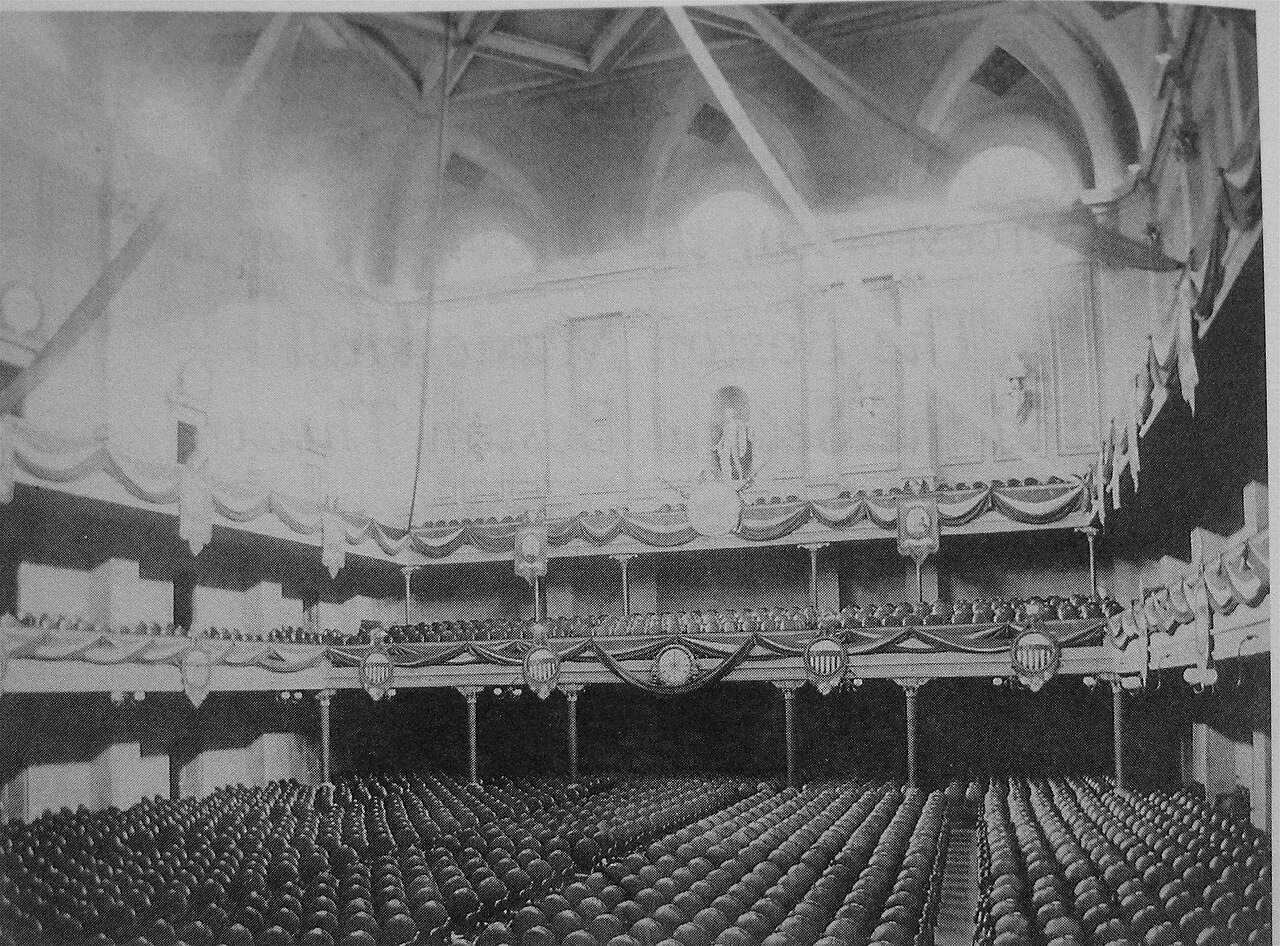
Image context: the cover uses a real archival photograph of Boston Music Hall rather than a studio portrait of James or a later film still. That choice keeps the guide near the novel's own machinery. When Olive imagines Verena giving "a lecture in the Music Hall," James has already translated idealism into venue, ticket price, and public scale. The hall is not background; it is part of the novel's argument about what speech becomes once it enters the world.[1][6]
1) Enter through the tug-of-war, but do not call it an ordinary romance
The first thing to know is that The Bostonians is organized by rivalry before it is organized by courtship. Basil Ransom arrives from the defeated South with charm, dryness, and political hostility to nearly everything Olive values.[1][2] Olive, rich and intense, belongs to the Boston reform world that Basil mocks on sight; he is warned early that she is a "female Jacobin."[1] Verena appears between them not as a fully settled self, but as someone whose talent invites projection.
That is why the triangle works. Basil sees feminine appeal and pliancy. Olive sees moral and political possibility. Each wants to rescue Verena from the wrong future, and each gradually reveals a desire to shape her completely.[1][2][4] Cambridge's edition description gets this into focus by calling the novel a drama of struggle for Verena's "possession."[4] If you keep that word in mind, the book stops looking like a simple marriage plot with suffrage trimmings. It becomes a study in how affection and principle both harden into claims of ownership.
So the first reading instruction is simple: do not ask too quickly which suitor is "better." Ask instead what each thinks Verena is for. That question opens the whole book.
2) Read Boston as a machine of rooms, platforms, and moral self-display
James gives the novel one of his sharpest city atmospheres, and he does it through interiors. Miss Birdseye's rooms, Olive's drawing room, lecture platforms, boarding houses, and crowded reform gatherings make Boston feel less like a backdrop than like a social technology.[1][2] Opinions here do not float in the abstract. They are staged. They gather audiences. They create reputations. Even casual moral talk carries the pressure of performance.
The early joke, "Nobody tells fibs in Boston," sounds comic because it advertises rectitude so loudly that self-consciousness starts leaking through it.[1] That is a useful tonal key. James likes Boston, but he also notices its appetite for purity, uplift, and self-scrutiny. Public virtue in this novel is never free of social texture. It comes with rooms, committees, introductions, and hierarchies of seriousness.[1][2]
This is one reason the novel feels more modern than new readers expect. The reform world is not a saintly counterspace outside competition. It has celebrity, gatekeeping, sponsorship, and audience management. Once you see that, Olive becomes more interesting and also harsher. Her devotion to the cause is genuine, but it develops inside a culture that can turn conviction into curation.
3) Treat Verena's voice as the book's central asset
If you want a real handle on The Bostonians, stop thinking of Verena chiefly as a heroine to be chosen between two futures. Think of her voice as the book's most valuable object.[1][4][5] She is persuasive, impressionable, charismatic, and not fully in possession of the uses to which her gift can be put. That combination is what makes everyone around her dangerous.
Olive dreams of preserving and directing that voice for the movement. Basil wants to draw it away from public circulation and back into intimate life. Verena herself is thrilled by sympathy, praise, stimulation, and nearness; she responds to atmosphere as much as to doctrine.[1][2] The result is a novel in which eloquence is never purely inward. It has logistics. It needs sponsors, rooms, timing, management, and listeners.
That is why the Music Hall line matters so much. When James imagines Verena on a larger stage, "at fifty cents a ticket," public speech has already become economic form.[1] A cause needs a crowd; a crowd needs an event; an event needs a star. James sees all of this at once. He is writing about reform, but also about the machinery that converts personality into public force.
Read this way, Verena becomes less exasperating. Her indecision is part of the design. She is a gifted medium moving among stronger wills, and the novel keeps asking whether a public gift can survive other people's plans for it.
4) Keep the Civil War afterlife inside every conversation
The book works best when you refuse to file Basil under mere sexism and Olive under mere progress. James wants the political weather to stay alive in the room.[1][2][3][5] Basil carries the afterlife of Southern defeat, social rank, and anti-reform disdain; Olive carries a Northern moral earnestness that wants history to move visibly forward. Their contest over Verena is therefore also a contest over what the United States will sound like after the war.
Britannica's novel overview is useful here because it puts the book squarely inside gender politics while also reminding readers how unusual the material was for its moment.[2] Library of America sharpens the larger frame by placing The Bostonians among James's studies of independence and possession.[5] Together those cues help prevent a common first-reading error. The novel is not simply asking whether Basil or Olive wins. It is asking what forms of freedom are available when every camp carries domination inside its own ideals.
That pressure is what makes Basil more than a villain and Olive more than a martyr. Both can love Verena. Both can also reduce her. The political intelligence of the book lives in that overlap.
5) Expect comedy, but do not mistake comedy for distance
James is very funny here. He notices postures, jargon, vanity, premature seriousness, and all the tiny absurdities of cause culture.[1][2] Miss Birdseye's saintliness, Olive's intensity, Basil's languid mockery, and the reform world's hunger for exemplary persons all receive comic handling. A new reader can enjoy that immediately.
But the comedy has teeth. It does not dissolve the stakes; it reveals the form in which the stakes become livable. Characters joke, pose, and sermonize because they are trying to organize desire into principle or principle into desire. James's wit therefore should not be read as neutrality. It is one of the tools by which he shows how public nobility and private appetite keep entering each other.
This is also why the ending remains abrasive. The final movement does not simply expose one bad man or one foolish woman. It shows how easily a gifted public self can be driven back into someone else's script.[1][2][4] The novel does not ask for sentimental grief. It asks for clear sight.
6) A practical route through the book now
If you want a strong first route through The Bostonians, use this one:
- Read the opening Boston scenes for room-pressure and social staging before you sort anyone into hero or villain.[1]
- Track every moment when Verena's voice changes status: private gift, reform instrument, ticketed attraction, intimate promise.[1][4]
- Keep asking what Olive and Basil each mean by freedom, and where each definition quietly narrows into possession.[1][2][5]
- Read the reform world as a public marketplace of seriousness rather than as a pure moral refuge.[1][2]
- Keep the Civil War afterlife in frame, because North and South are still arguing through gender, speech, and authority long after Appomattox.[2][3]
- Let the comedy sharpen your reading instead of softening it. The jokes are diagnostic.[1]
That route keeps the novel from shrinking into either a dated suffrage curiosity or a simple erotic contest. James built something meaner and more exact. He wrote a book in which public speech attracts every kind of desire around it, then asked what happens when liberation, admiration, career, and love all begin to sound like competing claims on the same voice.[1][2][4][5]
Sources
- Henry James, The Bostonians, Vol. I (of II) (Project Gutenberg HTML text).
- Encyclopaedia Britannica, "The Bostonians" (novel overview, characters, and political framing).
- Encyclopaedia Britannica, "Henry James" (biographical context and James's place in transatlantic literary culture).
- Cambridge University Press, The Bostonians (scholarly edition description and contextual introduction page).
- Library of America, Henry James: Novels 1881-1886 (volume overview placing The Bostonians among James's studies of independence and possession).
- Wikimedia Commons, "File:1876 BostonMusicHall.jpg" (source page for the archival photograph used as the article image).