Adventures of Huckleberry Finn is often discussed in two incompatible registers at once. It is praised as a breakthrough in American voice, and it remains contested for the racial language and social brutality it carries into the classroom and public culture.[1][2][3] Both responses touch something real, but Twain's deepest technical achievement lies elsewhere. Huck's narration sees quickly, names concretely, and judges late. The voice does not arrive with mature moral language already in hand. It has to move through embarrassment, comedy, fear, habit, and inherited prejudice before understanding catches up. That delay is not a flaw in the book's design. It is the design.
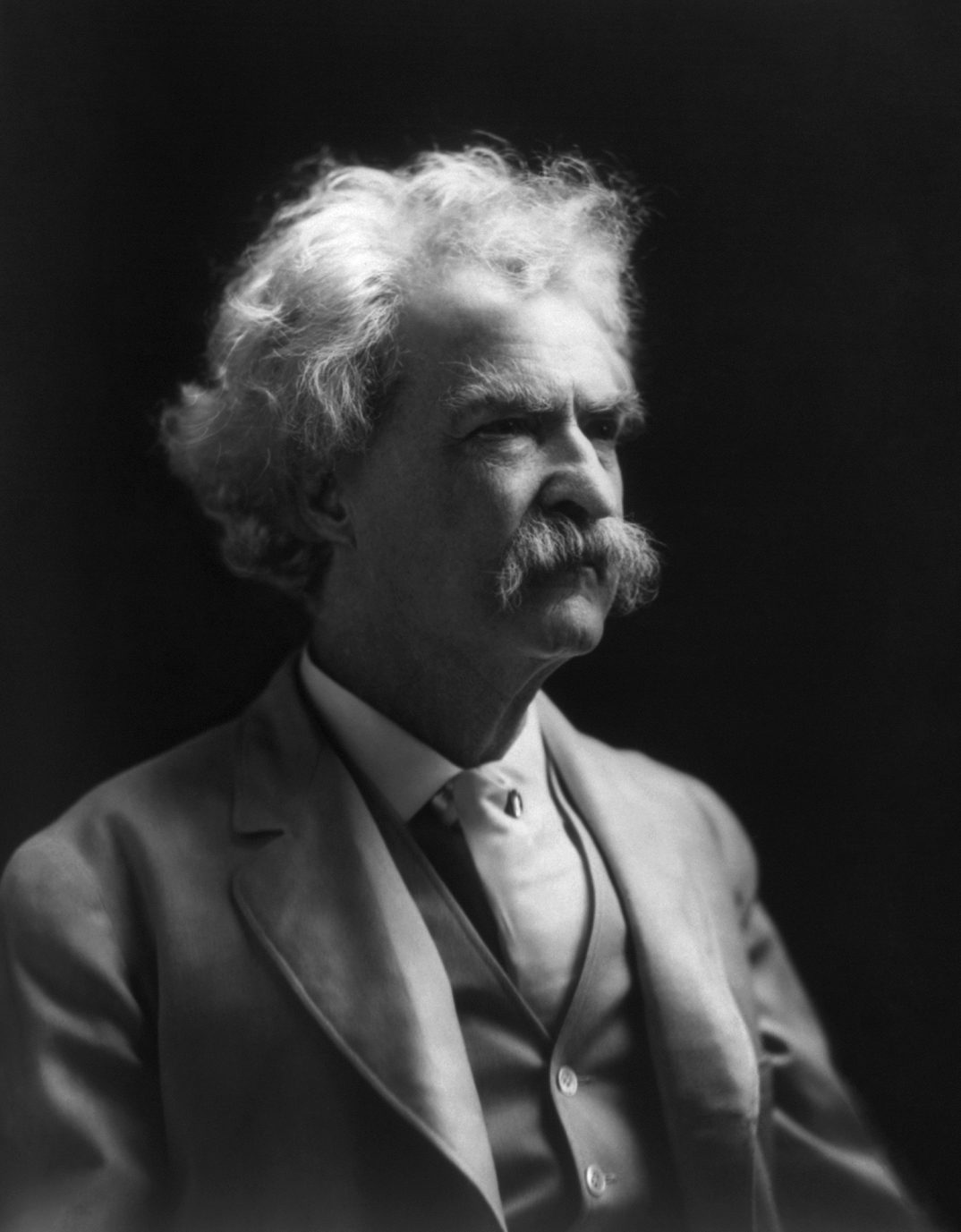
Image context: the cover uses a real 1907 archival portrait of Mark Twain from Wikimedia Commons. That choice suits the article because the novel's colloquial ease can make readers forget how much engineering sits behind it. Huck sounds uncoached, but the effect depends on authorial control over rhythm, spelling, timing, and the exact gap between what the boy can report and what he can yet explain.[5]
1) The opening contract sounds casual, but it is already highly designed
Huck begins, "You don't know about me" unless you have already read Tom Sawyer.[1] The line is famous for its looseness, yet the looseness is strategic. Twain starts by making narration feel unceremonious, anti-literary, almost resistant to official introduction. Then he quickly threads in two pressures that will govern the whole novel: Huck's suspicion of respectable forms and the adult world's desire to "sivilize" him.[1] The joke lands because the voice sounds self-starting. The craft lands because every word in the joke is placed to define a conflict between free motion and disciplinary language.
That is why Huck's vernacular should not be mistaken for raw transcription. Britannica is right to describe the novel as a landmark in American literature partly because it made colloquial speech structurally central rather than decorative.[2][3] But speech here is not mere local color. Twain uses idiom as a filtering device. Huck does not narrate from nowhere; he narrates from inside a social world whose assumptions he has half absorbed and half resisted. The style therefore arrives already split. It feels intimate and immediate, but it also carries the pressure of everything the boy has not yet fully sorted.
2) Vernacular in this novel is a sensor, not an ornament
One reason the book still feels alive is that Huck notices in active, physical units: canoes, drift, fog, rafts, shoes, dogs, boards, voices in the dark, the grain of fraud, the pace of the river.[1] Abstract judgment comes later, if it comes at all. This gives the prose unusual tactile authority. Readers trust Huck because he is exact about the world before he is exact about himself.
That sensor quality matters morally. A more polished narrator could have translated every scene into approved conclusions. Huck cannot. He reports scams, feuds, beatings, humiliations, and rituals of status in the same alert, body-level language he uses for weather or travel.[1][2] Because the voice stays close to experience, the novel does not let cruelty retreat into summary. It has to pass through seen particulars first.
This is also where Twain's dialect control becomes important. The Mark Twain Project's scholarly presentation of Huckleberry Finn makes clear that the book's apparent spontaneity rests on heavy textual care, including the management of recurring dialect forms and revisions.[4] The voice feels loose because the author has made it exact enough to feel loose. That is a harder trick than polish.
3) The book's real engine is moral delay
Huck often recognizes wrong before he can name it in stable ethical language. He recoils, pities, hesitates, improvises, and only later reaches a sentence that begins to resemble judgment. When he says, "Human beings can be awful cruel to one another," the line matters not because it is philosophically elaborate, but because it comes after scene-level witness.[1] Huck has had to watch enough humiliation before he can state even that much.
This is why the novel's style remains more disturbing than any simple celebration of boyish freedom suggests. Huck's language still bears the marks of the slaveholding society around him. Twain does not solve that fact by giving the narrator a purified moral vocabulary in advance.[1][2][3] Instead, he lets readers feel the lag between social grammar and humane recognition. The boy can be loyal before he can be articulate; ashamed before he can be theoretically clear; revolted before he can produce a public doctrine.
That lag is what gives the book its adult force. Many novels of moral education turn understanding into visible progress. Huckleberry Finn is harsher. Understanding arrives irregularly, under pressure, and sometimes in language too small for the experience that has produced it.
4) Jim changes the scale of Huck's sentences
The strongest proof of this method is Huck's evolving relation to Jim. The key movement is not that Huck becomes a philosopher of equality. The key movement is that loyalty outruns the inherited words available to him.[1][2] In the great crisis over the letter to Miss Watson, Huck still frames his rescue impulse as wickedness, then decides he would "steal Jim out of slavery again."[1] The sentence is crucial because its ethical courage appears inside a vocabulary that still cannot fully free itself from the law and theology that trained him.
That is style doing moral work. An adult narrator could have stood above the scene and explained its historical significance. Twain chooses the riskier path. He lets the language of a boy, saturated with bad teaching, become the medium through which readers register a better allegiance than the boy can yet defend in abstract terms. The voice does not become clean. It becomes truer.
This is also why Jim matters formally, not just thematically. Huck's sentences become steadier and less merely performative around the raft because companionship changes what narration is for. The voice still jokes and dodges, but it more often measures protection, trust, and shared exposure.[1] The raft does not remove the world's violence; it gives Huck a scale against which the shore can be judged.
5) The afterlife stays volatile because the style withholds distance
The novel has remained culturally unstable for a reason.[2][3] Its difficulty is not simply that it contains offensive language from its period. The harder problem is that Twain refuses hygienic distance. He does not let readers hear American cruelty only from the outside. He makes them inhabit a first-person voice in which comedy, affection, habit, performance, fear, and moral awakening coexist at close range.
That is why the book still divides readers, teachers, and institutions. If one reads only for plot, the novel can seem episodic. If one reads only for offense, the book's formal cunning disappears. But if one reads for voice, its real achievement comes into focus. Twain discovered that narration could carry social damage and ethical possibility in the same breath. Huck's voice is memorable not because it is free of contradiction, but because contradiction is exactly where it lives.
The novel's lasting modernity lies there. Huck sees before he understands, and the style makes readers undergo that sequence with him. Perception comes first. Judgment arrives late. Conscience enters the sentence after experience has already bruised it. Twain's triumph is that this delay never feels like inertness. It feels like a mind becoming morally audible under pressure.[1][2][4]
Sources
- Mark Twain, Adventures of Huckleberry Finn. Project Gutenberg ebook 76.
- Encyclopaedia Britannica, "Adventures of Huckleberry Finn."
- Encyclopaedia Britannica, "Mark Twain: Literary maturity."
- Mark Twain Project Online, Adventures of Huckleberry Finn (scholarly edition and textual apparatus context).
- Wikimedia Commons, "File: Mark Twain 1907.jpg" (source page for the lead photograph).