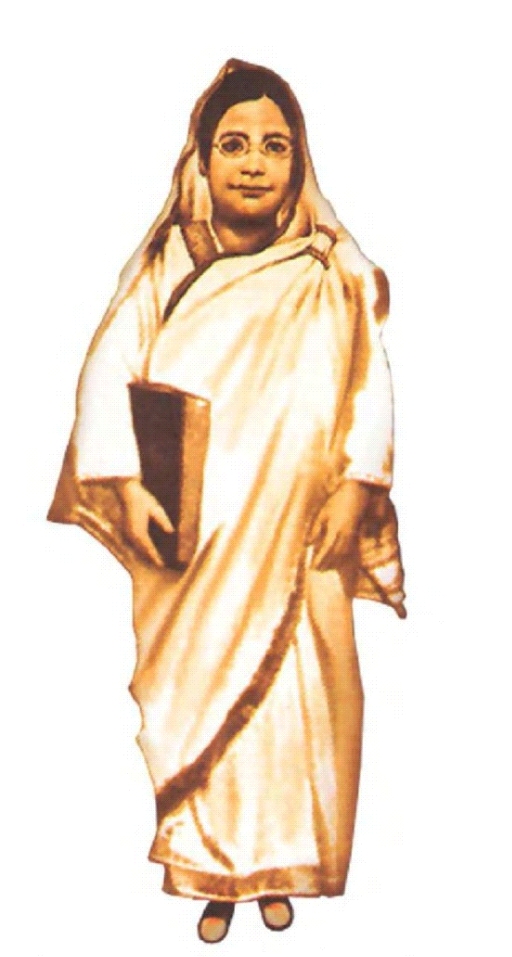
Sultana's Dream is often introduced by its neatest reversal: in Ladyland, women move freely through public life while men live indoors in the mardana, a mirror image of the zenana that structured seclusion for many women in Rokeya Sakhawat Hossain's Bengal.[1][4] That summary is useful, but it makes the story sound thinner than it is. The 1905 tale survives because the reversal is not only comic revenge. It is a way of testing what a society would look like if the energies locked inside seclusion were redirected toward education, science, public health, and peace.
The story begins with an almost casual threshold. Sultana is in her bedroom, thinking about "the condition of Indian womanhood," when Sister Sara appears and leads her outside.[1] The scene is small enough to feel like a parlor visit, yet it shifts the whole grammar of public space. Sultana's first anxiety is not metaphysical. It is social: she expects the street to be unsafe, because her world has taught her that female respectability depends on withdrawal. Ladyland answers by changing the premise. Safety is not produced by hiding women. It is produced by reorganizing power.
That is why a context-and-reception dossier fits the piece better than a plot summary. Rokeya was not merely imagining an agreeable fantasy island. Banglapedia frames her as a litterateur, educationist, and social reformer who learned Bangla and English at home after being denied formal schooling, then built a public career around Muslim women's education and self-respect.[2] Read beside that life, Ladyland's inventions are not ornamental gadgets. They are arguments about what learning makes possible when women are not treated as domestic surplus.
Publication As A Public Door
The publication context matters. Aishwarya Subramanian's Strange Horizons review notes that Rokeya published Sultana's Dream in The Indian Ladies' Magazine in Madras in 1905, before its standalone 1908 book publication.[4] The venue helps explain the story's tone. It is witty, conversational, and brisk, as if it knows that a radical claim may travel farther when it arrives as a dream shared among readers already negotiating the limits of respectable print culture.
That English-language choice also matters. The Encyclopedia of Science Fiction identifies Sultana's Dream as a feminist utopia and notes its later 1908 book publication, while placing it in a field of speculative interest: women scientists, transportation, weather control, automated agriculture, and social governance.[3] The story does not ask to be excused as a quaint reform tract. It belongs to the early history of science fiction because its social speculation and its technical speculation are inseparable.
The opening's dream frame gives Rokeya cover, but not escape. "I am not sure whether I dozed off or not," Sultana says, and the ambiguity is doing real work.[1] If it is only a dream, then the story can be playful. If she was "wide awake," as she also says, then Ladyland is a shockingly clear counter-world.[1] Rokeya keeps both possibilities alive. The reader is invited to enjoy the reversal and then notice that much of Ladyland's logic is less impossible than inconvenient.
Reverse Purdah Is A Literary Machine
The famous line is that men are "where they ought to be," shut indoors.[1] It is funny because it borrows the confidence of patriarchy and turns it around. But the phrase is also unsettling. Rokeya does not solve domination by pretending that confinement is harmless when applied to men. Instead, she exposes the absurdity of a social order that naturalizes one sex's captivity as the other sex's safety.
Sultana's embarrassment in the street is one of the story's sharpest craft choices. She has entered a society where she is free, but her body still carries the training of unfreedom. That is the psychological hinge. Ladyland is not persuasive because it says women can instantly flourish once doors open. It is persuasive because it notices how long a door remains inside the person who has been taught not to cross it.
This is also why the mardana is not the whole joke. Men retreat after a disastrous war and after women's scientific and strategic intelligence saves the country.[1] Seclusion follows failure. Rokeya reverses not only gendered space but the political meaning of competence. In Sultana's world, male rule has normalized danger; in Ladyland, female governance is justified by order, education, and restraint.
Science Replaces Force
Ladyland's technology has a strange serenity. There are no roaring machines at the center of the tale. Instead, the reader encounters solar heat, cloud-drawn water, air travel, disease prevention, clean streets, and gardens.[1][5] Leslie de Bont's ecofeminist reading is useful here because it stresses the story's alliance among nature, science, and women: Ladyland is not anti-technology, but its technology works by cooperating with natural forces rather than conquering them.[5]
That distinction keeps the utopia from becoming a mere gadget catalog. When Sister Sara explains that women use solar heat for cooking and power, the point is not just that Rokeya anticipated green technology.[1][4] The point is that the story measures intelligence by reduced violence. Good science makes smoke, crime, disease, and militarized spectacle recede. It gives people time, health, food, and beauty. In Ladyland, technological success is visible as ordinary calm.
The two-hour workday is part of the same design.[1][4] It is not laziness. It is a rebuke to waste. If public systems are rational, if education is universal, if agriculture and infrastructure are well organized, then long labor hours stop looking like virtue and start looking like bad administration. Rokeya's prose makes that argument lightly, but the implication is severe: social misery is often defended as necessity when it is really failed design.
The war episode sharpens the contrast. The men meet national danger with conventional military force and are defeated; the women, working from the university, use knowledge to end the threat.[1] The plot is fantastical, but its moral economy is exact. Rokeya asks what counts as defense. Is defense the public performance of masculine courage, or is it the capacity to preserve life with less damage? Ladyland chooses the second answer.
A Garden With Politics Inside It
The garden imagery can make the story seem delicate. Sultana sees streets like flower beds, clean air, and a city that feels hospitable rather than threatening.[1] But the softness is political. Ladyland's beauty is not private ornament. It is public infrastructure. The garden is what happens when city space is planned for safety, health, shade, and pleasure rather than domination.
That is why modern reception has returned so often to the story's ecological imagination. De Bont argues that Sultana's Dream can be read as a precursor to ecofeminist thinking because nature, science, and gender roles are redesigned together.[5] The claim fits the text, provided we do not flatten it into a present-day policy paper. Rokeya is writing a dream satire in colonial Bengal, not a climate manifesto. Still, the story's most durable insight is that the treatment of women, the treatment of the environment, and the organization of knowledge are not separate questions.
Subramanian's review helps explain the renewed afterlife by placing the tale beside turn-of-the-century feminist utopias while stressing how lightly and playfully Rokeya handles the form.[4] Early science fiction often imagined machines as conquest, extension, speed, or imperial reach. Rokeya imagines machines as domestic liberation and civic repair. Solar heat matters because it changes kitchens. Air travel matters because it changes movement. Agricultural automation matters because it changes hunger and labor. The speculative device is always tied to a social relation.
Why The Reception Keeps Expanding
Part of the story's afterlife comes from how early it seems. The Encyclopedia of Science Fiction treats Rokeya as a figure of science-fiction interest precisely because Sultana's Dream combines feminist utopia, scientific development, transportation, weather control, and a woman-dominated future long before many better-known Anglophone feminist utopias entered the field.[3] That chronology is important, but it should not become the only reason to read her.
Chronology can turn a work into a trophy: first, early, ahead of its time. Rokeya's tale is more active than that. Its compactness is part of its force. In a few pages, it links the bedroom to the street, the school to the state, the kitchen to solar power, the garden to public safety, and the war room to the university. The story works like a miniature system. Pull one thread, and the whole social fabric moves.
Its reception also keeps changing because different eras notice different Ladylands. Feminist readers see reverse purdah and female education.[2][4] Science-fiction readers see an early speculative future of solar power, air travel, and scientific governance.[3] Ecofeminist critics see the alliance of nature and technology.[5] Postcolonial readers can notice that the story speaks from within British India while refusing to make European modernity the only imaginable path to rational public life.
That last point is crucial. Ladyland is modern, but it is not modern because it imitates imperial masculinity. It is modern because it rejects the idea that power must look like command, extraction, smoke, and war. Its science is not a borrowed costume. It is a counter-argument about who gets to define intelligence.
The Dream That Refuses To Stay Decorative
The story's final movement returns Sultana to ordinary space, but not to ordinary thinking. The dream frame closes, yet the reader has already seen how easily "impossible" can mean only socially forbidden. Rokeya does not provide a blueprint, and the tale would be weaker if she did. The pleasure lies in the pressure of the thought experiment: what if the institutions that claimed to protect women were actually protecting male authority from female capacity?
That question explains why Sultana's Dream still feels quick rather than antique. Its sentences move with the lightness of satire, but its architecture is rigorous. Purdah becomes spatial theory. Education becomes infrastructure. Science becomes peace work. The garden becomes a civic plan. The mardana becomes both joke and indictment.
Read as a context-and-reception dossier, the story's central achievement is not that it predicted solar ovens or imagined women in charge. Its achievement is that it turned a social enclosure into a speculative engine. Rokeya took the walls around women and made them reveal the weakness of the world that built them. Ladyland is a dream, but it is not an escape from reality. It is reality rearranged until its excuses become visible.
Sources
- Rokeya Sakhawat Hossain, Sultana's Dream, Wikisource text taken from the Celebration of Women Writers series of Penn Libraries.
- Banglapedia, "Hossain, Roquiah Sakhawat" - biographical context on Rokeya as writer, educator, and social reformer.
- The Encyclopedia of Science Fiction, "Hossain, Rokeya Sakhawat" - science-fiction and publication-history context.
- Aishwarya Subramanian, "Sultana's Dream by Rokeya Sakhawat Hossain," Strange Horizons (September 30, 2013).
- Leslie de Bont, "An Ecofeminist Foremother? Rokeya Sakhawat Hossain's Oneiric Representation of Nature, Technology and Gender Roles in 'Sultana's Dream'," Representations dans le monde anglophone.
- Wikimedia Commons, "File:Rokeya Sakhawat Hussain.jpg" - 1931 archival portrait used as the article image.