Sui Sin Far's Mrs. Spring Fragrance can look, at first glance, like a book of small courtesies. Its rooms are full of visits, letters, tea, neighbors, children, marriage questions, and people trying not to embarrass one another. That surface is part of its intelligence. Edith Maude Eaton, writing as Sui Sin Far, made politeness do border work. She let domestic speech carry the weight of immigration law, racial caricature, mixed ancestry, and the problem of being read wrongly in public.[1][2]
The book appeared in 1912, two years before Eaton's death, and Project Gutenberg's catalogue identifies it as a short-story collection by Sui Sin Far with adult stories followed by "Tales of Chinese Children."[1] UBC's recovery project gives the larger career frame: Eaton was born in England in 1865 to a Chinese-born mother and a white British father, grew up in Montreal, worked in journalism, and by the late 1890s began publishing under the name Sui Sin Far while writing about Chinese diasporic communities in North America.[2] The University of Washington's Center for the Study of the Pacific Northwest places her especially in Seattle, San Francisco, Los Angeles, Montreal, and other routes where Chinese North American life was often made visible only through hostile stereotypes.[4]
What makes the book still feel alive is not only that it corrects those stereotypes. It changes the scale at which correction happens. Eaton does not answer caricature with a single manifesto voice. She builds a social field: husbands, wives, children, merchants, reformers, neighbors, white friends, Chinese elders, and Eurasian figures who know that identity is not an abstract category but a daily negotiation. The result is a literary profile of an author who understood that the intimate scene could be a public argument.
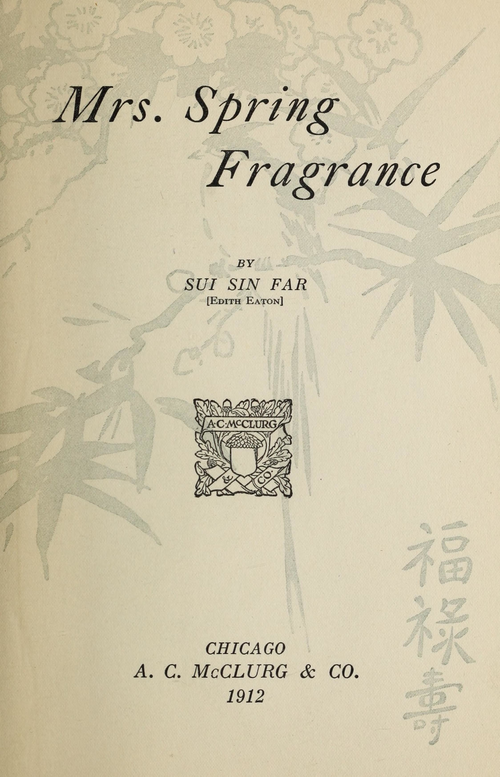
Image context: the cover scan is not decorative nostalgia. A title page is the threshold where periodical stories become a book, and that threshold matters here. Eaton's fiction had circulated through magazines before the 1912 volume gathered seventeen adult stories and twenty children's tales into the work by which she would be most remembered.[1][2][6]
The Author Who Chose The Border
Eaton's biography resists a clean national shelf. UBC's account tracks a family moving from England to New York, back to England, and then to Montreal, where Edith grew up in a city with a very small Chinese community and real anti-Chinese hostility.[2] She could have leaned into forms of passing more available to some of her siblings, but the same account emphasizes that she began openly identifying as Chinese and wrote anonymous journalism about Montreal's Chinese community.[2] That choice matters because Mrs. Spring Fragrance does not treat Chinese identity as costume, mystery, or distant atmosphere. It treats it as kinship, work, language, embarrassment, stubbornness, and pride.
Mary Chapman's Becoming Sui Sin Far, summarized by UBC's English department, also complicates the narrow canon story. Scholars in the 1990s helped recover Mrs. Spring Fragrance as a pioneering Asian American text, but Chapman's edition shows that Eaton had a wider transnational career before and around the Chinatown fiction: journalism, travel writing, early fiction, multiple pseudonyms, Canadian and Jamaican work, and more than 260 attributed pieces in an expanded bibliography.[3] That broader archive changes how the 1912 book should be read. It is not a sudden exception by a marginal writer. It is a selected public face from a working writer who knew magazines, readerships, and the market for racial stories from the inside.
That is why the title character is so apt. Mrs. Spring Fragrance is neither a solemn spokesperson nor a simple comic type. She is socially agile, emotionally perceptive, and linguistically mobile. Early in the opening story, her husband says there are "no more American words" for her to learn.[1] The joke is affectionate, but it also announces the book's method. Language is never just language here. It is a measure of adaptation, suspicion, status, and misrecognition.
Sentiment With Teeth
The opening story turns matchmaking into a lesson in translation. Mrs. Spring Fragrance helps Laura and Kai Tzu, while Mr. Spring Fragrance tries to understand American romantic ideals by half-misreading them. When he hears that "Love, in this country, must be free," the sentence sounds at once comic, sincere, and unstable.[1] Free compared with what? Free for whom? Free under what law? Eaton lets the line ring because everyone in the book lives inside uneven freedoms.
That is where the sentimental mode becomes sharper than it first appears. The stories often move through tenderness: lovers reconciled, children protected, lonely people comforted, misunderstandings softened. But the softness is tactical. In "In the Land of the Free," the title itself becomes bitterly ironic when a Chinese family's child is taken into the machinery of exclusion enforcement.[1][5] In "The Gift of Little Me," the language of Christian generosity and childhood affection makes the phrase "free gift" carry more social pressure than a lecture would.[1] Eaton repeatedly uses feelings that period readers recognized, then redirects those feelings toward people and families whom exclusion-era law and popular culture had trained them not to imagine fully.
The legal backdrop is not incidental. The National Archives describes the Chinese Exclusion Act of 1882 as the first significant U.S. law restricting immigration, creating a ten-year ban on Chinese laborers and certification requirements for the limited exempt classes.[5] Sui Sin Far's fiction does not need to summarize that law every time. It shows what restriction feels like after it enters households: delayed reunion, anxious paperwork, public humiliation, separated parents, and children made vulnerable by systems supposedly designed to regulate adults.
The Children's Tales Are Not An Appendix
The second half of Mrs. Spring Fragrance can be underestimated because children's tales are easy to file as lighter matter. Eaton makes that division less stable. Project Gutenberg's contents list shows the book moving from adult Chinatown stories to tales with titles such as "Children of Peace," "The Banishment of Ming and Mai," "The Dreams That Failed," and "Pat and Pan."[1] These are not merely charming add-ons. They extend the author's central argument about who gets interiority.
Children in the book often expose the adult world's moral weather. They notice unfairness, absorb prejudice, misread rules, and force adults to reveal what they value. In this sense, the children's tales are continuous with the adult stories: both sections ask readers to slow down before ordinary Chinese North American lives rather than consume them as exotic scenery. Eaton's child figures are not evidence props. They are agents of scale. They make policy and prejudice visible at the size of a family room.
The University of Washington commentary is useful here because it stresses Eaton's interest in everyday Chinese American residents and her desire to place sympathetic, realistic, multidimensional Chinese characters into American literature at a time when popular images were often sensational and degrading.[4] Mrs. Spring Fragrance answers that problem through accumulation. No single story has to bear the full burden of representation. The collection keeps adding tones: comic, mournful, didactic, romantic, ironic, devotional, and socially observant.
Why The Book Still Crosses
The cleanest way to read Sui Sin Far is not as an author who simply stood between cultures. That phrase is too static. Her fiction moves. It crosses among Montreal journalism, Seattle neighborhood knowledge, San Francisco domestic comedy, magazine sentiment, children's literature, and immigration politics.[2][3][4] It also crosses between what readers thought they were buying and what the stories quietly made them feel.
That crossing is the work-centered reason to return to Mrs. Spring Fragrance. Eaton's great device is not disguise but hospitality with conditions. She invites the reader into a social world that seems gentle, then makes gentleness morally demanding. If you laugh at Mr. Spring Fragrance's anxieties, you must also notice the law around him. If you enjoy Mrs. Spring Fragrance's tact, you must also see the intelligence required to survive constant translation. If you accept the children's tales as sweet, you have already conceded that Chinese North American children deserve the full literary protections of innocence, mischief, fear, and hope.
The book's afterlife has often depended on recovery: recovering Eaton from obscurity, recovering the periodical writer behind the single famous volume, recovering Chinese North American domestic life from the distortions of exclusion-era print culture.[2][3][4] But the fiction itself is not merely an object rescued by later scholarship. It is a rescue operation of its own. Story by story, it retrieves ordinary feeling from the public language that tried to flatten Chinese immigrants and their descendants into a problem.
That is why the title page still matters. Mrs. Spring Fragrance is Eaton's first and only book, but it is not a small book in ambition.[2] It understands that a border can run through a household, a sentence, a joke, a love plot, a child's misunderstanding, or a letter folded with perfect manners. Sui Sin Far made those small forms carry history. She made sentiment answer to law. And she made the act of being read, misread, and read again the central drama of Chinese North American literary modernity.
Sources
- Sui Sin Far, Mrs. Spring Fragrance, Project Gutenberg eBook no. 62940; source for the 1912 collection text, contents, publication metadata, and public-domain reading copy.
- Mary Chapman and Meghna Chatterjee, "Edith Eaton: Sui Sin Far (1865-1914) and the Birth of Asian North American Writing," Recovering Early Chinese Canadian Literature and History, University of British Columbia, August 10, 2023.
- University of British Columbia Department of English Language and Literatures, "Becoming Sui Sin Far" bookshelf entry for Mary Chapman's 2016 McGill-Queen's University Press edition.
- University of Washington Center for the Study of the Pacific Northwest, "Sui Sin Far (Edith Maude Eaton)" commentary on Eaton's Pacific Northwest writing and Chinatown fiction.
- National Archives, "Chinese Exclusion Act (1882)" milestone document page for the legal context of exclusion-era immigration restriction.
- Wikimedia Commons, "File:Mrs. Spring Fragrance.png" source page for the archival 1912 title-page scan used as the article image.