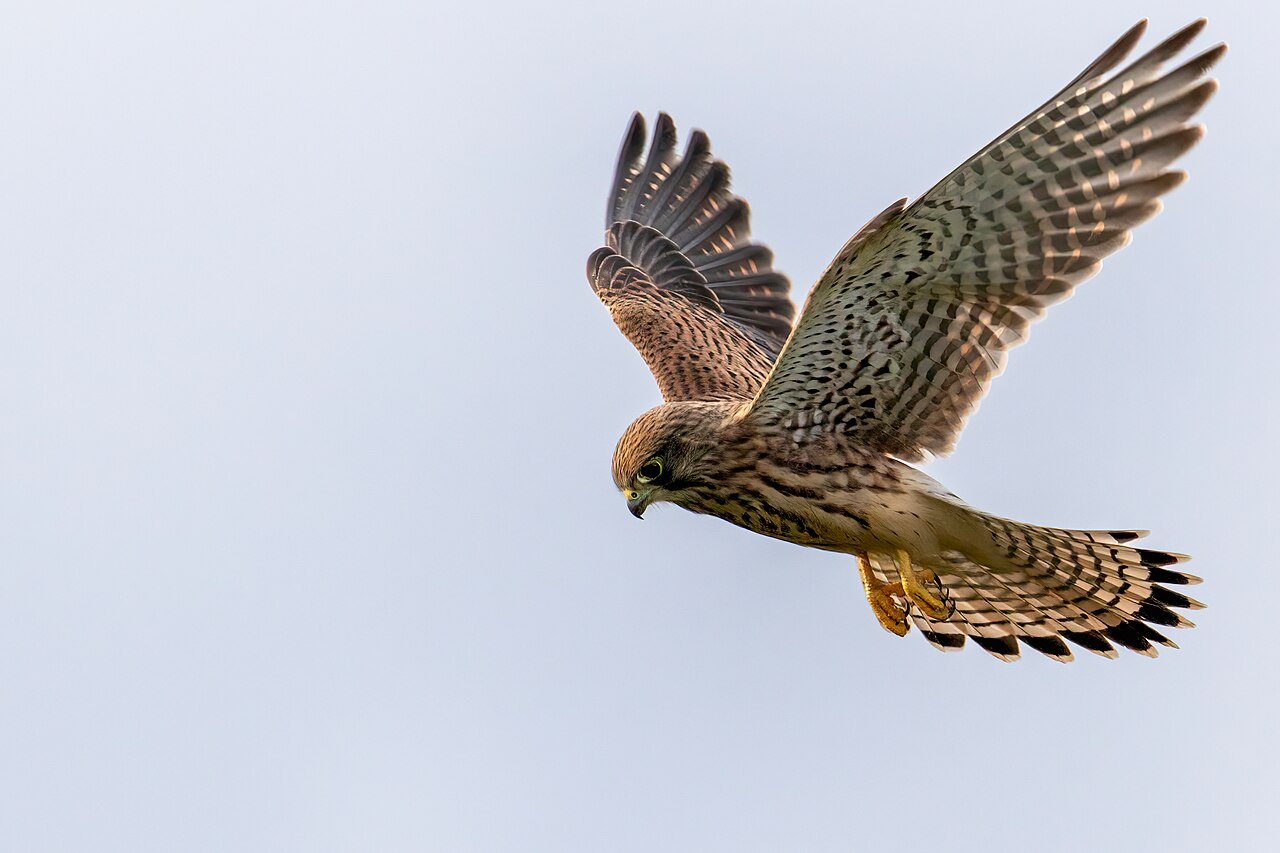
Gerard Manley Hopkins's "The Windhover" can be misread as a small religious nature poem: a poet sees a kestrel, admires its flight, and turns the bird into praise. That outline is not false, but it is too calm for the poem Hopkins actually made. The sonnet behaves less like a description than like a body trying to keep up with a force. Its syntax presses forward, its stresses thicken, its consonants grip and release, and its image of flight becomes a test of how language can register energy without smoothing it into scenery.[1][2]
That is why the poem still feels startling. Published after Hopkins's death in the 1918 edition of his poems, "The Windhover" belongs to the work that made his reputation feel posthumous and belated: Victorian in religious commitment, yet modern in pressure, compression, and sound design.[1][3] Britannica's account of Hopkins rightly emphasizes his experimental prosody and the importance of sprung rhythm, a method that let him build verse around strong stresses rather than regular metronomic smoothness.[3] In "The Windhover," that technique is not a display trick. It is the poem's way of making flight audible.
The title already gives the key. A windhover is not just a bird in motion; it is a kestrel holding itself in air.[2] Hovering is a paradoxical action: stillness achieved through continuous labor. Hopkins's poem finds a style for that paradox. It does not narrate the flight from a safe viewing distance. It strains its own line until suspension, mastery, danger, and devotion all occupy the same breath.[1][2][4]
The Sentence Takes Off Before It Explains
The opening movement is one long reach. Hopkins begins from a morning sighting, but the sentence does not settle into plain report. It keeps attaching name to name, title to title, force to force: the bird is falcon, royal child of morning, rider, darling, controlled energy in the dawn.[1][2] The sequence matters because the poem refuses to let the kestrel remain a single clean object. The voice sees, names, renames, and intensifies. Attention becomes acceleration.
That acceleration is syntactic as much as visual. A flatter nature poem might say: I saw a bird hover and dive. Hopkins does the opposite. He makes the reader live through the act of catching up. The phrase "morning morning's minion" repeats sound before it clarifies meaning; "rung upon the rein" tightens the flight into an equestrian image of control.[1] These are not decorative flourishes. They make the bird's poise feel like managed pressure, as if the air itself were something pulled, held, and answered.
This is where Hopkins's sprung rhythm earns its keep. The line does not glide in a neutral lyric manner. Stresses cluster, leap, and jam. The voice seems to lunge after what it admires, then correct itself with another apposition, another burst of sound, another figure. Britannica's prosody note describes sprung rhythm as an irregular system built around counted stressed syllables and variable unstressed syllables, which helps explain why Hopkins's line can feel pressured without becoming shapeless.[4] The poem's language hovers by effort too.
Sound Becomes Wingbeat
Hopkins's style is often described through terms like alliteration, sprung rhythm, and inscape, but the useful point is more concrete: in this poem, sound behaves like structure.[3][4] The repeated hard consonants and bright vowels do not merely ornament the kestrel. They make a pressure field around it. The reader has to mouth friction, lift, and compression before the theological turn arrives.
This is why the poem's beauty is never quite soft. It has glamour, but not ease. The kestrel is magnificent because it is under constraint: air, wind, gravity, instinct, balance. Hopkins's line copies that condition. It repeatedly risks overload. Instead of a transparent window onto the bird, the poem gives us a charged verbal mechanism whose difficulty is part of its honesty.[1][4]
The word "buckle!" marks the poem's central shock.[1] It can mean collapse, bend, fasten, or give way. The brilliance is that Hopkins does not have to choose only one. The bird's mastered movement suddenly turns into a theological crisis of force. The observed creature, the speaker's admiration, and the figure of Christ all tighten into a single hinge. The exclamation is not a pious label placed over nature after the fact. It is the moment when the sentence itself can no longer remain merely observational.
Read this way, "The Windhover" is not a poem that begins in nature and then abandons nature for doctrine. It discovers doctrine through the strain of perception. The kestrel's visible mastery becomes a way to feel spiritual energy as pressure, not abstraction. Hopkins does not dilute the physical bird into an emblem. He makes the emblem more physical.
Why Theological Language Arrives As Strain
Hopkins was a Jesuit priest, and ignoring the devotional structure of "The Windhover" would flatten the poem.[3] But reading it only as a devotional statement would flatten it too. The poem's religious force depends on how hard the language has to work before it can speak directly. Christ is not introduced as a tidy interpretive solution. The name arrives after the poem has built a sensory problem: how can beauty, mastery, danger, and sacrifice belong together?[1][2]
The sestet answers by shifting from airborne brilliance to earthbound labor. The poem's late images of ploughing and embers can feel surprising after so much sky, but they are not a retreat.[1][2] They broaden the argument. Ordinary work also hides brightness. Pressure makes shine visible. The line about "plough down sillion" giving way to shine is crucial because it brings glory out of abrasion rather than spectacle.[1] Hopkins is not saying only that the bird is beautiful. He is saying that beauty may disclose itself where force meets resistance.
That is why the final "gold-vermilion" blaze feels earned.[1] The poem has moved from seen flight to compressed stress, from stress to Christic recognition, from recognition to the darker logic of labor and fire. The ending does not cancel the kestrel. It completes the movement by showing that the same pattern can be read in air, soil, and ember: energy held under pressure until it flashes.
A Modern Poem Inside A Victorian Devotion
One reason Hopkins still feels alive is that his poems do not sound settled even when their beliefs are firm.[3][4] "The Windhover" has the devotional confidence of a priestly imagination, but its style is full of risk. The poem asks the reader to experience praise as strain, not as smooth assent. Its voice does not float above the world; it knots itself into the world's textures, muscles, and impacts.
That tension helps explain the poem's afterlife. Hopkins's work was not widely known in his lifetime, and the 1918 publication of his collected poems made readers encounter him as a strange predecessor, a writer whose Victorian religious intensity seemed to anticipate later experiments in sound and compression.[1][3][4] "The Windhover" is central to that afterlife because it gives the whole Hopkins problem in miniature. The poem is old and new at once: a sonnet, a prayer, a flight study, a rhythm experiment, and a theory of attention.
The best way to hear it, then, is not to paraphrase it too quickly. Do not rush from kestrel to Christ, from image to doctrine, from difficult sound to decoded meaning. Stay inside the pressure. The poem's intelligence lives in the interval before summary, where the hovering bird makes language hover too.
That is Hopkins's achievement. He takes a real act of seeing and refuses to let it become mere description. He makes the sentence climb, stall, tighten, break, and flare until praise feels like force under control. "The Windhover" endures because its music does not smooth the world into spirituality. It makes spirituality answer to wing, wind, soil, ember, and breath.[1][2][3]
Sources
- Gerard Manley Hopkins, Poems of Gerard Manley Hopkins, Project Gutenberg eBook no. 22403; source for "The Windhover" text and 1918 posthumous publication context.
- Encyclopaedia Britannica, "The Windhover" (work overview identifying the poem as a sonnet addressed to Christ and centered on a hovering kestrel).
- Encyclopaedia Britannica, "Gerard Manley Hopkins" (biographical context, Jesuit vocation, posthumous reputation, and sprung rhythm).
- Encyclopaedia Britannica, "sprung rhythm" (prosody definition and context for Hopkins's stress-based rhythm).
- Wikimedia Commons, "File:Common kestrel hovering.jpg" (source page for the article's real photographic cover image).