The women on the committee are discussing how to persuade poor people to save money when a stranger rushes in and hides under the table. She has stolen a bun. Miss Ford establishes that she was recently in possession of a hundred pounds, then rebukes her for wasting it: the money should have gone into the War Loan. That, the stranger explains, is exactly where it went.[1]
The joke catches a worthy principle colliding with an inconvenient person. It also introduces the peculiar hospitality of Stella Benson’s Living Alone, first published in 1919. The narrator invites us to sit beside her and enjoy the committee’s embarrassment. Before long, she will move our chair.
This essay follows the novel through its ending. Its subject is the voice that makes a witch in wartime London seem perfectly ordinary, while the ordinary language of helpfulness grows stranger by the page.
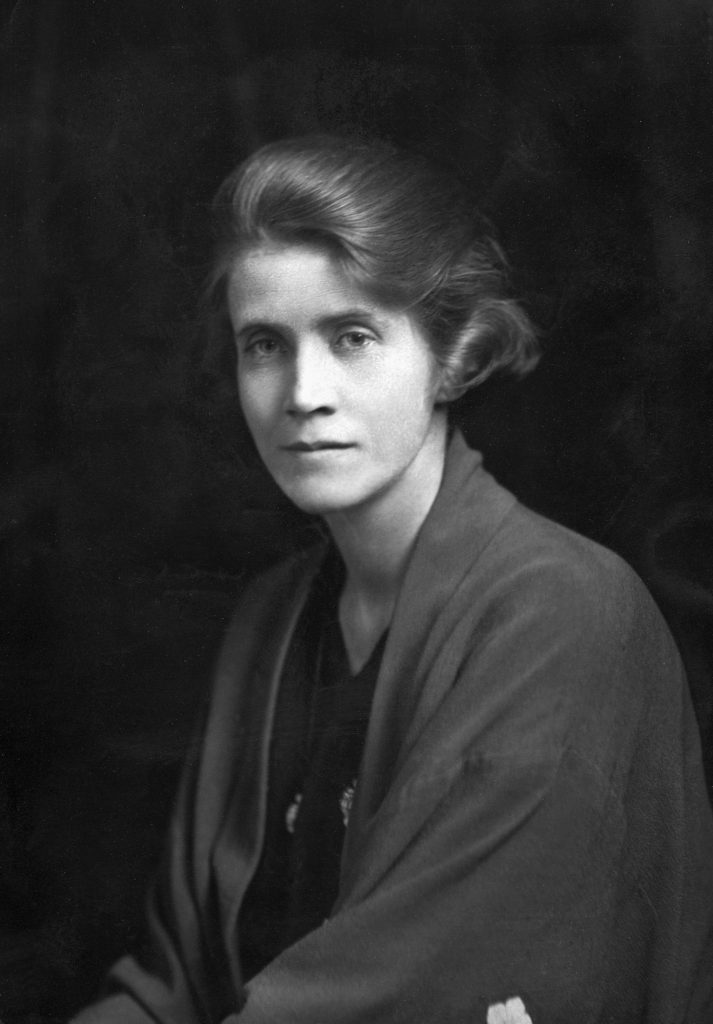
The confidence of a raised eyebrow
Benson begins with an inventory: women, chairs, a table. Within a few sentences, the neutral count has become a social sorting exercise. Three women need no description because committees have consumed their lives. Miss Ford’s beautiful hands owe their condition to a paid manicurist; her unpowdered nose advertises her righteousness. The narrator dispenses these judgments with the assurance of someone who knows both the room and our taste.[1]
The best little thrust comes when Miss Ford interrogates the bun thief: “You will notice that she had had a good deal of experience in social work.”[1] Grammatically, this is a helpful explanation. In context, it makes experience sound like a qualification for cruelty. The direct address flatters us. Surely we can recognize the kind of person being described.
Yet the same address quietly tests our own reflexes. Of the stranger’s clothes, the narrator remarks: “You would have enjoyed giving them to a decayed gentlewoman.”[1] The sentence catches the pleasure of charitable disposal. Someone else’s need allows the donor to enjoy being discerning and generous at once. We have been assigned that pleasure before we can object.
The witch’s dialogue works differently. She asks what familiar expressions mean and answers questions literally. Miss Ford’s unpleasant laugh hurts her enough to bring tears, yet she then treats it as a noise whose name she has only just learned. A social weapon becomes an odd sound made by a mouth.[1] Her question exposes its cruelty without protecting her from its force.
These exchanges are funny because each speaker thinks the other has failed to understand. The committee cannot imagine generosity without the correct limits and paperwork. The witch cannot see why a gift should stop where expectations stop. Benson lets the reader understand both vocabularies, then makes their incompatibility audible.
When “they” becomes “we”
At the end of Chapter I, the witch demonstrates her trade. The blind rises, distant trees appear against a pale sky, and the room briefly admits the sounds of spring. The prose changes with the light. Its clipped assessments open into an exclamation: “Oh, let us flee from April!” Then comes the remarkable phrase “we members of committees.”[1]
That “we” matters. The narrator who has been so good at exposing other people’s deadness now speaks from inside it. Readers who have enjoyed her superiority find themselves included in the retreat. The passage describes a kind of perception that neither administrative language nor excellent comic judgment can comfortably contain.
The rhythm expands into a vision of London as an enclosed, burdened figure, unaware of the seasons playing over its roof. Then the narrator resumes her brisk manner. Coloured flames and an intermittently materialized cat are dismissed as minor accompaniments. The mayor tries to stroke an animal that is no longer there.[1]
This return to comedy preserves the interruption’s force. Benson has allowed the voice to become lyrical without requiring it to remain solemn. The episode changes what counts as astonishing: a conjured cat is routine; a moment of unguarded attention is difficult to bear.
Rob Maslen’s essay on the novel emphasizes how Benson repeatedly makes enchantment vivid while reminding readers that it is an imaginative construction. He also notices the narrator’s participation in the committee’s alarm.[2] The change of pronoun gives that tension a particularly small, precise location. We can hear the storyteller lose her exemption.
A person emerges from a category
The woman who will become the novel’s central figure spends the first chapter identified only by her position in the group. Early in Chapter II, the narrator finally proposes calling this sixth member Sarah Brown.[1] A name arrives with almost apologetic practicality, after a committee role has already threatened to swallow its owner.
Sarah performs the errands. She has good intentions, little money, and insufficient confidence to resist other people’s instructions. Benson’s account of institutional charity turns grand abstractions into bodily inconvenience: long bus journeys, doorbells, absent householders. The elevated vocabulary of organization ends with someone standing on a doorstep.[1]
When Sarah returns the witch’s broomstick, their lunch supplies another test. Neither has enough cash for the proposed chops. They share an orange and biscuits instead. Sarah promises that, if her hostess is supernatural, she will refrain from recording the discovery on a case-paper. Even in friendship, her administrative training remains close at hand.[1]
The tenderness here depends on allowing Sarah to be inconsistent. She can recognize magic and still want to register it. She can dislike conventional conversation and still produce a theory about friendship that she cannot explain when challenged. The narrator gives her room to be more than an example of either oppression or liberation.
Nicola Darwood’s scholarly account places Benson’s early novels among experiments with inherited literary forms, women’s independence, and the pressures of war.[3] That context helps clarify what is at stake in the comic naming. A woman becomes visible beyond the functions available to her, but visibility does not instantly give her a free or coherent life.
The limits of meaning well
The final chapter makes the opening dispute about assistance hurt. Sarah has taken the witch to America to escape the law, spending everything she has. The witch never understood the journey as a rescue. She has cooperated partly because she mistook Sarah for a villain and felt that villains deserved consideration too.[1]
The misunderstanding is beautifully ridiculous. Its consequences are painful. Sarah has interpreted another person’s needs, acted on that interpretation, and made a sacrifice that the supposed beneficiary cannot accept on her terms. She has escaped Miss Ford’s manner without entirely escaping the helper’s assumption that she knows what help means.
The witch thanks her for intending kindness, then leaves. Sarah begs her to stay. Here the voice’s earlier ease meets an appeal that cannot be turned into a happy ending. The witch retains her freedom; Sarah remains ill, bewildered, and alone in an unfamiliar country.[1]
Benson does not flatten this into a verdict against either woman. The same independence that makes the witch delightful makes her departure possible. The same wish to protect that makes Sarah sympathetic has helped bring about her isolation. Their incompatible needs survive the narrator’s ingenuity.
Sarah nevertheless gets the final movement. Addressed by an official at the dock, she says she is stone deaf, then crosses into “the greater House of Living Alone.”[1] The image leaves solitude suspended between a home and an exile. It grants her a threshold to cross without assuring us that what lies beyond it will be happiness.
At the beginning, we are invited to recognize a bad kind of charity by its tone. At the end, a gentler tone offers no guarantee of understanding. The novel has trained our ear, then asked more of us than a well-placed laugh. After the most entertaining person has flown away, Benson keeps our attention with the woman who must find somewhere to go.
Sources
- Stella Benson, Living Alone (first published 1919; Macmillan, 1920 text), Project Gutenberg — primary text, especially Chapters I, II, and X; quotations and scene references.
- Rob Maslen, “Stella Benson, Living Alone (1919),” The City of Lost Books, University of Glasgow, December 8, 2015 — critical reading of wartime fantasy, narrative self-consciousness, and isolation.
- Nicola Darwood, “‘Sometimes I pose, but sometimes I pose as posing’: Stella Benson’s early fiction,” in Re-Reading the Age of Innovation (Routledge, 2022), pp. 190–202 — University of Bedfordshire record and abstract on formal experiment, gender, and war.
- Elizabeth Flock, “7 overlooked women writers you should be reading now,” PBS NewsHour, April 19, 2017 — Stella Benson section and the credited Hulton-Deutsch Collection/CORBIS archival portrait reproduced here.