A little girl hides from a wolf. The bushes conceal her, their scent defeats its nose, and the animal is about to leave. Then her medals for good behavior clink together. The decorations that prove her virtue give her away.[1]
This is the educational climax of Saki’s “The Story-Teller.” In “The Schartz-Metterklume Method,” another lesson escapes its respectable purpose: children learning Roman history drag the lodge-keeper’s daughters toward the house to reenact the abduction of the Sabine women. In both stories, an adult gets the children involved. Neither performance produces the reassuring result that the supervising woman expects.[1]
Read together, the stories ask an awkward question about instruction: who gets to decide what an engaging lesson is for? Saki makes the answer funny before making it uncomfortable. The pleasure of defeating a tiresome adult can conceal what happens to everybody else.
Both stories appear in Beasts and Super-Beasts (1914). Their first audiences were newspaper readers: “The Schartz-Metterklume Method” appeared in the Westminster Gazette on October 14, 1911; “The Story-Teller” followed in the Morning Post on September 2, 1913.[1][2] These compact performances were stories for adults about the trouble with stories for children. The comparison below follows both through their endings.
The question that breaks the moral
The aunt in “The Story-Teller” has three children to manage in a hot railway compartment. Saki reduces their conversation to competing impulses: her “Don’t” meets their “Why?” The difference is already a theory of narrative. She wants an action stopped; they want a cause supplied.[1]
Her tale of a good girl rescued from a bull cannot satisfy that demand. Would nobody have saved the girl if she had been less good? One child asks, and the aunt has to concede that someone would. The rescue no longer proves the moral. Goodness has been attached to the event without making the event happen.
The bachelor sharing their compartment takes up the challenge. At first, his heroine Bertha seems equally unpromising. Then he calls her “horribly good.” The adjective admits something the aunt’s vocabulary excludes: exemplary behavior can be oppressive to the people required to admire it. The children recognize an experience rather than receive an instruction.[1]
His real achievement, though, comes later. Bertha’s virtue earns her admission to a prince’s park. Her clean pinafore makes her visible to the wolf. Her medals make her audible. Each mark of adult approval becomes a practical disadvantage, and each earlier detail acquires a second use.
That is why the ending has more force than a random nasty surprise. The bachelor makes the moral apparatus operate as a plot. Where the aunt merely says goodness brings rescue, he supplies a chain of circumstances through which conspicuous goodness brings danger. We can reject his implied lesson and still recognize the superior construction.
He also treats interruptions as material. When a child asks why the park contains no sheep, he invents a reason; when the absence of flowers needs explaining, the pigs account for it. Questions help furnish the imagined world. The aunt experiences curiosity as interference. The bachelor makes it part of the entertainment.[1]
A method with an impressive name
Mrs. Quabarl, in the companion story, sounds more enlightened. She wants her children interested in history, with its people made vivid rather than reduced to memorized dates. The wish is reasonable. Her mistake begins with the certainty that she already knows whom she is addressing.
At a railway station she identifies Lady Carlotta as the governess she has come to collect. Carlotta accepts the mistaken identity. Their first exchange establishes the comic arrangement: Mrs. Quabarl assigns a role, and her supposed employee performs it with disastrous freedom.[1]
The invented Schartz-Metterklume method extends that arrangement. Its imposing name receives an approving response from both parents, who would rather appear knowledgeable than ask what it means. Compare the children on the train: they interrupt to demand explanations. Here, adult embarrassment prevents the question that might avert the trouble.
The next morning, history has become a household spectacle. One daughter represents Rome, another sits beneath a wolf-skin rug, and the boys have been sent to seize the lodge-keeper’s girls. A child’s mishearing turns the Sabine women into “shabby women.”[1] The slip gives an ancient episode the vocabulary of the household’s present social distinctions.
Carlotta claims to have fulfilled the brief. Acting out history should fix it in memory. When Mrs. Quabarl rescues the captives, the false governess treats the rescue as an educational error: the boys might now believe the Sabine women escaped. Historical accuracy becomes a wonderfully outrageous excuse for refusing to stop.
The joke exposes a limit in the parents’ attractive language. Making the past vivid sounds harmless until the selected past involves force. But Carlotta’s literalism is also a choice. Nothing in Mrs. Quabarl’s instructions required this episode, these unwilling performers, or the threat of a spanking to make the boys participate. The supposed teacher creates the crisis she then blames on the lesson.[1]
The children who cannot interrupt
The distinction between the stories sharpens around that threat. The bachelor must win his audience. Carlotta can issue orders. His children question the fiction and judge its ending; hers are assigned parts, while the lodge-keeper’s daughters become victims inside someone else’s demonstration.
This prevents a comfortable reading of both stories as celebrations of imaginative teaching. In the railway carriage, imaginative freedom includes listening to children. On the Quabarl lawn, it includes using children. The adults who disrupt authority do not necessarily distribute freedom to everyone below them.
Lorene M. Birden’s study of naming in Saki places “The Schartz-Metterklume Method” among stories where a temporary identity raises questions about the prankster’s responsibility toward victims.[3] That critical frame helps illuminate the borrowed name here. Carlotta can exploit the authority of “Miss Hope” and then discard it. The real governess arrives to a household already thrown into turmoil.
Carlotta’s opening defense of an overburdened horse makes this harder, and more interesting, than a portrait of simple cruelty. She notices suffering and is willing to intervene. Yet the same capacity to take command later produces suffering as entertainment. My reading is that Saki allows us to enjoy her resistance without giving us grounds to call every exercise of it generous.[1]
The people left holding the lesson
Both outsiders can leave. Carlotta walks away from the household; the bachelor gets off the train. Their freedom of movement is part of their victory.
The bachelor’s final pleasure is especially revealing. He anticipates the children repeatedly demanding improper stories from their aunt in public. His successful performance will become her continuing difficulty. The story ends with his satisfaction at that prospect, not with a promise to help educate them.[1]
Meanwhile, the lodge children have not volunteered for Carlotta’s experiment, and the actual Miss Hope must enter the confusion attached to her name. The joke distributes its rewards and costs unevenly. Its inventor enjoys the exit; somebody else remains in the room.
Saki’s comparison therefore reaches beyond the familiar contest between dull morality and lively imagination. A story can be beautifully made and mischievously used. A memorable lesson can still be an abuse of its audience. Listen for the medals: they are an exquisite piece of plotting. Then look toward the lawn, where the children being carried off have every reason to want the performance stopped.
Sources
- Saki, Beasts and Super-Beasts (John Lane, 1914), Project Gutenberg — primary text and author’s publication note; “The Story-Teller,” from the railway conversation through the bachelor’s departure, and “The Schartz-Metterklume Method,” from the station encounter through the real governess’s arrival.
- The Annotated Saki, “First publication” — bibliographic table documenting the two stories’ newspaper appearances and their collection in Beasts and Super-Beasts.
- Lorene M. Birden, “Layers of naming and responsibility in Saki’s short stories,” Brno Studies in English 38, no. 1 (2012), pp. 55–76 — journal abstract outlining the relationship between assumed names, pranksters, and responsibility toward victims.
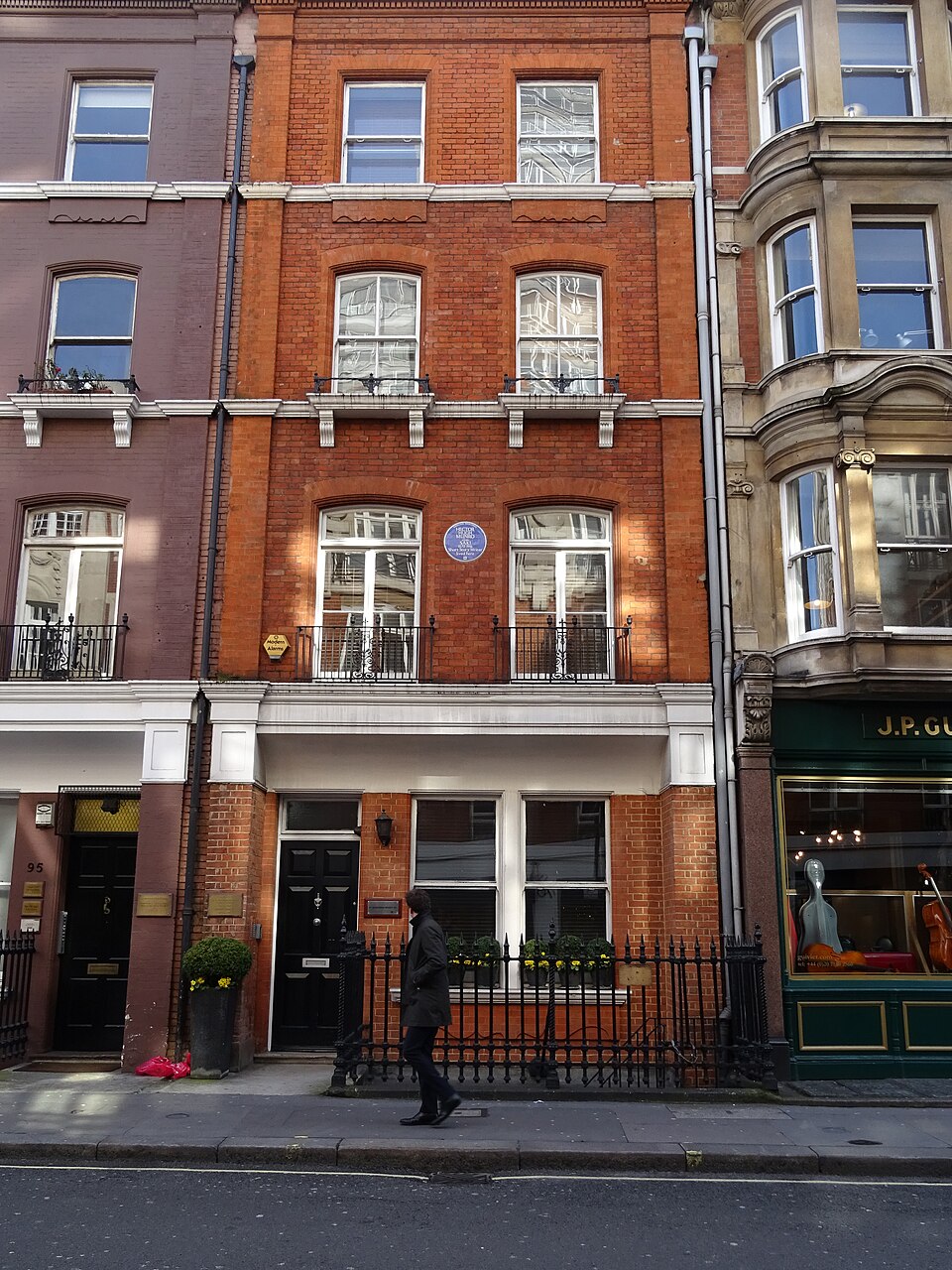
- Spudgun67, “Hector Hugh Munro — 97 Mortimer Street, Fitzrovia, London,” Wikimedia Commons — source and provenance for the March 6, 2017 photograph used above, licensed CC BY-SA 4.0.