The afterlife of A Doll's House begins with a sound the audience cannot see. Nora Helmer leaves the room, then the house, and the final stage direction gives the play its portable emblem: a door closes below. That noise has become shorthand for modern drama, feminism, domestic revolt, and the uneasy freedom that follows a public refusal. Yet its endurance comes from something more theatrical than a slogan. Every production must decide what the door is: a barrier, an accusation, a threshold, or a future address that someone else will one day answer.[1][2]
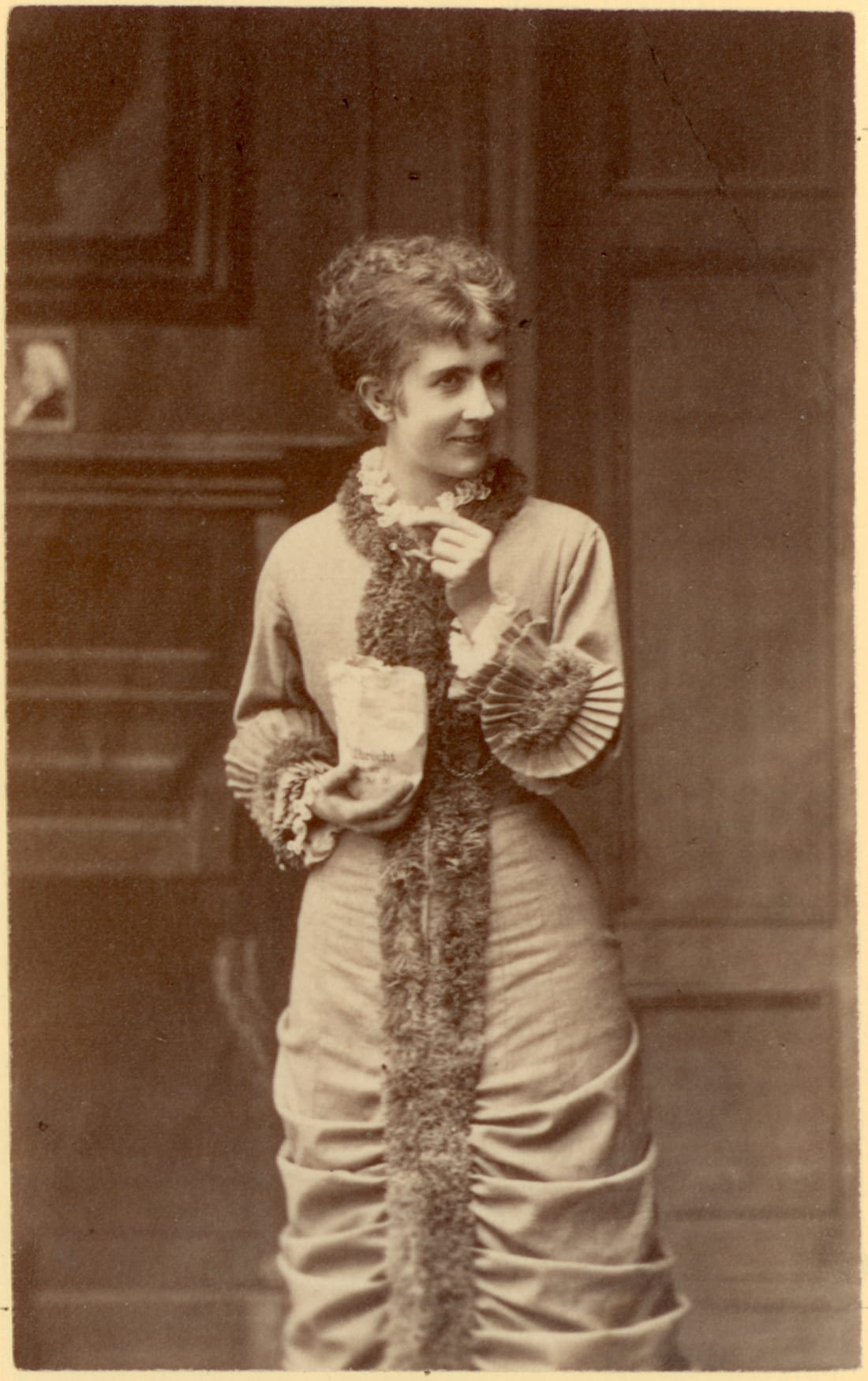
That is why the old photograph of Betty Hennings as Nora feels less like a relic than like evidence. Hennings played Nora in the first Royal Theatre Copenhagen production, which opened on December 21, 1879; IbsenStage records her as Nora, Emil Poulsen as Torvald Helmer, and the event as the very first performance of the play.[3][6] The photograph catches Nora before the exit became famous enough to detach from the body that performed it. Costume, posture, hair, and stillness remind us that the door slam was first a stage problem. A living actor had to move from charm to terror to self-recognition, and then leave enough silence behind for the audience to hear the house differently.
Image context: the cover is an archival photograph of Betty Hennings as Nora, dated 1879 or 1880. It suits an afterlife study because the play's later history repeatedly returns to the same practical question an actor first had to solve: how does a person leave a room without letting the room define the meaning of the departure?[3][6]
The Exit Is Built Before It Is Heard
Nora's final departure works because the play has spent three acts making the house feel active. The Christmas tree, the macaroons, the letterbox, the tarantella costume, the loan papers, the keys, and the wedding ring are not decorative domestic props. They are small systems of permission. Each object asks who may know, spend, conceal, perform, forgive, or command. By the time Nora speaks of being a "doll-wife," the metaphor has already been staged in wood, paper, money, and manners.[1]
The strength of the ending lies in that preparation. Nora does not simply change her opinion about marriage in the final scene. She reads the room backward. Torvald's panic over reputation, his quick shift into pardon, and his inability to understand her claim to be "a human being" make the entire household newly legible.[1] The door closes because the house has revealed itself as a machine for turning affection into arrangement. If Nora stayed inside that machine, the final conversation would become another scene of negotiation under Torvald's grammar.
This is the key to the play's adaptability. Directors can remove furniture, modernize language, alter period detail, or put the Helmers in a sleek apartment, but the structure survives if the house still behaves as a set of social permissions. The ending does not need a realistic heavy door so much as it needs an audience to feel what Nora is exiting. Without that pressure, the famous sound becomes a theatrical effect. With it, the sound becomes analysis.
The First Nora Was Already an Afterlife
The Copenhagen premiere makes this clear. IbsenStage's event record places the first production at Det Kongelige Teater and notes 100 performances across later seasons, with Hennings as Nora in the original cast.[3] That matters because A Doll's House did not enter history only as a printed controversy. It entered as repertoire, a repeatable arrangement of bodies, timing, roles, substitutions, and audience expectation.
Nora therefore became public in two forms at once. On the page, she was a problem of language: duty, selfhood, debt, marriage, law. Onstage, she was a problem of tempo: how quickly the mask slips, how long the tarantella can hold back disclosure, how much control remains in the voice during the last conversation, how the final exit asks an auditorium to sit with absence. Hennings's image is valuable because it gives Nora back some of that physical specificity. The afterlife of the play has often turned her into an idea, but the idea had to pass through performance first.
UNESCO's Memory of the World page for Ibsen's A Doll's House helps explain why the role could travel so far. The page treats the notes, drafts, and papers for the play as unusually rich manuscript material and emphasizes the work's global theatrical and social impact.[2] Those drafts matter to the afterlife because they show a play made through refinement, not through a single instantaneous doctrine. Nora's departure gained force through dramatic shaping: secrecy before confession, performance before recognition, household comedy before ethical rupture.
The German Ending Proved the Door's Pressure
The most revealing adaptation is the one designed to soften the play. In the early German stage history, the so-called alternative ending kept Nora home. IbsenStage's project page on German productions reports that most German stages producing A Doll's House in 1880-81 used the alternative ending, while some productions switched between the original and revised endings; the same project notes that critics and audiences disapproved of the play regardless of which ending was used.[4]
That history is often told as a story about timidity: audiences could not bear a mother walking out, so the ending was changed. The sharper lesson is that the altered ending could not neutralize the question the play had already built. Even if Nora is forced toward the children and collapses into staying, the audience has still watched the marriage expose itself. The domestic room has still become unstable. The house can retain her body, but it cannot restore the innocence of the arrangement.
The alternative ending therefore belongs to the afterlife rather than outside it. It proves that A Doll's House is not reducible to one closing gesture. The scandal lies in the play's whole diagnostic movement. The door slam concentrates that movement, but the pressure begins earlier, when a cheerful wife becomes visible as someone managing debt, fear, performance, and moral intelligence under a husband's pet names. Change the final movement and the earlier evidence remains.
Sequel Logic: The Exit Becomes a Knock
Modern afterlife has often understood this by returning Nora to the door instead of simply repeating her exit. Lucas Hnath's A Doll's House, Part 2 is built on that reversal. American Players Theatre describes the sequel as beginning with Nora launched back into the household 15 years after the events of Ibsen's play, with a knock at the door and a debate about chosen and forced roles.[5] The premise is clever because it treats the original ending as an address with consequences, not as a freeze-frame of liberation.
The return changes the question. In Ibsen, the audience asks whether Nora can leave. In the sequel logic, the audience asks what leaving has made possible and what it has left unresolved. Torvald, Anne Marie, the children, law, money, reputation, and Nora's own self-description all return as claims. The door does not lose its force by being reopened. It gains duration. The original sound becomes something like correspondence: a message sent in 1879 that later artists keep answering.
That is why A Doll's House remains so available to new staging without becoming empty. The play has a famous conclusion, but it is not trapped by its conclusion. Productions can emphasize marriage law, emotional manipulation, class comfort, gender performance, theatrical minimalism, comedy, cruelty, or the cold administrative texture of reputation. The ending can be slammed, muted, abstracted, contradicted, or answered. What cannot be evaded is the demand that the household be read as a social form.
Nora's afterlife endures because the door is both literal and unfinished. A woman leaves a room. A theatre hears the cost of that movement. Then another culture, another director, another actor, or another playwright has to decide whether the sound marked an ending, a wound, a beginning, or a summons. The play survives because it refuses to let any one of those answers close the door for good.
Sources
- Henrik Ibsen, A Doll's House, Project Gutenberg edition (public-domain English text used for quoted phrases and scene structure).
- UNESCO Memory of the World, "Henrik Ibsen: A Doll's House" (manuscript significance, global impact, and registration context).
- IbsenStage, event 98055, Et Dukkehjem at Det Kongelige Teater (opening night, venue, original cast, and performance record).
- IbsenStage, "Ibsen on the German Stage 1876-1918: A Quantitative Study" (German reception, alternative ending, and early performance patterns).
- American Players Theatre, A Doll's House, Part 2 by Lucas Hnath (modern sequel premise and return-to-the-house framing).
- Wikimedia Commons, "File:Betty Hennings Nora 1.jpg" (archival lead-image source page).