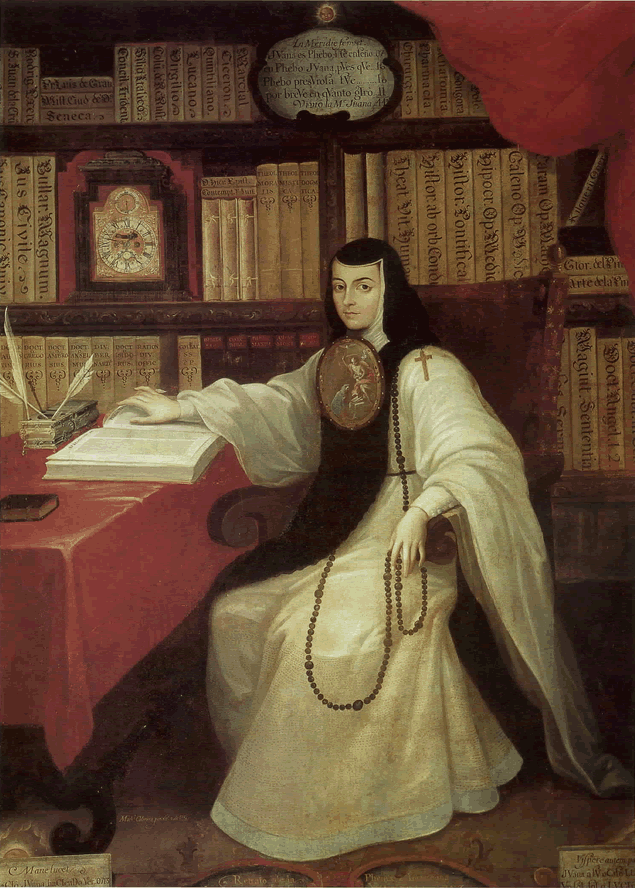
Sor Juana Ines de la Cruz's Respuesta a Sor Filotea de la Cruz is often introduced as a defense of women's education. That is true, but a little too smooth. The force of the letter comes from how nervously and brilliantly it refuses to sound like a modern platform statement. Sor Juana does not simply announce a right and then wait for history to catch up. She builds a self-defense out of apology, memory, theology, classical example, kitchen observation, and a strange kind of tactical modesty.
The document was written after the bishop of Puebla, Manuel Fernandez de Santa Cruz, had drawn Sor Juana into theological controversy, published her critique of a sermon, and then admonished her under the pseudonym Sor Filotea.[2][3] The Enciclopedia de la Literatura en Mexico describes the Respuesta as one of the best achievements of colonial New Spanish prose and emphasizes its mixed function: it is at once reply, intellectual autobiography, forensic defense, and argument for women's study.[2] That mixture is not ornamental. It is the whole philosophy of the piece.
Sor Juana's problem is that she must defend thinking without seeming to make self-assertion the center of the defense. The letter therefore moves like someone crossing a dangerous room without pretending the furniture is not there. She flatters, lowers herself, narrates childhood, invokes learned women, distinguishes private study from public preaching, and treats curiosity not as vanity but as a pressure placed in her by nature and God.[1][2] The result is not a simple manifesto. It is a survival form.
Appetite Becomes Argument
The most memorable part of the Respuesta is not abstract doctrine. It is appetite. Sor Juana recalls the child whose desire to learn outpulled ordinary bodily desire: the famous "inclinacion a las letras."[1] The phrase matters because it makes learning sound less like decoration than temperament. She is not saying that books made her socially impressive. She is saying that study arrived as an inward force before it became a public offense.
That distinction gives the essay its moral architecture. If her learning is mere ambition, then Sor Filotea can rebuke it as pride. If it is a natural and spiritual inclination, then suppressing it becomes more complicated. Sor Juana does not deny discipline; she relocates it. The disciplined life is not the life in which a woman stops thinking. It is the life in which thinking is ordered, tested, and made answerable.
Project Vox's profile preserves the same childhood pattern in narrative shorthand: early self-education, the convent as an alternative to marriage, and the Respuesta as a late-career defense written in 1691.[4] Biography alone can turn that into prodigy legend. The Respuesta makes it sharper. A prodigy story asks us to admire exception. Sor Juana asks us to examine the rule that required the exception to defend itself.
Kitchen Philosophy
The kitchen passage is the letter's small masterpiece because it refuses the hierarchy it appears to accept. Sor Juana asks what women can know except "filosofias de cocina," then turns cooking into experiment: eggs behave differently in oil and syrup, sugar changes with acidulated water, yolk and white separate in use.[1] The joke about Aristotle cooking is funny because it is not only a joke. It changes the location of philosophy.
On the surface, Sor Juana accepts the domestic boundary: if women are confined to kitchens, then the kitchen is what they have. But her examples make the boundary intellectually porous. The kitchen contains chemistry, classification, cause and effect, analogy, method. It is not a retreat from learning; it is evidence that learning is already embedded in supposedly lesser work.[1] The argument's elegance lies in its refusal to romanticize confinement. Sor Juana does not say the kitchen is enough. She shows that even the space used to limit women cannot keep thought out.
This is why the letter still reads with more energy than many later defenses of education. It does not merely ask that women be admitted to a preexisting idea of learning. It shows that learning has been misrecognized because the wrong people have been authorized to name it. If a woman notices natural causes while cooking, the question is not whether she has philosophy. The question is why philosophy has been trained not to recognize her.
Humility As Tactics
One risk in reading the Respuesta now is to flatten its humility into either sincerity or disguise. It is both more literary and more dangerous than that. Sor Juana repeatedly lowers her own authority, but the lowering is structurally active. It lets her speak at length while appearing to resist self-display. It lets her claim obedience while reopening the case. It lets her accept theological seriousness while showing that the charge against her depends on a badly simplified view of women, knowledge, and speech.[2]
ELEM's account is useful here because it emphasizes the forensic design under the letter's familiar tone: Sor Juana moves through defense, proof, recollection, and general argument, using rhetoric while making the rhetoric look domestic and modest.[2] That is not hypocrisy. It is form matching risk. A woman openly claiming intellectual authority in late seventeenth-century New Spain had to write under conditions where tone itself could become evidence against her.
The Stanford Encyclopedia of Philosophy places Sor Juana inside the Mexican Baroque and treats her as a thinker whose work considered her condition as human, American, and woman. It also reads the Respuesta as part of her defense of Americans, and American women in particular, thinking for themselves.[3] That frame helps explain why the letter feels larger than a private quarrel. Sor Juana is not merely asking one bishop to be fair. She is testing whether a colonial intellectual order can imagine reason arriving from a woman's cell.
The Self-Defense Of Thought
The Respuesta becomes philosophical when it turns self-defense into a theory of knowing. Sor Juana does not argue that every act of study is automatically virtuous. In fact, she is careful to distinguish learning from arrogance, interpretation from public preaching, and intellectual appetite from spiritual disorder.[1][2] This caution is part of her strength. She refuses the lazy counterclaim that because ignorant men can be dangerous, learned women must be dangerous too. The problem is not knowledge as such. The problem is knowledge without humility, discipline, or moral orientation.
That is why the critical tradition around the Respuesta keeps returning to its route, not only to its conclusion.[5] Sor Juana does not build a straight road. She builds a chambered argument. Childhood memory proves that the inclination preceded vanity. Kitchen observation proves that thought happens inside daily work. Theological caution proves that study can be reverent rather than rebellious. Lists of learned women prove that female intellect is not an anomaly. Autobiography proves that the issue is not abstract permission but lived pressure.[1][2][5]
The letter's afterlife often turns Sor Juana into a clean emblem: first feminist, silenced genius, Tenth Muse. Those names are not useless, but they can make the prose seem easier than it is. The Respuesta is powerful because it knows that intelligence under pressure cannot always speak in a single register. It must sometimes apologize, joke, cite, remember, bow, and then refuse the premise of the accusation.
The final effect is oddly modern without needing to be made modern. Sor Juana teaches that learning is not only accumulation. It is self-preservation under a regime that tries to tell a person which parts of her mind are excessive. Her defense of study is therefore not an extracurricular claim. It is a claim about personhood. To ask her to stop thinking is not to ask her to put down a hobby. It is to ask her to misname the force by which she understands God, language, nature, and herself.[1][3]
That is why the Respuesta still feels alive. It does not merely say women should learn. It shows a woman making thought defend itself so precisely that the defense becomes literature.
Sources
- Sor Juana Ines de la Cruz, Respuesta a Sor Filotea de la Cruz; public PDF text used for primary passages and close reading.
- Enciclopedia de la Literatura en Mexico, "Respuesta de la poetisa a la muy ilustre sor Filotea de la Cruz" (work record, context, rhetoric, and reception notes).
- Stanford Encyclopedia of Philosophy, "Philosophy in Mexico" (section on Sor Juana, Mexican Baroque thought, and the philosophical significance of the Respuesta).
- Project Vox, "Sor Juana (1648-1695)" (biographical profile and philosophical-literary context).
- Biblioteca Virtual Miguel de Cervantes, "Respuesta a Sor Juana Ines" (critical PDF on Sor Juana's response and controversy).
- Wikimedia Commons, "File:Sor Juana by Miguel Cabrera.png" (source page for the lead photographic reproduction).