Dom Casmurro is often called Machado de Assis's Brazilian Othello, and the label is useful as long as it does not make the novel seem derivative. Shakespeare gives jealousy a theater: a soldier, a marriage, an ensign, a handkerchief, a bed. Machado keeps the marriage plot but removes the external stage machinery. Bento Santiago does not need an Iago whispering beside him. He learns to perform Iago's work inside the story he tells about himself.
That change is not a small modernization of an old plot. It is a change in where literary pressure lives. In Othello, false evidence arrives through another person. In Dom Casmurro, evidence arrives through memory, resemblance, repeated phrasing, family hierarchy, and the narrator's power to arrange scenes after the fact.[1][2][3] Shakespeare asks how a noble man can be made to see falsely. Machado asks what happens when the man who sees falsely also controls the archive.
The Missing Iago
Shakespeare's plot depends on an intermediary. Iago turns ordinary social facts into a usable poison: Desdemona speaks for Cassio, a handkerchief is misplaced, Cassio is seen laughing, Othello is made to demand "ocular proof."[3] The terrible efficiency of the play comes from watching Iago convert fragments into a pattern before Othello can test the pattern against love, trust, or proportion.
Machado's Bento has no such technician standing outside him. The dependent Jose Dias may plant early class anxiety around Capitu, and the household around Bento certainly gives him a language of suspicion. But the adult memoirist does the lasting work himself. He selects the childhood scenes, returns to Capitu's eyes, lingers over Escobar's body at the funeral, and reads his son Ezequiel's face as if resemblance were a verdict.[1][2] The novel's genius is that it makes accusation feel like recollection.
That is why Helen Caldwell's famous critical frame matters. Her study made the Othello comparison central not simply by saying Machado borrowed Shakespeare, but by shifting suspicion away from Capitu and toward Bento's narration.[4] Once the question becomes "who is arranging the evidence?", the novel stops being a puzzle about adultery and becomes a puzzle about testimony. Bento is not only the jealous husband. He is also the clerk, advocate, and judge of his own case.
Evidence Without Cross-Examination
The two works use proof differently. Shakespeare lets the audience know much more than Othello knows. We can see Iago's plot from the side, so Othello's demand for proof is tragic because we know the proof will be manufactured.[3] The gap between audience knowledge and character knowledge is the engine. We watch deception happen.
In Dom Casmurro, the reader is trapped inside the retrospective file. Bento wants to "tie together the two ends of life," but tying is already interpretation.[1] He writes from old age, after loss, resentment, and self-justification have had decades to harden. A glance can be introduced as neutral description and then return as destiny. A resemblance can be made to look factual while hiding the assumptions that make it incriminating. Capitu's famous eyes become less a physical detail than a recurring instrument: Bento keeps asking us to treat metaphor as evidence.[1][2]
That is the crucial difference from Othello. Shakespeare's handkerchief is a prop that passes between hands. Machado's equivalents are often mental objects: remembered looks, analogies, scene order, echoes, and omissions. They cannot be examined apart from the voice that produces them. The reader cannot call Capitu, Escobar, or Ezequiel to the stand. The only available archive is Bento's book.
Capitu And Desdemona
The comparison also changes how the women are read. Desdemona is dramatically present; she speaks, pleads, and dies inside a structure that lets the audience know her innocence before Othello admits it.[3] The play's cruelty depends on that clarity. We are not asked to solve Desdemona. We are asked to endure the spectacle of a woman being destroyed by a false story about her.
Capitu is more dangerous to interpretation because she is filtered through Bento. Her intelligence, composure, and social mobility reach us through the very narrator who wants those traits to look like signs of dissimulation.[1][2] If she is practical, he can call her calculating. If she is self-possessed, he can call her cold. If she is unreadable, he can imply guilt. The same qualities that make her vivid also become available to the prosecution.
This is where Machado's irony bites hardest. Bento asks the reader to participate in a judgment while quietly exposing the unfairness of the courtroom. He gives Capitu enough life to resist him but not enough independent space to answer him fully. The novel therefore makes readers feel the seduction of suspicion. We notice a detail, connect it to another, and may briefly become Bento's accomplice before remembering that he supplied both the detail and the connection.
Jealousy As Form
In Othello, jealousy accelerates. Iago's insinuations push Othello toward irreversible action, and the play tightens around the murder bed.[3] Time becomes compressed. Decision outruns inquiry. The tragedy is partly a disaster of speed.
In Dom Casmurro, jealousy curdles across narrative time. The disaster has already happened when the book begins, and the question is not whether Bento will act, but how he will make his action narratively defensible. Machado's short chapters, direct addresses, digressions, and jokes do not decorate the jealousy plot. They are its form.[1][2] Bento's mind keeps interrupting itself because interruption is how he manages pressure: he advances, retreats, flatters the reader, changes scale, and resumes the case.
Brown University's Brasiliana profile emphasizes Machado's unusual rise into the highest level of Brazil's literary establishment and describes him as standing almost alone in nineteenth-century Latin American fiction.[5] Dom Casmurro proves the point at the level of method. The novel knows Othello, but it does not merely transplant Venice to Rio de Janeiro. It turns the tragic device into a modern reader problem. The question is no longer only "what did the jealous husband do?" It is "what kind of book would a jealous husband write afterward?"
The Reader In The Box
The most unsettling thing about the comparison is that Machado gives the reader a role Shakespeare largely withholds. In Othello, the audience knows the moral orientation of the plot early. We may understand Othello's vulnerability, but we are never invited to convict Desdemona. In Dom Casmurro, Bento's memoir keeps making that invitation. He wants us to infer, nod, remember, and condemn.
That invitation is why the novel has generated such durable disagreement. If one reads for plot verdict alone, the book can look like a cold case: did Capitu betray Bento or not? But the better comparative question is formal: how does a literary work make suspicion feel like evidence? Shakespeare answers by dramatizing manipulation from outside. Machado answers by letting a narrator build a beautiful, damaged machine of retrospective proof.[3][4]
The result is more than an adultery mystery. It is a study of how style can become accusation. Bento's sentences do not merely report jealousy; they practice it. They circle, collect, insinuate, and polish. They also charm. That charm is essential, because a crude prosecutor would be easier to reject. Bento is persuasive because he is wounded, funny, cultivated, and often acute. He is wrong most dangerously when he sounds most literary.
So Dom Casmurro does not shrink Othello. It internalizes it. Iago has not disappeared; he has moved into the memoir's grammar. The handkerchief has become a chain of remembered signs. The tragic bed has become a book in which a man asks strangers to ratify the story that preserved him from doubt. Machado's achievement is to make that request feel tempting, then to make the temptation itself the real object of judgment.
Sources
- Machado de Assis, Dom Casmurro, translated by Helen Caldwell; Internet Archive scan used for the English text and chapter references.
- The Machado de Assis Digital Corpus Project, Dom Casmurro; Portuguese text used to check phrasing and chapter structure.
- Folger Shakespeare Library, Othello full text and synopsis; used for the play's jealousy, handkerchief, and evidence structure.
- Helen Caldwell, The Brazilian Othello of Machado de Assis: A Study of Dom Casmurro; Internet Archive record for the critical comparison.
- Brown University Library, Brasiliana, "Machado de Assis"; biographical and literary-context profile.
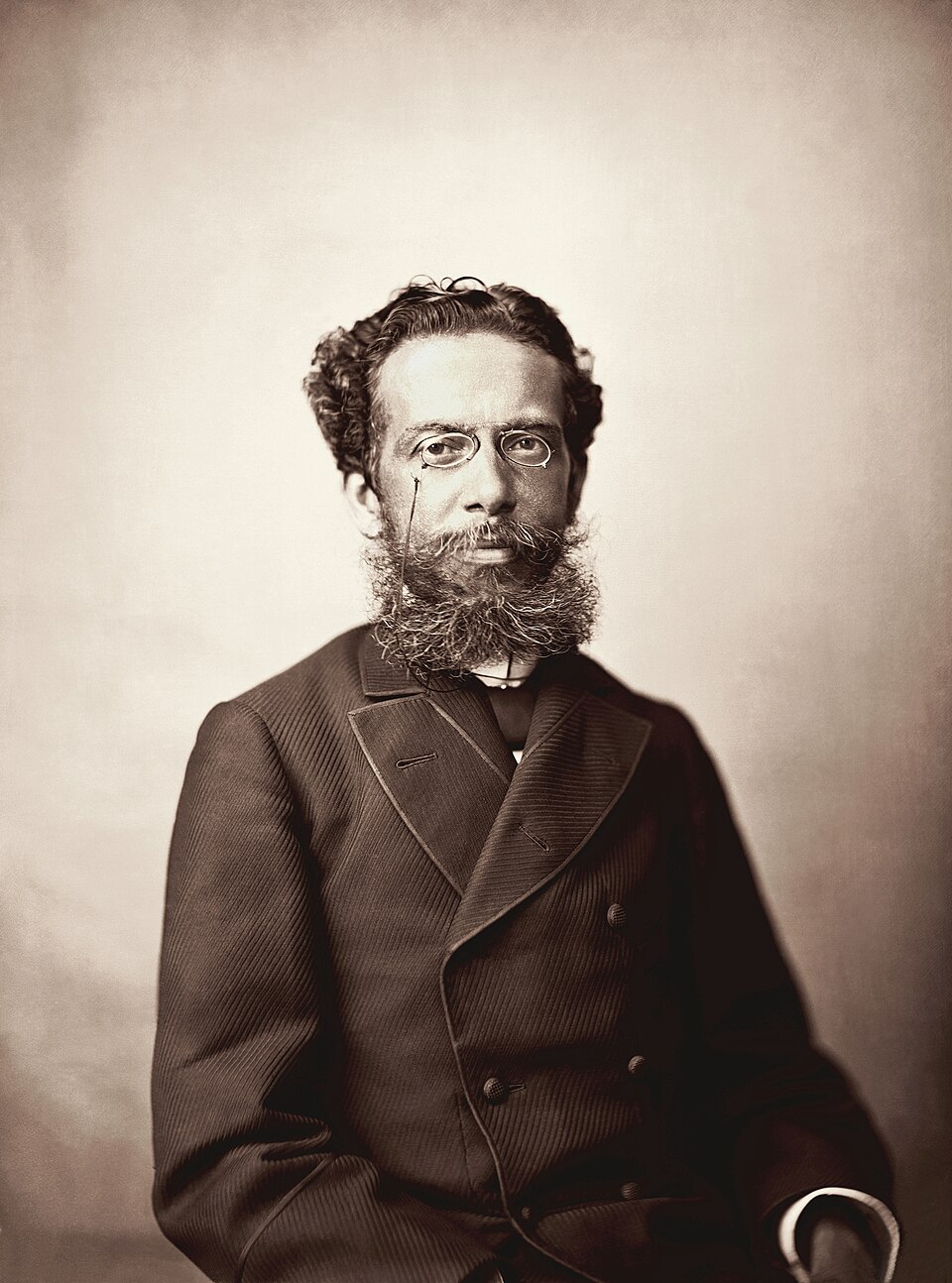
- Wikimedia Commons, "File:Machado de Assis by Marc Ferrez.jpg"; source page for the 1890 photographic portrait.