
Nadine Gordimer is often summarized too quickly: South African novelist, anti-apartheid witness, Nobel laureate, writer of political fiction. None of that is false, but it can flatten the thing that makes her work difficult and still alive. Gordimer did not simply attach correct opinions to narrative. She spent a career asking what forms of attention fiction could sustain when the ordinary arrangements of domestic life, desire, property, language, and law were already political.[3][4]
That is why a 1988 unedited interview from the Villon Films archive is worth watching as literature, not only as historical testimony.[1][2] The footage comes from a collection of interviews with South African and American writers, journalists, and activists made in the late 1980s, mostly around censorship and film, with related material on Steve Biko protests and newspapers.[2] It preserves Gordimer before the 1991 Nobel Prize sealed her international reputation, but after decades of fiction had already made her one of apartheid South Africa's most exacting witnesses.[3][5]
The timing matters. In 1988, South Africa remained under apartheid rule, with censorship, political banning, and state control still shaping the public conditions under which art, journalism, and testimony moved. Gordimer's own writing had repeatedly tested that pressure. The Nobel site later described her work as writing that was "of very great benefit to humanity," but the phrase can sound ceremonial unless it is returned to the practical conditions of her books: who may speak, who may read, who is watched, who is misread, and what happens when private life is organized by public violence.[3][4][5]
Gordimer's 1991 Nobel lecture gives one key to the interview's deeper value. She insists there that "the life, the opinions, are not the work."[4] That short sentence is not a retreat from politics. It is a warning against confusing political position with literary transformation. Biography and conviction are raw materials; the work begins when they are changed into scene, voice, structure, delay, pressure, and moral uncertainty. The 1988 interview lets us hear that distinction before the Nobel frame makes it famous.
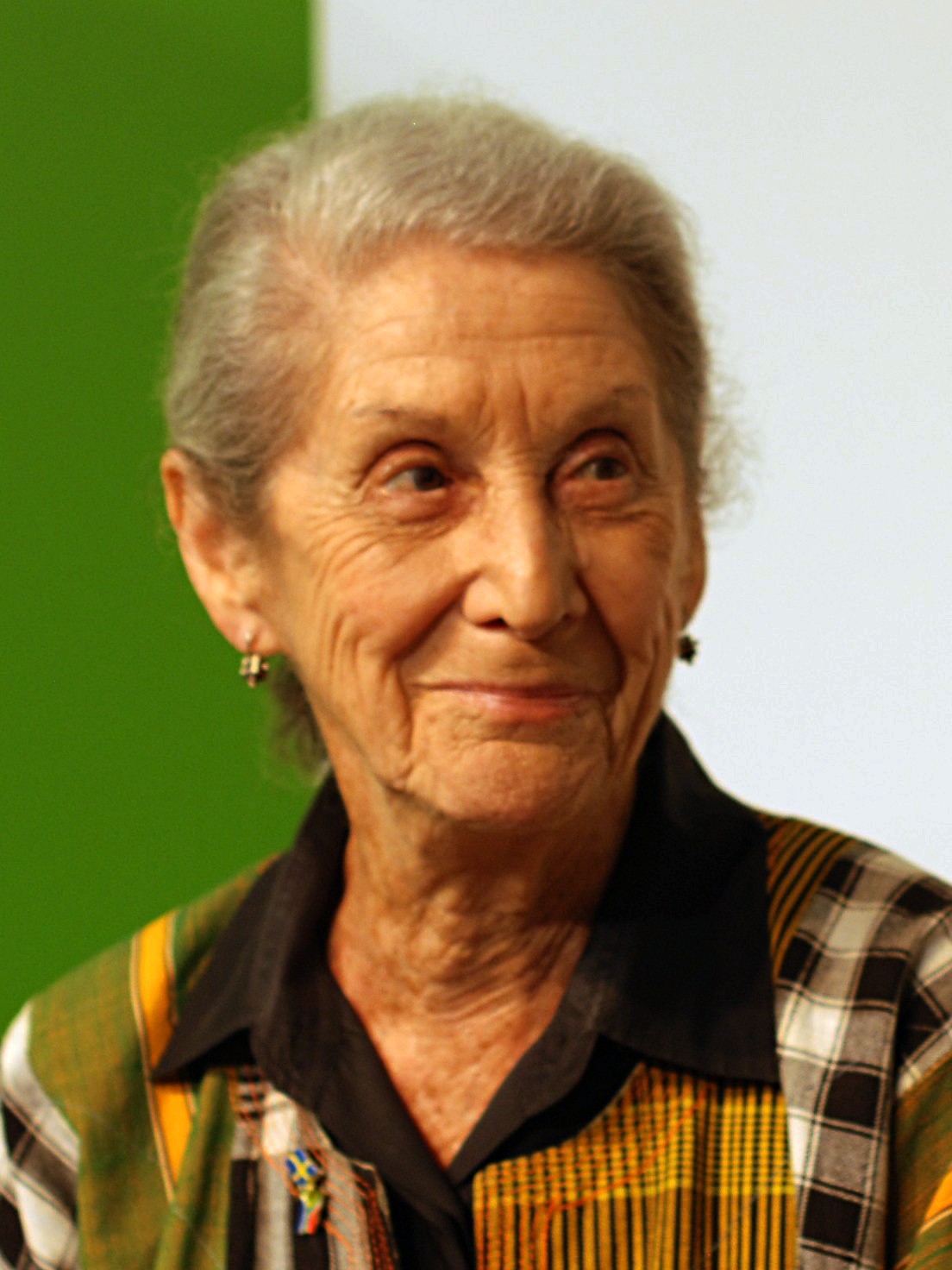
Image context: the cover photograph shows Gordimer in 2010 at the Goteborg Book Fair, long after the 1988 interview but still in a public literary setting where the writer's voice, face, and reception history meet. It is a photographic author-context image, not a symbolic bookish placeholder.[6]
The embedded video below is a Villon Films YouTube upload of the 1988 unedited interview.[1] Villon Films identifies the archive record as a 50-minute sound-and-color interview in South Africa, preserved from Betacam SP and available digitally as ProRes.[2] That provenance makes it especially useful as an archival spotlight: it is not a polished prize package, not a late-career memorial clip, and not a book-tour excerpt. It is working footage from a contested public culture, with Gordimer thinking inside the historical situation her fiction had long been converting into form.
What The Recording Preserves
The first thing the recording preserves is Gordimer's refusal to let censorship remain an external topic. Censorship is not only a government office, a ban, or a missing page. For a novelist, it also becomes a force that changes what can be said openly, what must be displaced, what readers learn to infer, and how characters inhabit speech. Gordimer's strongest fiction often works in that middle zone. It shows people living under structures they may not name directly, yet those structures determine the terms of touch, work, sex, inheritance, fear, education, and loyalty.[3][5]
That is why the interview pairs so well with Burger's Daughter and July's People. The first is organized around the inheritance of a revolutionary father and the burden placed on a daughter by public meaning. The second imagines white liberal dependence after social order has overturned, forcing private habits to reveal the political assumptions they had concealed.[3][5] In both cases, the political crisis is not a backdrop. It is a pressure that changes narrative grammar. Who sees? Who interprets? Who owns the room? Who can leave? These are formal questions before they become thesis statements.
The second thing the video makes legible is Gordimer's distrust of purity. A weaker political fiction turns characters into proof. Gordimer's more durable method is harder: she lets compromised people remain morally readable without becoming morally simple. NobelPrize.org's work summary is useful here because it says the stories of individuals stay at the center of her narratives, but always in relation to external limitations and frameworks.[5] That is exactly the discipline the 1988 footage helps clarify. Gordimer is not trying to inflate the role of the writer. She is trying to keep the work answerable to the complicated life around it.
This is also where her Nobel lecture's account of writing as an exploration of self and world becomes useful.[4] In Gordimer, "world" does not mean scenery. It means law, labor, mine compounds, libraries, townships, police power, publishing channels, family arrangements, and the inherited reflexes of race and class. In her 2005 Nobel interview, she recalls that the municipal library was formative, then immediately marks the racial boundary inside that fact: a Black child would not have had the same access.[3] The point is not sentimental childhood memory. It is a miniature of unequal reading conditions.
Censorship As A Craft Problem
To watch the 1988 interview well, listen for how steadily Gordimer treats censorship as a craft problem as well as a civil one.[1][2] A censored culture does not only remove documents; it distorts the relationship between writer, reader, and public knowledge. It creates official language, forbidden names, evasive habits, coded circulation, and a split between what everyone knows and what may be printed. For fiction, that split is fertile and dangerous. It can intensify implication, but it can also tempt the writer into allegory so neat that life disappears.
Gordimer's answer was not to hide from history. It was to write history through intimate arrangements until the reader could feel public power in private syntax. A marriage, a servant's room, a child's fear, a party, a car journey, a document, a farm, a safe house: these are not neutral objects once apartheid has organized the social field. The political system enters the sentence by controlling what each object permits. The archive matters because Gordimer can be heard explaining the world from which that pressure arose, while the novels show what happened when explanation became structure.
There is a useful tension here. Public interviews invite authors to clarify. Fiction often works by resisting clarification too early. Gordimer's achievement lies in using both registers without confusing them. In interview, she can name apartheid, censorship, privilege, and the writer's obligations directly.[1][3] In fiction, she can let those forces appear as pace, silence, misrecognition, and delayed consequence. The recording is therefore not a substitute for reading her. It is a guide to the conditions under which her fiction learned to withhold, reveal, and rearrange knowledge.
Why It Still Matters
The danger with archival author footage is that it can become personality evidence: here is the famous writer speaking; therefore the work is explained. Gordimer resists that use. The video is valuable because it does not solve her fiction. It returns readers to the problem her fiction keeps reopening: how can a novel tell political truth without becoming a pamphlet, and how can it preserve moral complexity without laundering injustice into ambiguity?
That question remains current because censorship rarely announces itself only as a censor's stamp. It can appear as platform pressure, market caution, classroom panic, legal intimidation, state secrecy, publishing gatekeeping, or the social cost of naming what a community has agreed not to know. Gordimer's archive is not a period piece because it trains attention toward the relationship between power and form. If certain realities cannot be said plainly, literature must decide whether to evade them, encode them, or build a structure strong enough to expose the evasion itself.
The 1988 footage catches Gordimer at that hinge. She is already internationally known, but not yet encased by Nobel shorthand. She speaks from within a culture where censorship was not metaphorical, and from within a literary career that had proved political seriousness can be a formal discipline. The result is a video that should send readers back to the books with sharper questions. Do not ask only what Gordimer believed. Ask how belief becomes scene. Ask how apartheid enters a room before anyone names it. Ask how a censored world teaches fiction to make silence audible.
Sources
- Villon Films, "1988, Nadine Gordimer - Unedited Interview, South Africa," official YouTube video.
- Villon Films, "Nadine Gordimer - Unedited Interview" (archive record with year, duration, location, collection context, and primary YouTube ID).
- NobelPrize.org, "Nadine Gordimer - Interview" (April 2005 interview transcript and topic guide).
- NobelPrize.org, "Nadine Gordimer - Nobel Lecture: Writing and Being" (December 7, 1991 lecture text).
- NobelPrize.org, "Nadine Gordimer - Facts" (biographical summary, banned books note, work overview, and prize motivation).
- Wikimedia Commons, "File:Nadine Gordimer 01.JPG" (source page for the 2010 Goteborg Book Fair photograph by Bengt Oberger).