Elizabeth Barrett Browning's Sonnets from the Portuguese is often remembered through one portable phrase: "count the ways."[1] That shorthand is affectionate, but it can make the sequence sound simpler than it is. The poems do not merely celebrate love already secured. They dramatize the difficulty of accepting love when the speaker has learned to treat desire as risk, exposure, and almost an argument against herself. The famous counting arrives late, after poems of hesitation, letters, self-doubt, theological scale, and bodily strain.
Edmund Spenser's Amoretti, printed with the wedding song Epithalamion in 1595, offers a useful older countershape. It also moves toward marriage, and that successful courtship arc is unusual among sonnet sequences built from delay, complaint, absence, and frustrated desire.[2][6] Yet Spenser and Barrett Browning solve the marriage-bound sonnet in opposite ways. Spenser makes courtship visible as pursuit, seasonal discipline, and public culmination. Barrett Browning turns the same broad destination inward: the drama lies in whether the beloved's claim can be received without erasing the speaker's freedom.
The comparison matters because it rescues both works from greeting-card reduction. Spenser is not only the poet who writes a name in sand; Barrett Browning is not only the poet who counts love upward into infinity. Each sequence asks what has to change before lyric desire can become an ethical bond. Spenser's answer is ceremonial and social. Barrett Browning's answer is psychological and vocal. One sequence wants the wedding day to gather the world around it; the other wants the private "yes" to become speakable without becoming less private.
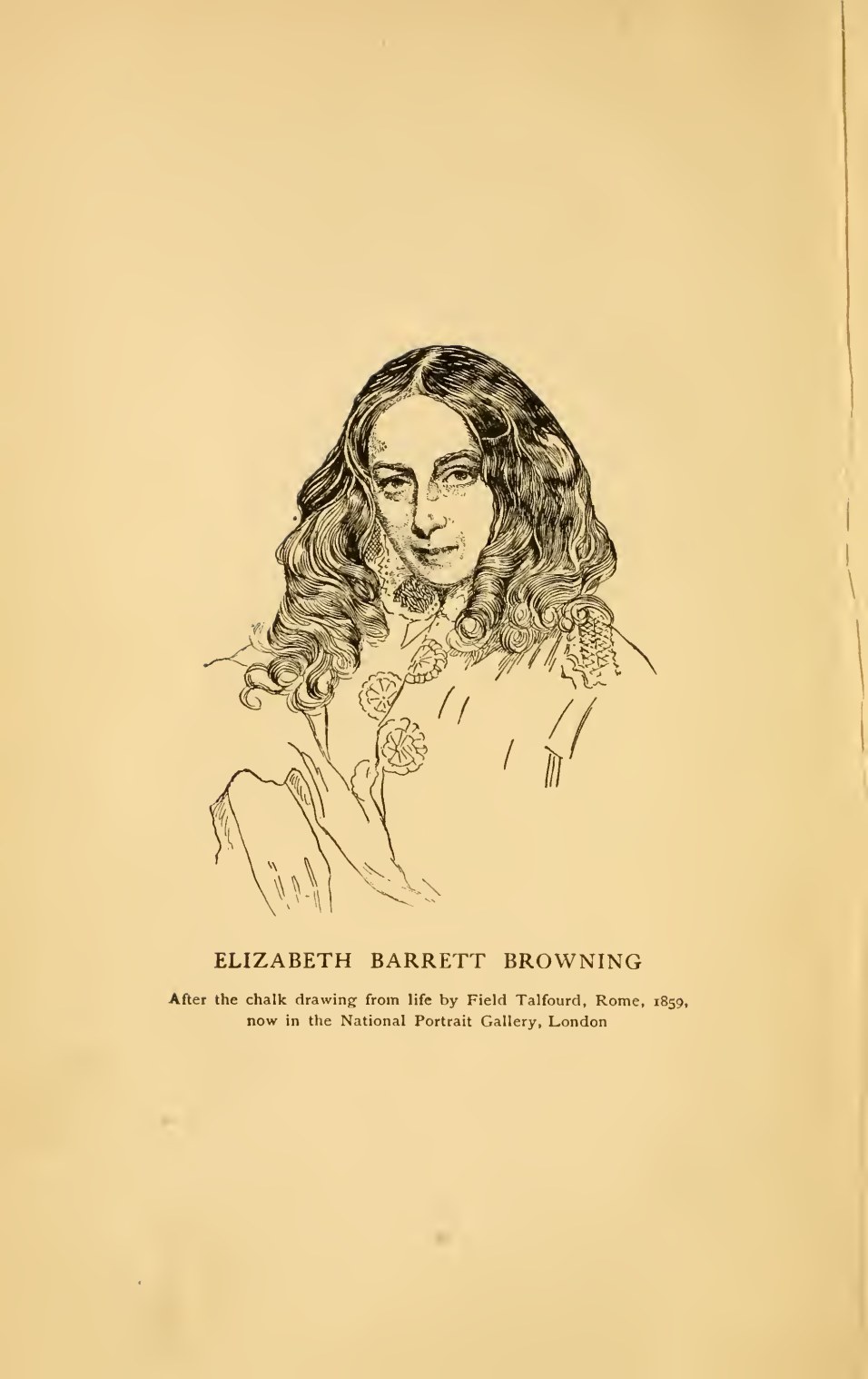
Image context: the cover uses an archival scan of an Elizabeth Barrett Browning frontispiece from a digitized early twentieth-century edition of her selected poems. The image is documentary rather than illustrative filler: a printed page, a portrait, and a public edition of a poet whose most famous love sequence keeps negotiating the border between private feeling and readable form.[7]
Spenser: courtship as chase, calendar, and public weather
Spenser's courtship grammar begins with motion. In Amoretti Sonnet 67, the lover compares himself to a hunter after "weary chace," and the beloved to the creature who at last returns of her own accord.[2] The figure matters because Spenser's sequence repeatedly works through pursuit without letting pursuit remain mere force. The speaker desires, praises, complains, and waits; the beloved resists, tests, withdraws, and gradually alters the terms of approach. Courtship becomes a sequence of regulated approaches rather than a single conquest.
That regulation is one reason Epithalamion belongs so naturally beside Amoretti. Britannica notes that the wedding ode was originally published with the sonnet sequence and celebrates Spenser's 1594 marriage to Elizabeth Boyle.[6] The lyric "I" therefore does not vanish into private feeling. It moves toward a social day: muses, townspeople, ritual time, blessing, song.
This makes the famous sand-writing sonnet less isolated than classroom memory can make it. In Sonnet 75, the speaker "wrote her name upon the strand," only to watch the waves erase it.[2] The beloved calls the gesture vain; the speaker replies by turning poetry into durable memorial. The poem can sound like a swaggering claim for literary immortality, and it is that. But inside the larger sequence, it also marks a shift from pursuit to inscription. The beloved is no longer only the pursued figure. She becomes the name that poetry must learn to preserve without losing to water, time, or pride.
Spenser's sequence thus turns consent into order. The beloved's resistance is gradually absorbed into a structure of providential timing, liturgical echo, and public celebration. The risk is that the woman's inwardness can be overmanaged by the speaker's ceremonious design. The achievement is that desire does not stay trapped in complaint. It learns to pass through waiting, feast days, marriage rite, and communal recognition. Love becomes real by entering time.
Barrett Browning: courtship after the inward barricade
Barrett Browning inherits the sonnet sequence with a different pressure point. The beloved is not chiefly distant because he refuses love. The problem is that love has arrived and must be believed. Britannica frames the courtship through Robert Browning's January 1845 letter, the secret relationship that followed, and the claim that Sonnets from the Portuguese records Elizabeth Barrett Browning's reluctance to marry before the September 12, 1846 wedding.[3] Wellesley's Browning Collection gives the material scale behind that story: the courtship letters were written almost daily from January 1845 to September 1846.[4] The title's fiction matters because it gives public cover to poems that feel almost too near the pulse.
The drama of Sonnets from the Portuguese is therefore not the Petrarchan ache of an unreachable beloved. It is the work of consenting to be loved. Sonnet 14 asks to be loved for "love's sake only," stripping away pity, beauty, manner, mood, and other unstable reasons.[1] That request is severe. It is not a decorative ideal of pure romance. It is the speaker testing whether love can survive the loss of the very traits that first invite love. Desire has to pass through a court of reasons before it can become trust.
The letters make that inward trial material. In Sonnet 28, the speaker calls them "dead paper, mute and white," then lets memory animate them into proof of returned feeling.[1] The real correspondence is recoverable at large scale through the Wellesley-Baylor digital project and the Brownings' online edition, but the poem itself offers only a compressed trace of that archive.[4][5] That withholding is crucial. Spenser writes the beloved's name into public permanence; Barrett Browning lets letters enter the poem while guarding what they said. Privacy is not abolished by publication. It becomes the shape of the poem's tact.
The voice of the sequence moves by negotiated self-permission. Barrett Browning's speaker is learned, devotional, passionate, and wary of her own hope. She measures love through breath, tears, death, childhood faith, and afterlife, but those expansions do not flatten the beloved into an emblem. They show a mind trying to find a scale large enough for acceptance. When the famous counting arrives in Sonnet 43, it is not a simple inventory. It is a late form of steadiness, a way to turn overflow into grammar.[1]
Two marriage plots, two ethics of voice
Read side by side, the sequences expose two different ethics of lyric courtship. Spenser's speaker wants desire to be ratified by pattern: chase, calendar, feast, inscription, wedding song. Barrett Browning's speaker wants desire to be ratified by inward freedom: the right to fear, test, withhold, answer, and finally speak. Both are marriage plots. They differ in where the decisive event occurs.
For Spenser, the decisive event is visible. The wedding day completes the sequence by moving private longing into public order.[6] That visibility gives Amoretti and Epithalamion their distinctive brightness. The sequence can imagine love as a structure that the world helps hold: religious time, civic sound, domestic futurity, and poetic fame. Even the erased name in the sand becomes part of a confidence that verse can defeat time.[2]
For Barrett Browning, the decisive event is almost invisible. The poems keep returning to thresholds of acceptance: can the speaker believe the beloved, can she receive joy without mistrusting it, can she remain herself inside the bond? The public book arrives after the private transformation. Its art lies in making that transformation readable while preserving a sense that some things remain between the lovers alone.[3][4][5]
This is why Barrett Browning's sequence feels startlingly modern beside Spenser's. She does not reject ceremony; she relocates the deepest ceremony into consent itself. The beloved's love has to be answered by a voice that has learned the cost of answering. Spenser's lover writes outward, into sand, calendar, and song. Barrett Browning's speaker writes through the inward barricade until speech can stand without apology.
Why the comparison still changes the reading
Putting the two sequences together also changes how the famous moments sound. Spenser's sand sonnet stops being a detachable boast about poetic immortality and becomes part of a larger movement from pursuit toward authorized union. Barrett Browning's "count the ways" stops being a sentimental flourish and becomes the result of a long discipline of receiving. In both cases, the familiar line is a late-stage event.
The difference is tonal as much as structural. Spenser's sequence has bright architecture. It trusts pattern, echo, culmination, and ceremonial enlargement. Barrett Browning's sequence has pressure in the throat. It trusts qualification, inward recoil, renewed address, and the courage of measured disclosure. Spenser gives love a day. Barrett Browning gives love a voice that has had to win itself back.
That is the pleasure of reading them together. The marriage-bound sonnet sequence is not a single tradition moving smoothly from Renaissance courtship to Victorian intimacy. It is a problem that each poet solves by choosing where love becomes real. In Spenser, love becomes real when desire enters shared time. In Barrett Browning, love becomes real when the self can answer without surrendering its inward life. One writes the beloved's name against the waves. The other counts because abundance needs form, and because the act of counting lets a private astonishment become speech.
Sources
- Elizabeth Barrett Browning, Sonnets from the Portuguese, Project Gutenberg full text.
- Edmund Spenser, The Poetical Works of Edmund Spenser, Volume 5, Project Gutenberg edition containing Amoretti and Epithalamion.
- Encyclopaedia Britannica, "Elizabeth Barrett Browning" biography.
- Wellesley College Special Collections, "The Browning Collection" overview of the courtship letters.
- The Brownings' Correspondence, "About the Edition".
- Encyclopaedia Britannica, "Epithalamion" overview of Spenser's wedding ode and its relation to Amoretti.
- Wikimedia Commons PDF scan, Selected Poems of Elizabeth Barrett Browning (lead image source, frontispiece after Field Talfourd).