Sancho Panza is easy to underestimate because Cervantes lets him arrive with such material clarity: belly, donkey, wife, hunger, fear, bargaining instinct, and a head full of proverbs. He enters Don Quixote as a neighbor willing to follow a cracked gentleman because an island has been promised.[1][2] That premise looks like broad comedy. Yet Cervantes quickly makes Sancho into one of the novel's most durable instruments of intelligence. He does not correct Don Quixote from above. He tests romance from ground level, with sore bones, empty stomachs, local memory, and sayings that seem foolish until they begin to outlast everyone else's abstractions.[1][4]
The great trick is that Sancho's practicality does not make him immune to enchantment. He knows windmills are windmills, inns are inns, and beatings hurt. He also keeps riding. He believes and disbelieves by turns, and that oscillation gives the novel one of its richest forms of movement.[1][2] Don Quixote turns the world into an adventure book; Sancho turns the adventure book back into weather, food, wounds, cash, reputation, and household consequences. The character study therefore has to treat him neither as mere clown nor as simple common sense. He is the novel's portable intelligence: comic, bodily, verbal, and loyal enough to stay inside the delusion long enough to measure it.
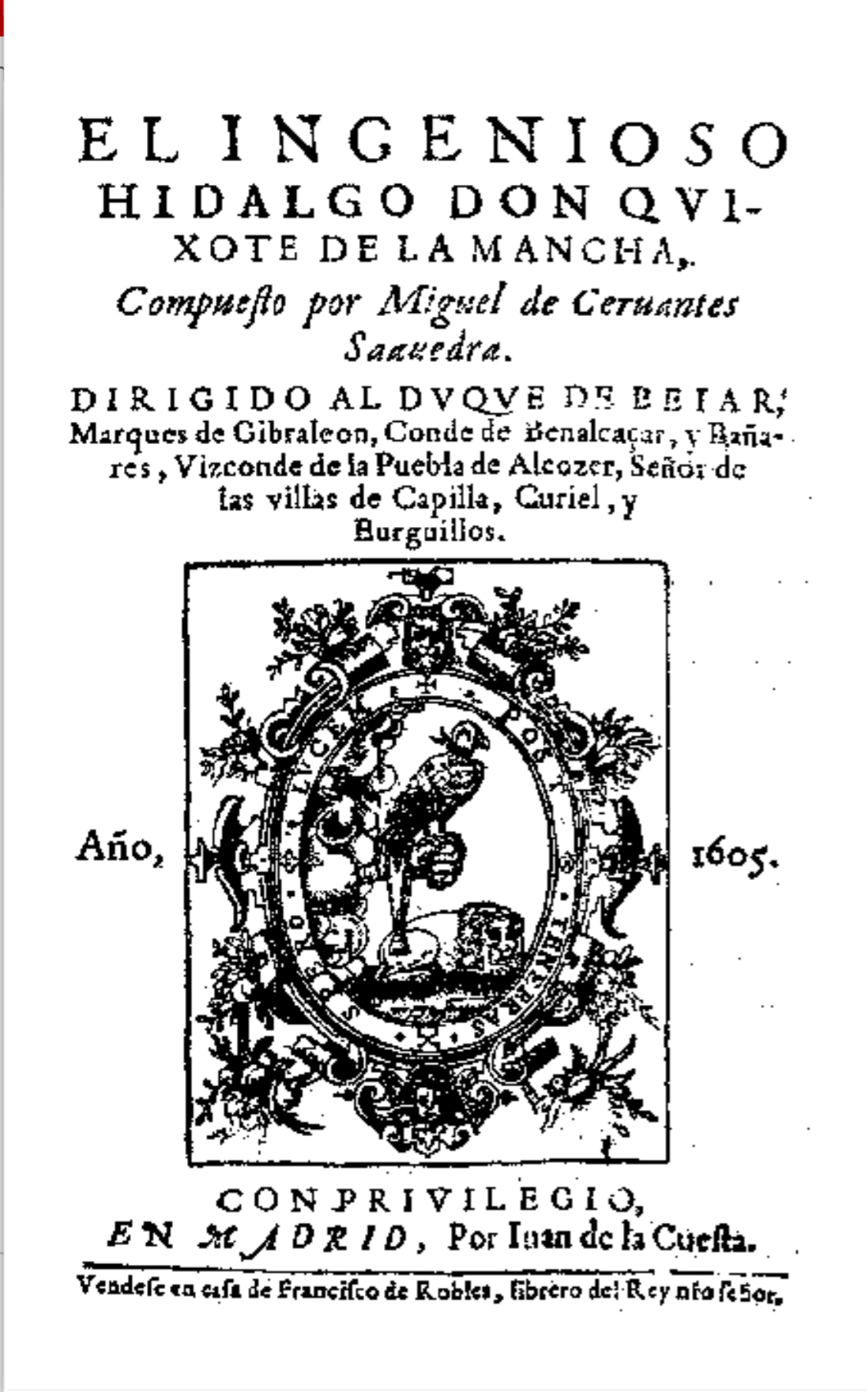
Image context: the cover uses an archival scan of the 1605 first-edition title page rather than a later illustration of Sancho and his donkey. That choice fits the essay because Sancho's force comes from the printed novel's founding tension: a book about books that keeps being interrupted by hungry, talkative, weather-exposed life.[6]
1) Sancho begins as appetite, but appetite is not stupidity
Cervantes introduces Sancho through motives that respectable romance usually keeps offstage. He wants an island, wages by another name, and an improvement in household fortune.[1] He leaves Teresa Panza not because he has been seized by chivalric sublimity, but because Don Quixote's promise gives fantasy an economic shape. That makes him comic, but it also makes him legible. Sancho's first intelligence is that he recognizes desire when it appears in usable form.
The novel never lets readers forget his body. Sancho wants sleep, food, shelter, a less painful saddle, and a future in which adventure pays.[1] Those wants keep lowering Don Quixote's rhetoric into the world where consequences accumulate. When the knight names glory, Sancho asks what the road costs. When the knight sees enchantment, Sancho remembers who has been punched. This bodily grounding can look like dullness only if one accepts Don Quixote's vocabulary as the novel's higher language. Cervantes does something subtler. He lets appetite become a truth procedure.
That is why Sancho's materialism is not a defect to be cured. It is the condition that lets the novel remain plural. Without him, Don Quixote's fantasy would either become pure pathos or pure satire. Sancho gives it friction. He makes every heroic claim pass through hunger, fatigue, cowardice, calculation, and local knowledge. The result is not a victory of realism over romance. It is a shared road where romance has to keep negotiating with lunch.
2) His proverbs are comic excess and social memory at once
Sancho's most famous verbal habit is his flood of proverbs. Don Quixote often rebukes him for pouring sayings into conversation as if language were a sack split open.[1] The rebuke is funny because Sancho often chooses the wrong proverb, piles up too many, or lets a saying substitute for a thought he has not fully formed. The comedy is real. So is the intelligence.
Proverbs give Sancho a portable library. He is not a learned reader in the knight's sense, but he carries condensed social experience in speech.[4][5] His sayings belong to kitchens, roads, fields, taverns, markets, and families. They do not provide a system. They provide pressure. Against Don Quixote's chivalric books, Sancho sets the low archive of communal survival: when to distrust, when to eat, when to save face, when to retreat, when luck has turned, when a bargain has hidden teeth.
Cervantes keeps the habit unstable. A proverb can be wisdom, evasion, noise, or self-protection depending on the scene.[1][5] That instability is exactly the point. Sancho does not possess a clean doctrine of common sense. He has a speech practice that gathers past use and tries to spend it on present difficulty. Sometimes it fits. Sometimes it rattles around. But the proverbs make him impossible to reduce to ignorance. He is full of other people's tested sentences, and he keeps testing them again.
3) Sancho is loyal because he is not fully converted
The emotional center of Sancho's character lies in an apparent contradiction: he sees through Don Quixote repeatedly, and yet he remains attached to him.[1][2] This is not just greed for the island. The promise matters early, but the journey changes the texture of loyalty. Sancho comes to care for the knight not because he accepts every illusion, but because he has learned the particular rhythm of the man who needs those illusions.
That mixed loyalty makes Sancho more interesting than a faithful servant type. He complains, bargains, lies, grumbles, advises, mocks, worries, and stays. He can manipulate Don Quixote's belief when he needs to, most famously in episodes where enchantment becomes a practical solution to social embarrassment.[1] Yet he is also moved by the knight's vulnerability. His loyalty is not pure obedience. It is a rough companionship built from repetition: shared roads, shared beatings, shared jokes, shared exposure.
Cervantes uses that companionship to soften both men without sentimentalizing either. Sancho becomes more imaginative through Don Quixote; Don Quixote becomes more human through Sancho. The exchange does not erase difference. It makes difference habitable. Sancho's skepticism would be cruel if it simply crushed the knight. His credulity would be foolish if it simply surrendered to him. Instead he hovers in the middle, and that middle is where the novel breathes.
4) The governorship proves that comic speech can become judgment
Sancho's brief governorship of Barataria is the great test of the character. The joke seems prepared in advance: a peasant stuffed with proverbs is placed in office so the aristocratic prank can expose his inadequacy.[1][4] But Cervantes lets the joke turn. Sancho governs better than expected. He listens, reasons, detects fraud, and delivers judgments with surprising proportion.[1]
This section matters because it prevents readers from treating his speech as mere rustic color. Sancho's proverbs and bodily instincts have trained a certain practical attention. He is not educated for theory, but he is alert to motive, timing, appetite, and self-interest. Those are exactly the materials of many disputes brought before a governor. His judgments work because he does not have to pretend human beings are nobler than they are.
Barataria also clarifies the limits of Sancho's ambition. The island was the lure that got him moving, but office does not become his final fantasy. Its diets, rules, threats, and anxieties make power feel less like reward than performance under constraint.[1] Sancho's withdrawal is comic, but it is also sane. He learns that a promised island can be another kind of beating. The man who wanted elevation discovers that returning to ordinary life may be a more exact form of self-knowledge.
5) Sancho's comedy protects the novel from cruelty
Much of Don Quixote is built from humiliation: beatings, tricks, falls, broken objects, mistaken identities, public laughter.[1][2] Without Sancho, that pattern could harden into cruelty. His presence changes the moral temperature. Because he suffers too, complains loudly, and insists on the body's account of events, the reader cannot keep Don Quixote's injuries at the distance of elegant literary irony.
Sancho also protects comedy by making it reciprocal. He is laughed at, but he laughs, interprets, bargains, and survives. His verbal energy turns many scenes away from simple victimhood. Even when others stage cruel entertainments, Sancho's responses keep pushing back against the frame. He may be fooled, but he is seldom emptied out by the joke. His appetite returns; his tongue returns; his judgment returns.
This resilience is one reason the pair has had such a long afterlife in translation, adaptation, illustration, and public memory.[2][3] Don Quixote supplies the grand silhouette of impossible idealism. Sancho supplies the counterweight that keeps the silhouette from floating away. Together they become a portable human arrangement: dream and stomach, book and road, illusion and repair.
6) Why Sancho remains modern
Sancho Panza still feels modern because he understands that people rarely live by one register at a time. A person can be skeptical and suggestible, loyal and self-interested, foolish and shrewd, hungry and morally awake. Cervantes does not resolve those mixtures into a clean lesson.[1][4] He lets Sancho remain compound.
That compound nature is his dignity. Sancho's proverbs may be messy, but they acknowledge a world where wisdom travels in fragments. His appetite may be comic, but it keeps ethics attached to bodies. His loyalty may be compromised, but it is durable enough to become care. His governorship may begin as farce, but it reveals a mind trained by roads rather than schools. Don Quixote can say, in one of the novel's most compact assertions, "I know who I am."[1] Sancho's answer is less declarative and more lived. He knows where he is, what hurts, what people usually do, and why a foolish companion may still deserve company.
That is why he is more than ballast for a mad knight. Sancho is Cervantes's proof that ordinary speech can think. It can blunder, repeat, evade, and overfill the room; it can also notice what elevated language misses. In character-study terms, his greatness lies in the way he keeps the novel answerable to life as it is actually carried: in stomach, proverb, fear, hope, fatigue, loyalty, and the stubborn desire to get home with something learned.
Sources
- Miguel de Cervantes, Don Quixote, translated by John Ormsby, Project Gutenberg full text.
- Encyclopaedia Britannica, "Don Quixote".
- National Endowment for the Humanities, "One Master, Many Cervantes".
- Matthew Manfredi, "Sancho Panza, Illiterate Voice of Reason: A Study of Irony in Miguel De Cervantes' Don Quixote" (Roger Williams University thesis, 2014).
- Miguel de Cervantes Saavedra, Sancho Panza's Proverbs: And Others which Occur in Don Quixote (Google Books scan).
- Wikimedia Commons, "File:Title page first edition Don Quijote.jpg" (lead image source).