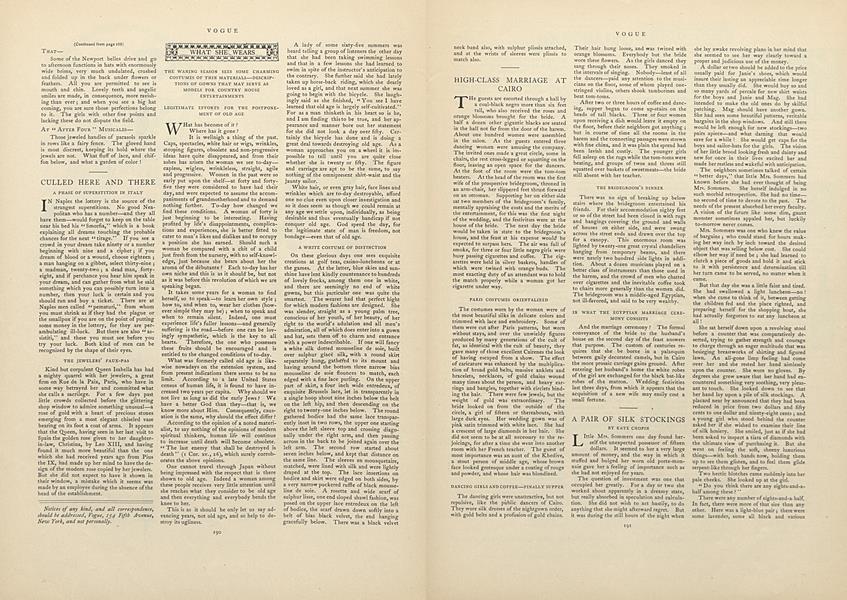
A man sits opposite Mrs. Sommers on a cable car and studies her face. He has “keen eyes”; something about the small, pale face puzzles him. Then Kate Chopin quietly removes his authority: he “saw nothing.” The reader receives what the attentive stranger cannot discover—a wish that the car should carry this woman onward forever.[1]
That is where “A Pair of Silk Stockings” ends. No arrival, no children at the door, no accounting for the money. After an afternoon of buying things, Mrs. Sommers wants an extension of time. Chopin makes the wish legible while leaving the woman herself silent.
This essay discusses the ending. Page references follow the Kate Chopin International Society text in source 1.
The story appeared in Vogue on September 16, 1897, having been written the previous year.[2][4] Its magazine setting has a particular pleasure: Mrs. Sommers herself buys expensive magazines during her excursion, carrying them visibly through the street. Reading is among the comforts she briefly recovers. Someone turning the original pages could encounter a woman for whom that very kind of unhurried attention has become a luxury.
The last scene begins by dismantling a small community. Inside the theatre, Mrs. Sommers has laughed, cried and exchanged a few words with the woman beside her, who shares her candy. Once the performance ends, the crowd disperses. Chopin calls it a “dream ended” (p. 3).[1] The phrase first describes the theatre’s shared illusion, but it also lets the afternoon’s larger spell begin to break. The movement from the crowded auditorium to the seat opposite a stranger replaces companionship with inspection.
Earlier, being seen had helped the excursion along. New stockings, boots and gloves gave Mrs. Sommers confidence among fashionable people. At the restaurant, nobody reacted to her entrance; she could sit alone and receive attentive service. The cable car brings another kind of attention. The man finds her interesting, but interest creates no conversation. His looking stops at a surface the narration passes through.[1]
Chopin gives him no speech and no usable knowledge. Even his apparent discernment becomes gently comic: only supernatural powers could reveal the longing he is trying to read. This is a useful limit on our own interpretation. A face does not disclose a biography. As the Chopin Society points out, the text never establishes whether Mrs. Sommers’s husband is dead or alive, and it never names the city.[2] Her circumstances exert pressure without becoming a complete case history.
We do know how much thinking ordinary life requires of her. At the beginning, unexpected money sends her into careful plans for the children’s clothes. She considers durability, repairs and the labor a purchase might save. By the time she reaches the shop, she has forgotten her own lunch. The first pleasure of the silk is touch; the next is a temporary release from calculation (pp. 1–2).[1]
That release remains complicated. The narrator describes a “mechanical impulse” guiding her purchases (p. 2).[1] The word makes enjoyment sound partly automatic, even as each transaction gives her more room to enjoy herself. In a retrospective account of her criticism, Dan Shen explains how she came to read the story’s feminist and consumerist meanings together, then identified a further pattern involving the force of environment. The same details can pull in several directions.[3] Her account helps preserve the uneasiness here: Mrs. Sommers feels restored while moving through places equipped to sell that restoration.
The cable car gathers those tensions into one ordinary action: being carried. For a while, she need not plan the next purchase, bargain for it or manage anyone else’s needs. The vehicle supplies the movement. Yet its journey must also have stops. The comfort has a built-in ending.
Her wish reaches precisely for that limit. She wants the car to “never stop anywhere,” then to “go on and on” (p. 3).[1] Anywhere removes a destination from the fantasy. She does not imagine a particular better house, another restaurant or a new city. My reading is that the desired freedom lies in prolonging the interval before another demand must be answered. The repeated on gives that interval a little audible length. We feel continuation inside a sentence that is almost over.
Chopin keeps the wish distinct from an action. Mrs. Sommers does not announce that she is leaving her children; neither does she return home on the page to receive a lesson about spending. The story gives us the desire and ends before its consequences can settle into a verdict.
That restraint makes the last word, “forever,” ache.[1] The day has supplied pleasures that can be bought individually. What Mrs. Sommers finally wants cannot be purchased in the same way. The stranger remains opposite her, the journey remains unfinished, and the reader knows why its next stop will matter.
Sources
- Kate Chopin, “A Pair of Silk Stockings,” Kate Chopin International Society text based on Per Seyersted’s edition of The Complete Works of Kate Chopin—primary text, pp. 1–3, especially the final paragraph on p. 3.
- Kate Chopin International Society, “A Pair of Silk Stockings”—composition and publication history, critical perspectives, and the limits of what is known about Mrs. Sommers and the setting.
- Dan Shen, “JNT 52.1 Featured Author: Dan Shen,” Journal of Narrative Theory, May 13, 2022—first-person account of reading the story’s feminist, consumerist and naturalistic meanings together.
- Vogue archive, “A Pair of Silk Stockings,” September 16, 1897—original publication record and the public archival page preview reproduced above.