A path almost disappears in the grass. Bend down to the height of a squirrel and it becomes a road. Climb a hill and its faint course joins a whole network leading toward water. In “Water Trails of the Ceriso,” Mary Austin makes the reader change position before offering much explanation. The country has signs; the visitor has been looking from the wrong height.[1]
This small adjustment is characteristic of the writer who published The Land of Little Rain in 1903. Austin’s authority comes from staying, watching, and reconsidering an impression. Her prose can be extravagantly sure of itself, especially when it speaks for other people. Yet it also preserves encounters that unsettle that assurance. Following those encounters gives us a more interesting author than the solitary desert sage.
Born in Illinois in 1868, Austin moved with her family to California at twenty. The Huntington traces more than a decade of research behind The Land of Little Rain, including photographs and sketches as well as written observation.[2] The book became the best-known part of a much larger career: Austin also wrote novels, among them Isidro and The Ford, and eventually settled in Santa Fe.[4] Here, in her early desert essays, we can watch her develop a way of making knowledge into literature.
A country with its own calendar
In the preface, Austin warns that the region’s deepest character will not yield to a month’s vacation. Cones take seasons to ripen; roots wait years for rain. Her instruction to “summer and winter with the land” gives residence the force of a verb. Knowing this place requires surrendering the timetable on which a visitor expects to understand it.[1]
The opening chapter performs that surrender. Austin divides the year into three seasons, describes their approximate months, then qualifies the arrangement: rain may arrive earlier or later. The neat calendar loosens as soon as she has drawn it. The sentence follows the weather’s authority rather than making the weather obey the scheme.
Her famous landscape is consequently full of activity. Plants turn their leaves, grow protective hairs, and spread their roots in search of moisture. The space between shrubs becomes evidence of what happens below the ground. A seemingly sparse surface asks the reader to imagine the work supporting it.[1]
This is part of Austin’s gift for description. A detail becomes beautiful through the demand it answers. The lean plant has a history of accommodation; the empty interval has a purpose. Her opening insistence, “Void of life it never is,” keeps returning as a method of reading. Before declaring the country deficient, examine what you expected it to provide.
The observer changes height
“Water Trails of the Ceriso” turns that method into a lively expedition. At human standing height, small tracks are hard to see. Near the ground they become substantial; from a hill they resolve into a pattern. Even an abandoned stage road, invisible to someone walking through the grass, reappears from above.[1]
The sequence makes perception physical. Austin does not simply urge us to be attentive. She asks us to crouch and climb, exchanging the familiar view for positions that disclose different evidence. A landscape can contain several legible versions of itself.
Animals then become experienced inhabitants with something to teach. Austin follows a coyote’s route, noticing its detours, pauses, and economical crossings. She proposes that coyotes navigate by the skyline, carefully introducing the claim with “I am persuaded.” That phrase leaves a seam between the movements she has watched and the explanation she gives them.[1]
Elsewhere the prose is less restrained. Quail bustle like cheerful bathers; a road-runner seems offended by the sparrows’ splashing. Such scenes lend the animals the timing and temperament of comic characters. Austin’s literary pleasure depends partly on this willingness to imagine a social world around the spring. We can enjoy it while recognizing that a bird’s apparent indignation belongs to her account of the scene.
Water also organizes the chapter’s action. Different visitors arrive at different hours, and predators follow the creatures drawn there. The spring becomes a meeting place whose whole population no single glance could reveal. The narrator earns her crowded picture by returning.
A basket maker answers back
The quail return in “The Basket Maker,” this time as a pattern woven into Seyavi’s bowls. Austin describes the Paiute woman’s technical precision, the willow gathering, and the design’s expansion around the vessel’s flare. Seasonal knowledge has become workmanship. The eye that followed animal paths now follows a maker’s decisions.[1]
Seyavi also makes the limits of Austin’s method harder to overlook. The chapter recounts her survival with her son amid violence and dispossession, but acknowledges that she will not discuss part of that experience. Austin responds by imagining it through the image of a stray mother dog foraging for her young. She claims “perfect leave to think” precisely because Seyavi remains silent.[1]
That is a troubling reversal. Earlier, a gap in perception sends the observer back to the landscape. Here, a gap in testimony becomes permission to supply a story. The comparison conveys admiration for maternal resourcefulness, but it also puts an Indigenous woman’s unspoken experience inside a narrator’s chosen animal analogy. Sympathy has not eliminated the imbalance between the person describing and the person described.
The Huntington’s Storm Cloud exhibition labels make a related distinction: Austin advocated for Indigenous rights while tending to romanticize Native people.[3] The chapter lets us see both impulses at work. She attends closely to Seyavi’s artistry and records the violence surrounding her life, while making broad claims about Indigenous temperament and belief.
Then Seyavi gives a reply that punctures the collector’s confidence. Austin asks what benefit the dead receive from baskets burned for them, admitting that she wants those baskets for her own collection. Seyavi answers: “As much good as yours of the flowers you strew.”[1]
The sentence changes who is examining whom. Austin’s apparently practical question carries a wish to possess the object. Seyavi brings the questioner’s own mourning customs into view. A basket can be admired, bought, or studied; that does not make its ceremonial use answerable to the collector’s preference. Austin gives the exchange its sting by preserving both her acquisitive motive and the answer.
What survives the beautiful view
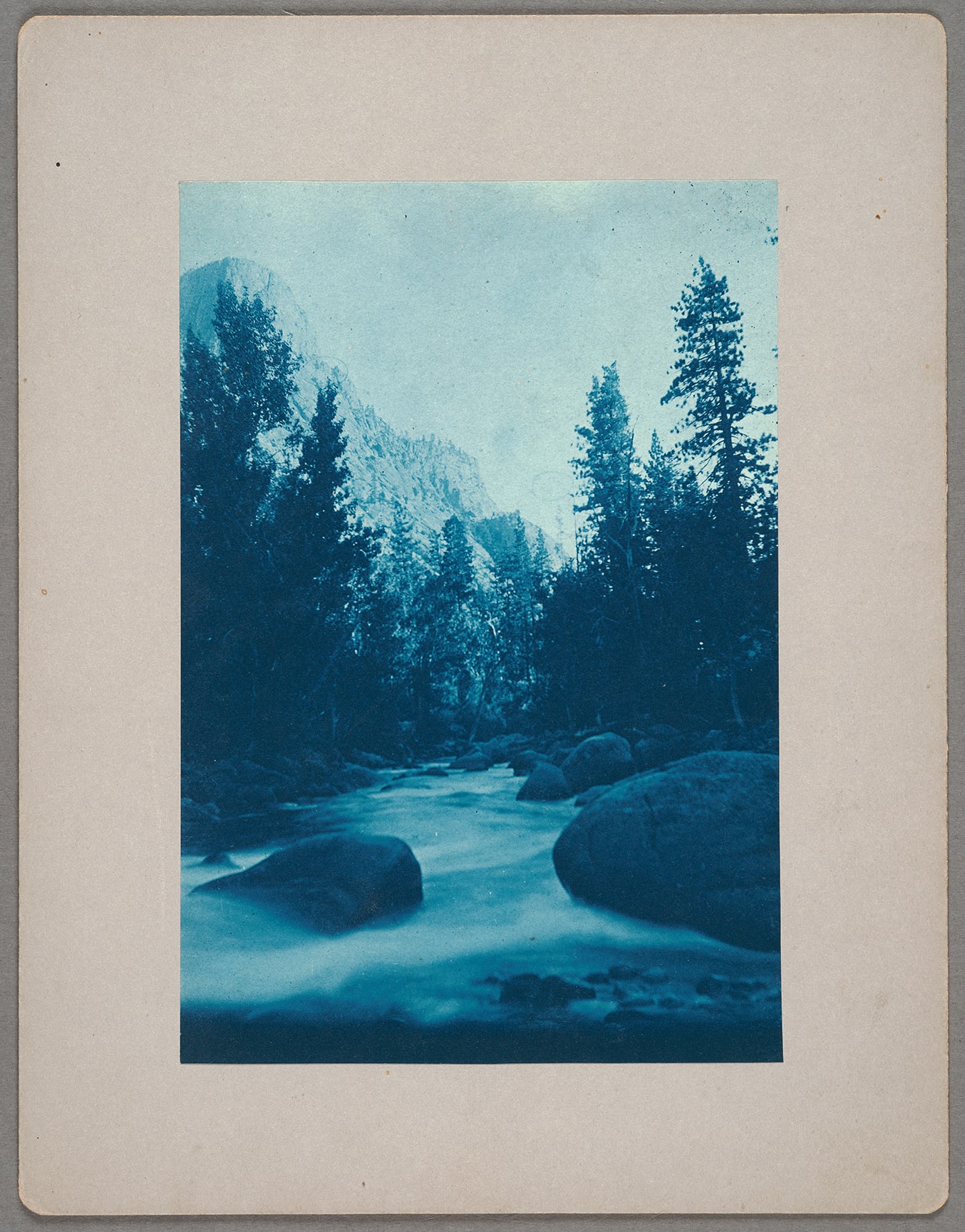
The book’s afterlife has continued to emphasize landscape. Counterpoint’s 2014 edition paired the complete text with Walter Feller’s color photographs and presented Austin as a foundational environmental writer.[4] Her own surviving cyanotypes offer an earlier connection between the page and the camera: observation was part of her practice across several forms.[2]
But the most revealing portrait of Austin emerges where description meets resistance. An animal trail requires a different height; the seasons require a longer stay; Seyavi requires recognition that another person’s purposes may exceed the observer’s curiosity. Austin does not always accept those limits. She does, however, leave enough friction in her prose for a reader to feel them. Beside the shimmering country stands a woman who can answer back.
Sources
- Mary Austin, The Land of Little Rain (1903), preface and chapters “The Land of Little Rain,” “Water Trails of the Ceriso,” and “The Basket Maker.” Project Gutenberg eBook 365; primary text for quotations and close reading.
- The Huntington, “The Land of Little Rain,” digital classroom resource. Austin’s fieldwork, biographical context, and her 1903 Sierra Nevada cyanotypes, Mary Hunter Austin papers, photCL 296; source of the reproduced photograph.
- The Huntington, Storm Cloud: Picturing the Origins of Our Climate Crisis (2024), large-print exhibition labels, printed p. 132. Austin’s advocacy, environmental writing, and romanticized representations of Indigenous people.
- Counterpoint Press, The Land of Little Rain, with photographs by Walter Feller (2014). Edition description, environmental-literary reception, and Austin’s broader writing career.