The telegram contains two words: “Eureka. Immense.” A literary critic has travelled to India and says he has discovered the principle that unites a novelist's books. Back in London, two people are desperate to hear what he has found. The message announces a breakthrough and communicates almost nothing.[1]
That little gap expands to fill Henry James's “The Figure in the Carpet,” first published in 1896.[3] Its unnamed narrator wants to understand the fiction of Hugh Vereker. He interviews the author, follows a friend's investigation, questions a widow, and watches her second husband for signs of enlightenment. Each new connection seems to bring the answer closer. Each also creates another place where it can stop.
The story's structure makes a peculiar bargain with us: keep reading, and someone may finally explain. By the end, James has shown exactly how that promise works on a person.
This essay discusses the ending. Chapter references follow the eleven-part text in Project Gutenberg's transcription of the 1916 Martin Secker edition.[1]
The author sends the critic back to the books
The first handover occurs before anyone mentions a secret. In chapter I, George Corvick asks the narrator to take over a review he cannot write. The younger critic sees an opportunity to advance his reputation. Corvick wants him to describe a particular pleasure in Vereker's writing; the narrator keeps reaching for rankings and general compliments.[1]
The distinction becomes uncomfortable at a country-house dinner. Vereker dismisses the resulting review, then visits the narrator's room to soften the injury. His kindness opens the conversation that will make the narrator miserable. No critic, he says, has identified the governing intention of his work.[1]
In chapter III, Vereker locates that intention in “the order, the form, the texture” of his books. The phrase asks the critic to attend to relationships: how the writing is arranged, how its parts feel together. The narrator immediately tries to turn this into a question with separable answers. Is the secret in the style or the thought? Could its author state it plainly?[1]
Vereker insists that he has already expressed it through his fiction. There is comedy in an author explaining at length why he should not need to explain. But his refusal also establishes the story's difficulty. The narrator has gained privileged access to the person who could settle the question, and the conversation sends him back to the work.
For a month, he rereads. Then he gives up. The search has spoiled pleasures he formerly enjoyed without trouble. When he tells Corvick about the conversation, however, the same information produces excitement. A message that exhausts one reader becomes another reader's invitation.[1]
Every message moves the explanation further away
The middle chapters change the pace. Vereker's long conversation gives way to cables, letters, journeys, and hurried visits. After Corvick announces his discovery from Bombay in chapter VI, the narrator expects a written explanation. Instead, Corvick must first take it to Vereker in Rapallo for confirmation.[1]
A later telegram reports the author's enthusiastic approval. This is powerful evidence within the narrator's account, but it reaches us as Corvick's report of a meeting we never witness. We learn that the answer has supposedly passed a test. We still cannot inspect the answer itself.
James makes the expense and bustle wonderfully concrete. The narrator and Gwendolen Erme, Corvick's fellow enthusiast and future wife, spend money on telegrams and cabs. She arrives waving a message from the footboard of a hansom. They stop before shop windows without looking at the goods. Their bodies move through London while their attention stays fixed on an absent conversation.[1]
Then the conditions change again. Corvick will tell Gwendolen after their marriage. For the narrator, he promises an authoritative essay. Access now depends on two different arrangements: private intimacy and eventual publication. Neither is something the waiting critic can command.
In chapter VIII, the narrator must leave England to nurse his sick brother. Corvick marries Gwendolen and dies in a driving accident on their honeymoon. His essay survives only as a beginning; the revelation was to have come later. The planned climax inside that unfinished article repeats the promise of the larger story. Both have persuaded someone to wait.[1]
The narrator's first letter after the death includes a postscript asking whether the essay was finished. James scarcely needs to rebuke him. The placement does the work: grief has hardly arrived before the question of usable literary information follows it onto the page.
A confidence cannot simply be inherited
Gwendolen confirms that Corvick told her everything. She also says she will keep it to herself. Death has interrupted the promised publication; a living person's refusal now blocks the alternative route.[1]
In chapter IX, the narrator begins to wonder whether marrying her would secure the disclosure. The thought exposes how readily he mistakes a relationship for a means of access. Because one husband told one wife, he imagines that marriage might be a repeatable procedure for transferring the secret.
When she refuses again, he dismisses the discovery as worthless. Her answer, “It's my life,” puts a limit on his account of its value. For him, the missing interpretation is something another person ought to supply. For her, knowledge belongs to a life shared with someone who has died. We cannot independently verify what she knows, but we can hear that she rejects his claim upon it.[1]
James allows the books to remain tantalisingly available. Gwendolen publishes a second novel, and the narrator reads it looking for a trace of the secret. He recognizes a pattern of its own and judges it a better novel than her first, but it is not the pattern he is looking for. Even this new book sends his attention back to the same unanswered question.[1]
After Vereker and his wife die, Gwendolen marries the critic Drayton Deane. The narrator assumes that she must have passed her knowledge to her new husband. He scans Deane's publications and interprets his manner, constructing an elaborate explanation of why this supposed initiate keeps silent. Only after Gwendolen's death does he discover that Deane has never heard of the secret.[1]
That reversal deserves its full force. A large part of the narrator's investigation has depended on reading knowledge into another person's blank expression. The sought-for literary interpretation remains unavailable; his interpretation of a living man is demonstrably wrong.
The last reader receives the story
The tale has sustained sharply different accounts of what reading should accomplish. Tamás Ivor Batta's 2005 essay challenges Wolfgang Iser's approach to meaning by emphasizing the contrast between the narrator's habits and the more committed reading of Corvick and Gwendolen.[2] Vedran Dizdarevikj's 2020 study examines the organisation of the narrative and its techniques of delay.[3] These approaches suggest why the missing answer has proved so productive: the story gives readers much to examine before they agree about what, if anything, has been withheld.
Its final chapter does something more precise than leave a puzzle unsolved. The narrator sits Deane down, lights another cigar, and tells him the history we have just read. Deane moves from shock about his wife's silence to consuming curiosity. The narrator watches the same desire take hold and admits that his companion's suffering can feel like “revenge.”[1]
The ending therefore changes what has been handed on. Vereker's explanation never reaches us. The narrator's account of wanting it reaches Deane, and reaches the reader through the written story. This is a formal pattern we can trace without claiming to have solved the fictional novelist's secret.
At the beginning, Corvick puts a book on the narrator's table and asks him to describe its pleasure. At the end, the narrator places his own experience before another listener and finds satisfaction in the discomfort it produces. We have spent the story waiting for a successful act of explanation. Its completed act is the recruitment of someone else who will wait.
Sources
- Henry James, The Figure in the Carpet, chapters I–XI; Project Gutenberg, transcribed from the 1916 Martin Secker edition—primary text, messages, interrupted essay, Gwendolen's refusal, and the final conversation.
- Tamás Ivor Batta, “Getting at ‘The Figure in the Carpet’,” The AnaChronisT 11 (2005)—the article's abstract outlines its disagreement with Wolfgang Iser and its contrast between modes of reading.
- Vedran Dizdarevikj, “A Comparative Interpretation of Henry James's Novella The Figure in the Carpet,” Journal of Contemporary Philology 3.1 (2020), pp. 137–149—1896 dating and an abstract describing its focus on narrative construction and delayed meaning.
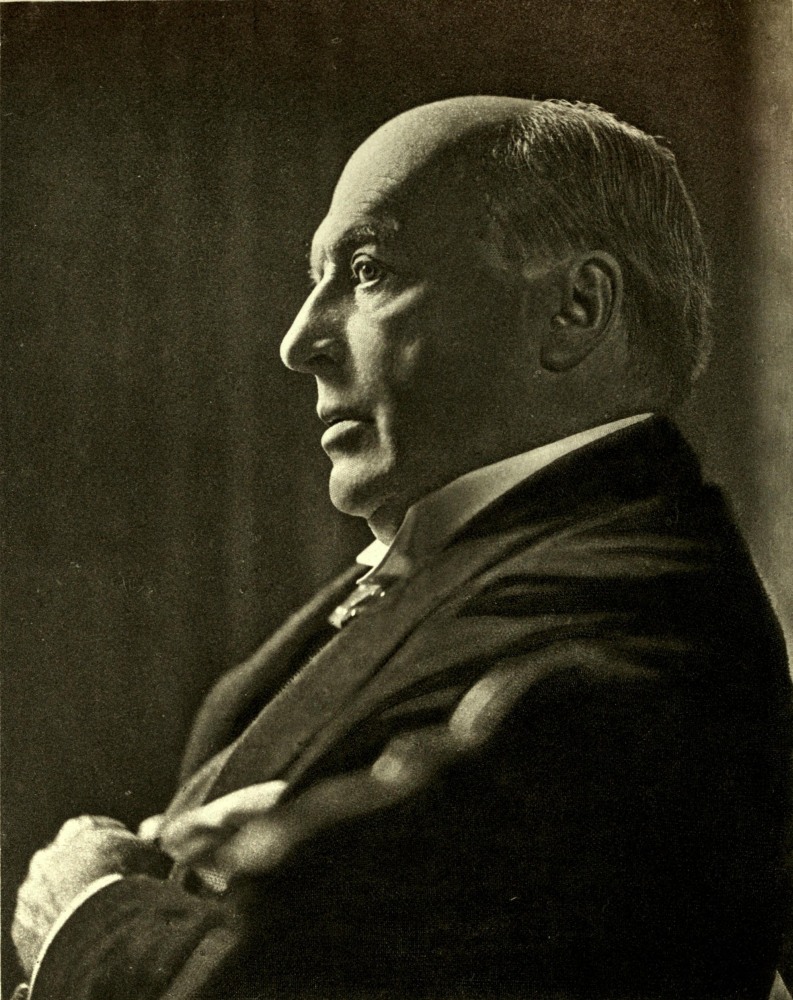
- E. O. Hoppé, photograph of Henry James (1912), frontispiece to The Letters of Henry James, volume II, selected and edited by Percy Lubbock (Charles Scribner's Sons, 1920); Project Gutenberg—the frontispiece dates the portrait and the illustration list credits its photographer.