Henry James's The Ambassadors can look inert from a distance. A middle-aged American goes to Europe to retrieve a younger man, lingers in Paris, keeps revising his judgment, and ends with more understanding than practical victory.[1][2] Reduced to plot, the novel sounds almost anti-narrative. Its force lies elsewhere. James makes delay itself into a form of action. The book moves not by event-density but by changes in perception, and its style is what makes those changes feel costly, intelligent, and irreversible.[1][4]
That is why the novel remains one of the great tests of literary patience. James does not simply ask readers to wait for Strether's conclusions. He makes them inhabit the process by which conclusions become difficult. The sentences qualify, double back, narrow their claims, and then discover that a social fact has already changed shape while they were approaching it. In The Ambassadors, style is not polish laid over insight. Style is the instrument by which insight arrives late.[1][2]
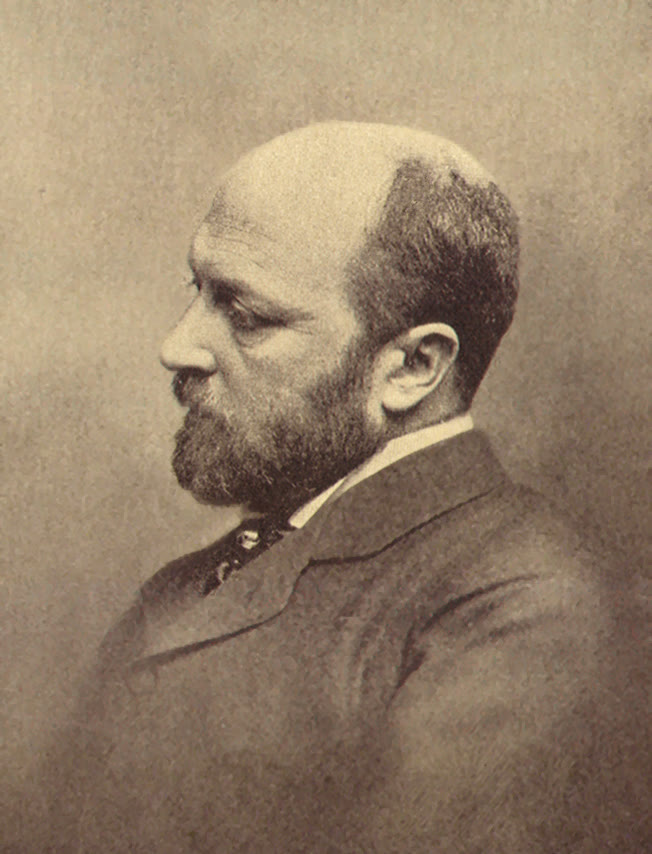
Image context: the cover image is an archival photographic portrait of Henry James from Wikimedia Commons. It belongs here as authorial context for a late-style novel whose real theater is mental bearing: attention, tact, self-correction, and the composure of a mind discovering that it has come to knowledge after the moment when knowledge could still be simple.[5]
One center, one consciousness
James says in the preface that the major formal problem was to keep the book within "one centre" and inside the hero's compass.[1] That remark is the novel's first technical key. The Ambassadors is not a diary or a first-person confession, yet it behaves as if the whole social world must pass through one nervous system before it can become legible. Paris, Chad, Madame de Vionnet, Maria Gostrey, Bilham, Waymarsh: all of them reach us under the pressure of Strether's partial understanding.[1][4]
This choice does two things at once. It gives the book extraordinary intimacy without surrendering James's analytic distance, and it turns every scene into a problem of interpretation rather than report. Strether is observant, cultivated, and more morally serious than the people who sent him from Woollett, but he is never omniscient. His intelligence is the medium of the novel; it is not a guarantee against misreading.[1][2]
That is why James's prose feels so unlike Victorian decisiveness. Instead of marching from premise to verdict, the sentences keep building a chamber around perception. They tell us what Strether notices, what he nearly infers, what he tactfully postpones, and what only later becomes undeniable. Social knowledge arrives by accretion. A James sentence often sounds as if it has learned its own point only after passing through several courteous evasions.
Qualification is the rhythm of discovery
Readers often call this style difficult, which is fair, but difficulty in James is rarely ornamental. The long clauses, the parenthetical turns, the curving syntax of correction and refinement all have a job to do. They reproduce the pressure of a consciousness that does not want to violate the scene by naming it too quickly.[1][4]
This is especially clear in the Paris chapters, where Strether gradually understands that Chad's transformation cannot be explained by the crude Woollett story he brought with him. James does not stage revelation as a clean exposure. He stages it as tonal drift. Strether keeps finding that people are more formed, relations more shaded, and motives less vulgar than the categories he arrived with. The style therefore works by graduated permissions: it lets a perception become sayable only after the sentence has tested whether the mind is ready to own it.[1][2]
Even James's omissions become stylistic events. When a crucial relation is held at the edge of statement, the prose does not feel blank; it feels charged. A phrase like "little nameless object" matters because the novel repeatedly discovers that social truth can be fully operative before it is fully uttered.[1] This is James's great late trick. Indirection does not weaken the fact. It gives the fact atmosphere, consequence, and moral temperature.
Strether's education is linguistic before it is ethical
Strether is often described as a man who learns to live, and the famous line "Live all you can" invites that summary.[1][2] Yet the novel's deeper education happens one layer earlier, at the level of language and attention. Strether learns not only that Woollett is limited, but that its language for experience is disastrously thin. The book keeps teaching him to perceive before it allows him to judge.
That is why Maria Gostrey matters so much. She is not merely a guide to Paris. She is a tutor in interpretive tempo. Around her, Strether becomes more articulate about what he sees and more cautious about premature certainty. His development is not the acquisition of cosmopolitan opinions; it is the acquisition of finer intervals between impression, phrasing, and conclusion.[1][4]
Seen this way, The Ambassadors is a novel about belatedness without self-pity. Strether has come to Europe late in life, late in freedom, late in erotic possibility, late in aesthetic surrender. James could have made lateness purely tragic. Instead he makes it stylistically fertile. The prose turns delay into a medium in which intelligence ripens. What Strether gains is not youth recovered, but a better language for what youth, opportunity, and compromise have meant all along.[1][3]
Why the style still feels modern
Britannica notes that James himself regarded The Ambassadors as his most nearly perfect novel.[2][3] The claim makes sense once the book is heard rather than merely summarized. James found a way to write social complexity without flattening it into thesis or melodrama. He made consciousness itself into plot architecture.
That solution still feels modern because our own experience is saturated with delayed interpretation. We do not meet events directly; we meet them through framing, revision, rumor, self-protective language, and after-the-fact recognition. James's late style turns those mediations into sentence form. The novel's slowness is not a defect to be excused before classroom use. It is the very shape of its intelligence.[1][4]
That is also why The Ambassadors stays moving at the end. Strether does not convert perception into possession. He leaves with understanding, and understanding arrives in a form that cannot be cashed into romance, mastery, or return. James lets knowledge remain accurate and unusable at once. Few novels make that bargain feel so exact. In The Ambassadors, late perception is not the residue after action. It is the action.[1][2]
Sources
- Henry James, The Ambassadors (Project Gutenberg HTML text, including the New York Edition preface).
- Encyclopaedia Britannica, "The Ambassadors".
- Encyclopaedia Britannica, "Henry James".
- Library of America, Henry James: Novels 1903-1911 (volume page covering The Ambassadors, The Golden Bowl, and related late works).
- Wikimedia Commons, "File:HenryJamesPhotograph.png" (archival photograph provenance).