The family is already happy. That is the difficulty in Thomas Hardy's “The Self-Unseeing.” A woman smiles by the fire, a man plays music, and a child dances. Nothing interrupts them. The poem's sting comes afterward, when the remembered evening acquires a value its participants apparently failed to see.[1]
It would be easy to turn these twelve lines into an instruction to appreciate what we have. But the dancing child makes that instruction awkward. What would better appreciation have looked like? Stopping the dance to consider how much it would one day be missed?
Published in Poems of the Past and the Present, whose first edition appeared in 1901 with a 1902 date, the poem makes its collection's title almost a set of stage directions.[1] Past and present occupy the same room. They cannot quite look each other in the face.
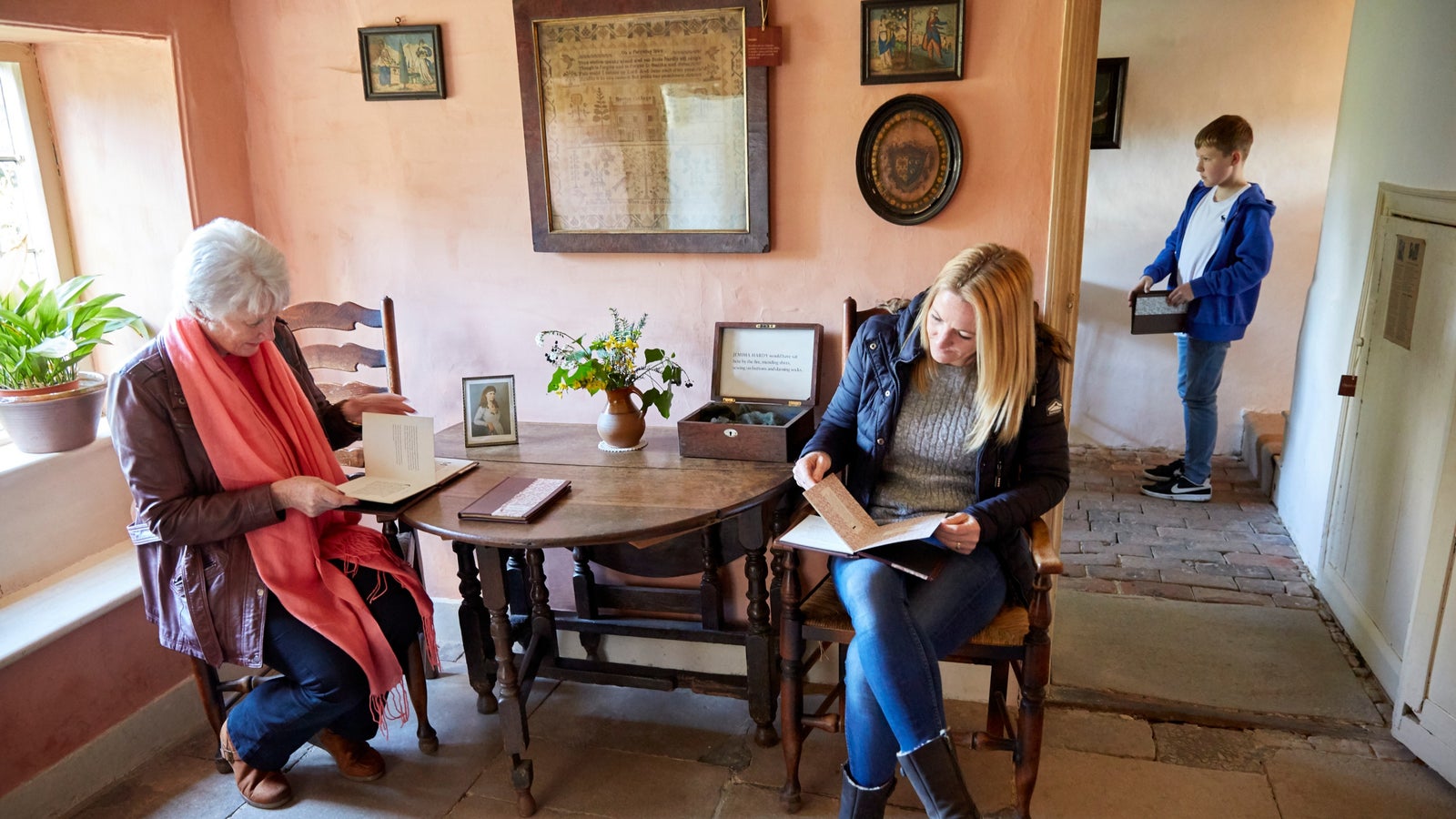
The floor stays in the present
The first stanza begins with something solid:
Here is the ancient floor,
Footworn and hollowed and thin,
Here was the former door
Where the dead feet walked in.[1]
The crucial change is smaller than the nouns. The floor “is”; the door “was.” Before the poem supplies a person, its verbs divide the room between what remains and what has disappeared. The repeated “Here” sounds like someone pointing out familiar features to a companion. Yet the pointing cannot restore them.
“Footworn” gives the floor an intimate kind of history. It has been altered by use, by people doing nothing more exceptional than entering and leaving. The three descriptions make that ordinary traffic palpable: worn, hollowed, thin. A household has worked itself into the surface beneath it.
Then the feet become “dead.” The word reaches backward from the speaker's present into the remembered movement. Those feet were alive when they crossed the threshold; only the person looking back can describe them this way. We are made to see the room through knowledge its inhabitants did not possess.
That knowledge matters to the ending. The speaker's extraordinary attention has a cost. He can read the floor because he knows what it has outlasted.
Music puts the people back
In the second stanza, the room fills. “She” sits by the fire; “He” stands playing.[1] Hardy does not give them names or explain their relationships. The pronouns assume an intimacy that needs no introduction, even though a stranger reading the poem lacks it.
The family context helps without exhausting the scene. The Thomas Hardy Society describes Hardy's father as a builder with a passion for music, an enthusiasm passed to his son.[2] Critic Geoffrey Harvey reads the poem as a memory of Hardy dancing to his father's violin while his mother sits beside the fire.[4] The National Trust's account of the cottage parlour, where the family played music and socialised at the hearth, gives that reading a material setting.[3]
Within the poem, however, we encounter gestures before biography. Sitting, smiling, standing, bowing: each person has a position and an activity. The room is sufficiently small for “here” and “there” to organise an entire world.
The music briefly loosens the first stanza's severity. “Bowing it higher and higher” extends the movement beyond a single stroke.[1] The repeated word seems to ask for another lift, another moment. When the next stanza brings in the dancing child, sound has become bodily motion. The floor that bore the dead feet now supports a living response.
Hardy's alternating rhymes also keep the little scene together. Floor answers door; chair answers there. The poem makes a pattern of the place even while its verbs tell us that the place cannot preserve everything. Its order offers the reader a momentary experience of belonging.
Who decides that the child was dreaming?
The child enters as “I,” but with a qualification: “Childlike, I danced in a dream.”[1] The speaker can remember the action more confidently than the consciousness inside it. “Dream” gives the dancing a lovely absorption and, at the same time, makes it available for criticism. Perhaps the boy was too absorbed to understand.
The stanza then grows unusually bright. Blessings are emblazoned; everything glows. The clustered sounds in “glowed with a gleam” thicken the radiance.[1] We have moved from the worn texture of the floor to a scene lit by remembered feeling.
Whose light is this? The poem leaves room for two answers. The family may have possessed a happiness they failed to recognise. Or the speaker's later loss may be what makes that ordinary evening shine so intensely. These possibilities can coexist: an experience can have been good without having felt, at the time, like a treasure being lost.
Harvey's 1978 essay gives the scene a sterner reading. He argues that the three figures remain absorbed in themselves, missing the deeper connection made possible by their shared place. Their pleasure becomes a form of escape rather than full recognition.[4] That account takes the closing reproach seriously. I find the dancing child a reason to hesitate before accepting it completely. His response to the music is already a response to another person. The poem shows participation as well as withdrawal.
The distinction changes the emotional pressure. A child need not possess an adult's retrospective understanding to be present at an evening's joy. Yet the adult cannot stop wishing that the child had somehow known.
The last rhyme carries us away
“Yet we were looking away!” ends the poem.[1] The pronoun gathers the separate figures into a group at precisely the moment their attention is declared to have wandered. Earlier there was she, he, and I. Now there is we.
The speaker therefore includes himself in the failure. This is no accusation delivered safely from outside the family. Nor does the line tell us what distracted them. The woman looks into the fire; the man and child are occupied with music and movement. Their supposed inattention has no simple villain.
The final rhyme makes the loss audible. “Away” answers “day”: the sound completes the stanza while the meaning turns from the occasion it has just illuminated.[1] Form supplies closure; memory supplies dissatisfaction. We reach the right ending and wish it could have been otherwise.
That is why the poem survives its obvious moral. It makes the injunction to notice happiness feel both urgent and difficult. Looking back can reveal what an experience meant, but it cannot send that knowledge into the room in time. The floor remains. The music can be imagined. The child is still dancing, unable to know how carefully he will one day be watched.
Sources
- Thomas Hardy, “The Self-Unseeing,” Poems of the Past and the Present, pp. 441–442 in the 1919 Macmillan edition — primary text and the edition history identifying first publication as 1901, dated 1902. Project Gutenberg.
- Thomas Hardy Society, “Life of Thomas Hardy” — the childhood household at Higher Bockhampton and the musical interests of Hardy and his father.
- National Trust, “Things to see and do at Hardy's Cottage” — the parlour's domestic and musical uses, the childhood home, and the photograph credited to National Trust Images/Arnhel de Serra.
- Geoffrey Harvey, “Thomas Hardy's Poetry of Transcendence,” ARIEL, vol. 9, no. 4 (October 1978), especially pp. 10–11 — a critical reading of the family's absorption, shared place, and missed recognition; journal record with downloadable full text.