Anna Tellwright is peeling potatoes when her father calls her into his office to tell her she is rich. She signs the documents, holds them briefly, and agrees that he should keep them. Then she returns to the kitchen and peels more carefully, making the skins almost transparent. In chapter III of Anna of the Five Towns, a fortune arrives without disturbing the household's economy of obedience.[1]
That thinner potato peel is an exquisite disappointment. Money ought to enlarge the scene: new clothes, a journey, a room of one's own. Instead, Anna responds by making herself still more economical. Bennett puts the evidence of her upbringing into her hands. Her circumstances have changed faster than her gestures can.
Published in 1902, the novel asks what ownership can mean to a woman trained to experience another person's wishes as necessities. Anna's difficulty is more intimate than ignorance of banking. She has trouble imagining that her own judgment could be sufficient reason to act.[1]
This essay discusses developments late in the novel.
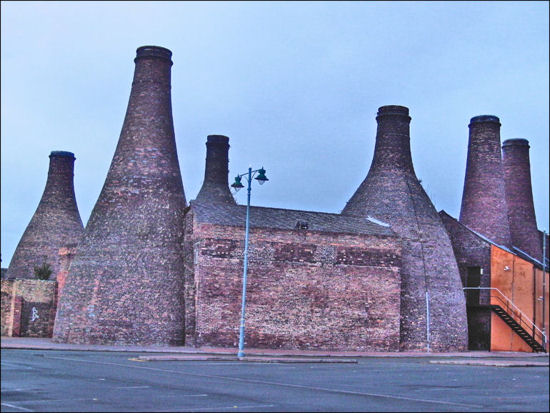
Bennett grew up in the Staffordshire Potteries, renaming its towns for his fiction and leaving Fenton out of his literary five.[2] The photograph shows one surviving part of that manufacturing landscape: buildings at the former Gladstone works largely date from around 1860 onward.[3] Such places matter to Anna's story because her wealth includes a factory occupied by tenants. An inheritance is also a relationship with people who must produce something before they can pay her.[1]
When the securities are enumerated, Bennett compares Anna to a child given a traction engine to play with in a backyard. The comparison is comic, but it refuses to make wealth weightless. This gift is huge, powerful, and grotesquely unsuited to the space in which its recipient knows how to move. Her question is practical: “What am I to do with it?” Her father's answer amounts to preserving it.[1]
For Ephraim Tellwright, accumulation almost completes the purpose of money. Anna's question threatens to introduce other purposes. What might it relieve? Whom might it help? What might she want? At this point she cannot formulate those possibilities, and the papers pass back into his keeping. The little ceremony confers adult standing while rehearsing dependence.
Yet Anna is allowed to exercise authority when someone poorer must feel it. In chapter VI, her father sends her to deal with Willie Price about the rent. She wants to be kind and speaks coldly; she imagines forgiving the arrears and asks about payment instead. Bennett lets us hear the two versions of the conversation, one inward and one spoken.[1]
The discrepancy prevents us from treating her harshness as a transparent expression of character. It also prevents an easy acquittal. Willie has to answer the words she says, whatever generous feelings remain unspoken. Anna is simultaneously subject to her father and powerful in relation to her tenant. Sympathy becomes uncomfortable precisely because both positions are real.
Her religious aspirations sharpen the discomfort. The wish to follow Christ supplies a language in which mercy matters, while the household supplies the habits that make collecting a debt seem unavoidable. These claims meet inside one hesitant person. Anna cannot resolve them merely by feeling more sincerely. Someone must receive a different answer.
In chapter XI, a forged bill of exchange finally makes that difference urgent. Willie has confessed, and Anna means to persuade her father to surrender the document. She rehearses a magnificent confrontation. Then he snaps about her younger sister's bedtime, and her prepared courage collapses before she has begun.[1]
Bennett gives the defeat a painfully small trigger. Ephraim does not refute her argument; he restores the familiar atmosphere in which she cannot deliver it. Readers who demand one decisive declaration of independence have to sit through the household routine that makes declaration so difficult.
The action comes later, without an audience. Anna goes downstairs and burns the bill. The bureau is unlocked: fear has done the work of a key. Her hand can cross a boundary her voice could not cross in his presence. When she eventually tells him, her defense is “It was mine, really.”[1]
The qualification is heartbreaking. Really ought to settle the question, yet it sounds like an appeal for confirmation. Anna asserts ownership while still addressing the person from whom she expects permission. Her rebellion contains the accent of her submission.
Nor does Bennett make the burning an uncomplicated moral victory. The bill involves a forged signature, and Anna's mercy cannot erase every other person's interest in the affair. The force of the scene lies in her willingness to judge and bear consequences. She acts before she has acquired either serene confidence or an argument that will satisfy everyone.
A later confrontation, in chapter XIII, concerns money for her wedding preparations. Anna repeats: “I'm only asking you for my own money.” This time persistence wins her the cheque-book and pass-book. Almost immediately, she asks her fiancé, Henry Mynors, to manage her finances after marriage.[1]
The sequence makes progress look uneven. Henry offers assistance and a more cheerful prospect; accepting help need not itself cancel independence. But Anna is also transferring responsibility just as she has secured the means to exercise it. Bennett leaves us watching the difference between choosing whom to trust and escaping the habit of entrusting every consequential choice to someone else.
Penguin's 2016 edition presents the novel through parental tyranny and rebellion, a durable account of its appeal.[4] The rebellion is especially persuasive when read through its awkward scale: a sentence withheld, a sheet of paper destroyed, a demand repeated. Anna does not become another person whenever she resists. She carries her training into resistance, and that is what makes her recognizable.
At the birthday bureau, she can sign her name before she can imagine what her signature permits. By the later scenes, she has begun to discover that ownership requires decisions which may disappoint the people she loves. The fortune can be handed over in an afternoon. Learning to call a decision her own takes much longer.
Sources
- Arnold Bennett, Anna of the Five Towns (1902), chapters III, VI, XI, and XIII — primary text for the inheritance, rent interview, forged bill, and wedding-money scenes; Project Gutenberg transcription of a later Methuen edition.
- Arnold Bennett Society, “The Five Towns” — Bennett's Potteries upbringing and his transformation of the six towns into a fictional five.
- The Potteries, “Listed Buildings in Stoke-on-Trent and area: Gladstone museum, Longton” — architectural history and Chris Oldfield's 2007 photograph of six kilns at Gladstone Pottery.
- Penguin, Anna of the Five Towns, Penguin Classics edition published 25 August 2016, ISBN 9780241255773 — modern publication context and the publisher's framing of Anna's struggle with parental authority.