The boy gets the golden key almost immediately. That is the first surprise in George MacDonald's fairy tale: the treasure arrives before he knows what to do with it. His earlier suggestion that he might sell it earns a brisk reply from his great-aunt: “Better never find it than sell it.”[1]
Selling would give the adventure a convenient ending. The thing would acquire a price, and the boy could spend it. Keeping it means accepting an unanswered question.
First published in Dealings with the Fairies in 1867, “The Golden Key” follows Mossy and a girl called Tangle into a world where growing older can bring you closer to childhood.[1] Its images invite interpretation so insistently that it is tempting to treat the story as a puzzle with a hidden solution. Yet its pleasure lies in watching familiar things change their demands on us. A key, a shadow and a stair each promise something recognizable; each makes recognition insufficient.
This essay discusses the ending.
A key that gives its owner work
At Grandmother's cottage, Mossy asks for help finding the lock. She assigns the search to him: “That is your work.”[1] The possessive matters. Having the object makes him responsible for a task that nobody can complete on his behalf.
A key usually offers practical certainty. Its shape has been determined by a particular mechanism; somewhere, one thing should fit another. MacDonald borrows that reassuring precision while withholding the mechanism. We can understand why Mossy keeps looking without being able to tell him where to look.
I read the key as a promise whose value must be discovered through use. Calling it faith is a plausible beginning, but the label alone misses its peculiar inconvenience. It can be held securely while its purpose remains obscure. The story lets confidence and bewilderment occupy the same hand.
That combination also describes the reader's position. We have the title from the outset. We expect the named object to explain the story eventually. As the journey grows stranger, we discover how little a title guarantees: it identifies what to attend to without telling us what attention will yield.
Shadows that teach desire
In the valley, the travelers encounter beautiful shadows whose sources remain invisible. Their delight becomes a longing to reach the beings casting them; later, thickening darkness separates the companions.[1]
These changes make the shadow the tale's most unstable image. Ordinarily, a shadow is useful because we can connect it to a body. Here the connection has become a hope. The characters experience enough beauty to want more, but cannot inspect the original.
The distinction between delight and possession is crucial. A pleasant spectacle might simply persuade them to stay. This one makes staying inadequate. Its loveliness gives them a destination they could not previously have imagined, then leaves them with the difficulty of getting there.
Their separation complicates the invitation. Beauty does not guarantee that the next step will be comfortable, or that two people will experience it together. The same image can awaken desire and obstruct companionship. Assigning shadows a single meaning would flatten that emotional movement.
MacDonald's own account of fairy tales helps here. In “The Fantastic Imagination,” he argues that readers bring different capacities to a story and that its work includes awakening thought. He compares the experience to music, whose force need not resolve into one proposition.[2] This gives us a way to read the valley without treating its changing atmosphere as a failure of symbolic consistency. The sequence of feelings is part of the meaning.
The stair changes the use of the key
Mossy first sees people ascending inside the rainbow. Near the end, his key opens a stair through rock to a hall where Tangle is already waiting. It later opens a rainbow pillar; the key disappears, and the pair begin climbing within the rainbow themselves.[1]
The recurrence turns spectators into participants. What began as a picture to admire becomes an experience they can enter. The story earns its sense of completion through that change in relation: the image returns, and the people encountering it have changed.
Tangle's presence in the hall matters just as much as Mossy's arrival. She has traveled without possessing the title's treasure. We should therefore hesitate before making ownership of the key a universal measure of worth. It belongs to his route; her journey has its own demands and discoveries. Their reunion allows experience to be shared without making the experiences identical.
The disappearing key is a particularly elegant touch. A souvenir would preserve Mossy's status as the person who found something extraordinary. Its disappearance directs attention toward what the finding enables. Once the passage is open, the object has finished its work.
The stair, meanwhile, preserves motion inside the happy ending. We receive the satisfaction of a pattern coming together without a final inventory of everything the destination contains. The promise becomes more intimate as it becomes less possessible.
What remains beyond the last page
There is a religious argument beneath this movement. Marilyn Pemberton reads “The Golden Key” alongside At the Back of the North Wind as MacDonald's response to anxiety about death and immortality: fairy tale gives him a form in which death can become passage into a fuller existence.[3] That reading has explicit support in Mossy's encounter with the Old Man of the Sea, who describes death as “only more life.”[1]
Yet recognizing the argument does not exhaust the reading experience. A statement about immortality can be understood immediately. The tale asks us to live for a while with a promise we cannot immediately interpret, with beauty we cannot keep, and with another person's route we cannot take over.
MacDonald's defense of imaginative openness is useful precisely because it leaves room for such differences of emphasis.[2] A reader may attend most closely to faith, another to companionship, another to the changing meaning of growing old. Each reading still has to answer to what happens to the objects.
The key gives Mossy a task. The shadows give the companions a desire. The stair lets them act on it. By the time they climb, finding the treasure has become the least complete thing that could have happened to them.
Sources
- George MacDonald, “The Golden Key,” first published in Dealings with the Fairies (1867) — complete primary text, especially the opening exchange, Grandmother's instructions, the shadow valley and the final two locks. George MacDonald Society.
- George MacDonald, “The Fantastic Imagination” — the author's discussion of fairy tales, readers' differing interpretations and the analogy with music. George MacDonald Society.
- Marilyn Pemberton, “The Ultimate Rite of Passage: Death and Beyond in ‘The Golden Key’ and At the Back of the North Wind,” North Wind, vol. 27 (2008), pp. 35–50 — especially the introduction's account of fairy tale, mortality and the promise of an afterlife. St. Norbert College repository record.
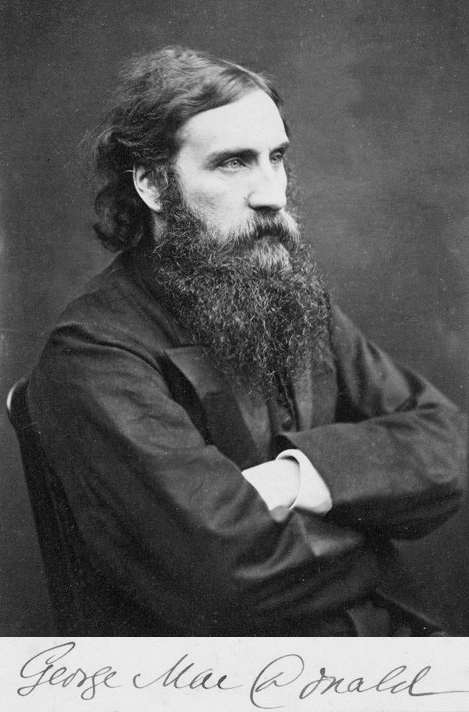
- Wikimedia Commons, “George MacDonald 1860s.jpg” — digital reproduction of William Jeffrey's albumen portrait, with National Portrait Gallery provenance and identifying metadata for NPG P36.