A white hat floats beside a ship in the dark. Its owner has given it to a fugitive, who has slipped overboard; now the captain needs that small patch of brightness to discover which way his vessel is moving. The most useful object in Joseph Conrad’s “The Secret Sharer” has become useful by getting away from both men.[1]
The scene is exhilarating. A near disaster becomes a successful maneuver; an inexperienced commander begins to trust himself. Yet the hat also interrupts the captain’s fascination with his own reflected image. For a few decisive seconds, he must read something outside himself. That change of attention gives the ending its force—and leaves room to question the confidence with which he narrates it.
This essay discusses the ending.
A resemblance made in the cabin
At the beginning of section I, the unnamed captain looks across the Gulf of Siam at a world apparently without divisions. Sea and shore seem joined into one continuous surface. The stillness is beautiful, but it is also difficult to read: a commanding view provides surprisingly little information about movement or distance.[1]
Conrad makes that visual uncertainty rhyme with the captain’s private uncertainty. He has only recently joined the vessel and admits to being a “stranger to myself.”[1] The phrase quietly unsettles the authority of everything that follows. An officer can receive command before he possesses a usable account of the person who will exercise it. His problem is not simply lack of experience. He wants to know what kind of man the experience will disclose.
Leggatt seems to arrive as an answer. The swimmer climbs aboard at night, accepts the captain’s spare sleeping suit, and tells him that he killed a sailor on another ship. Their matching clothes help turn physical likeness into a feeling of intimate recognition. Notice the order: the captain dresses the stranger as another version of himself before he hears the whole story.[1]
That sequence makes the scene more troubling than a neutral assessment of testimony. Sympathy is already arranging the evidence. When Leggatt announces the killing, the captain supplies “Fit of temper” as a possible explanation.[1] He is helping the stranger find the shape of his account. The apparent mirror works in both directions: Leggatt gives the captain someone to recognize, while the captain gives Leggatt a listener disposed to understand.
This need not make their connection false. It makes it interested. The reader can feel the relief of finding a confidant without treating resemblance as proof of innocence. Conrad’s intimacy is persuasive precisely because it lets us experience how quickly an emotional need can become a conviction.
The question from the deck
The historical material gives that conviction an uncomfortable background. Royal Museums Greenwich records that, aboard Cutty Sark, first mate Sydney Smith fatally injured sailor John Francis. Captain James Smith Wallace subsequently let Smith escape at Anjer; the crew reacted with anger. Historian Robert D. Foulke identifies this incident as a source for part of Conrad’s story.[3][4]
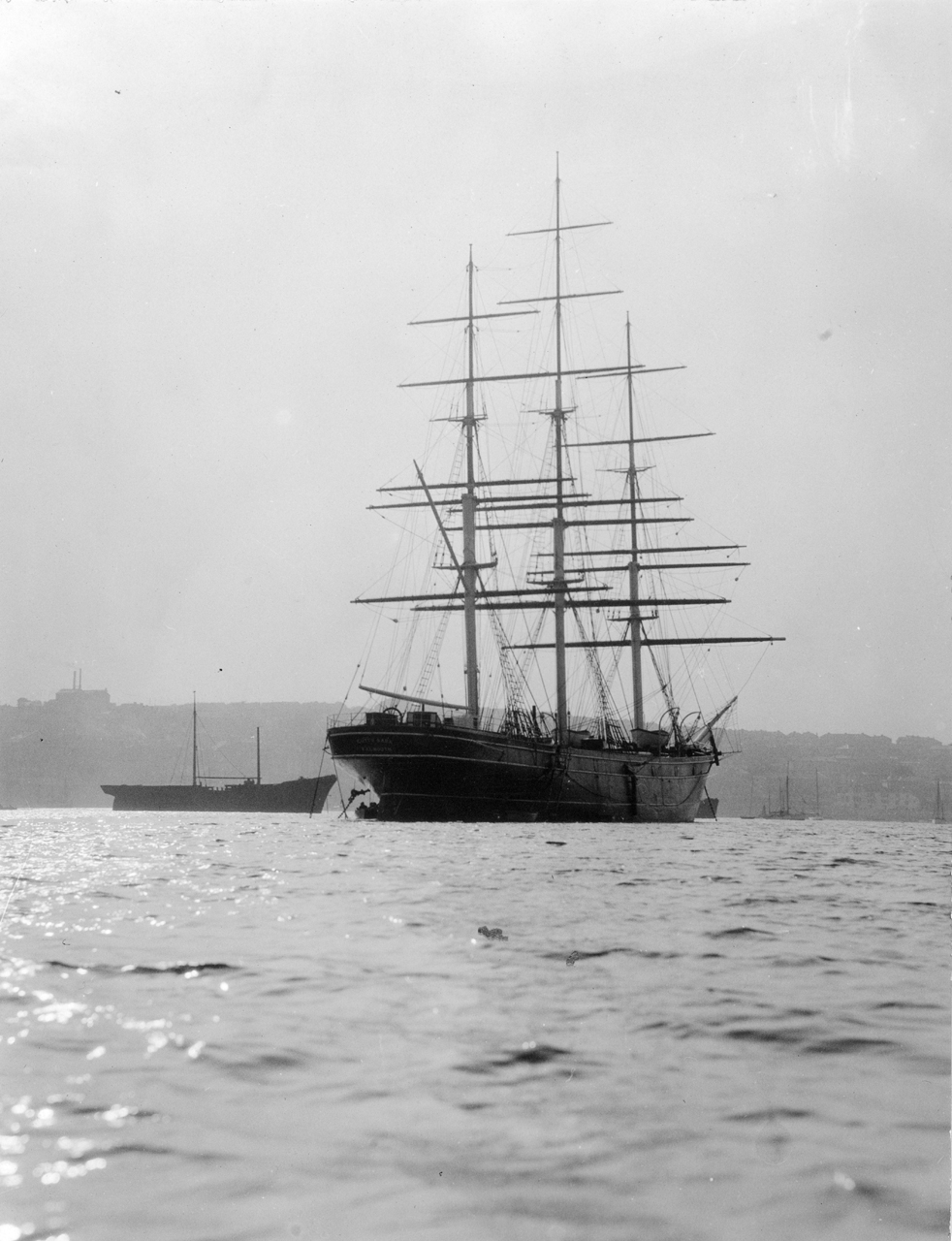
The photograph above shows Cutty Sark decades later, at Falmouth in 1930.[5] Its rigging and hull restore some material scale to a tale easily reduced to two minds in a cabin. Command also involves a large, vulnerable object and the people required to move it.
Conrad’s story is no documentary reconstruction of that killing. Its first-person narration invites us into a particular act of solidarity. But the historical parallel makes one distinction worth keeping: a captain’s loyalty to an officer can look very different to the sailors whose lives are under their authority.
That difference becomes audible near the end of section II. To give Leggatt a chance of reaching land, the captain takes his ship dangerously close to Koh-ring. The mate asks, “What are we doing here?”[1] Within the narrator’s account, the mate often seems ridiculous, all agitation and extravagant whiskers. His question, however, is entirely reasonable.
The pronoun matters. We includes the men who must execute orders without knowing the private obligation behind them. The captain’s secret gives him a purpose; it denies his crew an explanation. Read from the deck, this is a collective danger organized around a relationship almost nobody aboard knows exists.
The scene therefore asks the reader to do two things at once: share the captain’s suspense and retain the mate’s question. Conrad can make the escape feel necessary without making its cost disappear.
What the hat actually tells him
Just before Leggatt leaves, the captain imagines the fugitive exposed to the sun and presses his hat on him. It is a touchingly ordinary concern, especially after so much language of doubles and mysterious understanding. A human head will get hot. Affection briefly becomes attention to a bodily need.[1]
Then the hat returns as something neither man has planned. Beside the dark island, in light wind and smooth water, the captain cannot feel how the vessel is moving. The floating hat appears to travel forward along her side. He recognizes that she has gathered “sternway”: she is moving backward through the water, and he orders the helm shifted.[1]
The distinction is essential to the passage. The hat supplies a visible reference for relative motion. It does not pronounce on Leggatt’s character or certify the captain’s decisions. Its authority is narrow and practical. It answers the question the water can answer.
Here the story’s visual pattern changes. At first the captain finds reassurance in someone who resembles him. Now he has to respond to an object that behaves independently of his wishes. The hat’s small, indifferent movement is more useful than another moment of inward certainty. My reading is that this outward attention, as much as the bond with Leggatt, makes his successful command possible.
There is no need to turn the hat into a fixed code for conscience, maturity, or absolution. Its power comes from the way its uses accumulate. A possession becomes a gift; the gift becomes an accidental aid to navigation. The symbolic richness depends on its stubborn usefulness as a thing.
Who gets the last word
The story’s critical afterlife has preserved the tension between self-discovery and responsibility. In his 1954 essay “Conrad’s Two Stories of Initiation,” Carl Benson disputes Albert Guerard’s account of the tale as a psychological journey into a primitive self. Benson’s published notes also question the captain’s closing ideal of “perfect communion” with his ship, setting it against the more demanding human fellowship he finds in The Shadow-Line.[2]
That disagreement helps keep the ending open. The captain has accomplished something real. He has also survived a danger he chose to create. Those statements can coexist. A successful maneuver cannot retroactively give the crew knowledge or choice, and the reader never receives a viewpoint independent of the captain that settles every claim he makes for Leggatt.
The final glimpse of the hat is beautifully spare. What remains visible is a trace of departure, while the swimmer’s future passes beyond the captain’s sight. We can accept the relief of the ship turning safely without extending that relief into a universal verdict. The hat has helped him learn which way he is moving. Whether he has learned everything he needs to know about command is left with us.
Sources
- Joseph Conrad, “The Secret Sharer,” sections I–II, in ’Twixt Land & Sea—primary text; this digitized 1920 printing records the collection’s first edition in October 1912. Project Gutenberg.
- Carl Benson, “Conrad’s Two Stories of Initiation,” PMLA 69, no. 1 (March 1954), pp. 46–56—publicly accessible extract and notes 4–5 on the ending and Guerard’s interpretation.
- Royal Museums Greenwich, “Meet the captains of Cutty Sark”—James Smith Wallace section, covering the killing of John Francis, Smith’s escape, and the crew’s response.
- Robert D. Foulke, “Life in the Dying World of Sail, 1870–1910,” Journal of British Studies 3, no. 1 (November 1963), pp. 105–136—publicly accessible note 62 identifies the Cutty Sark incident as source material for Conrad’s story.
- Royal Museums Greenwich, Cutty Sark (1869), photographic negative P70157, dated 12 September 1930—collection record and source of the Falmouth photograph.