On 7 December 1995, Seamus Heaney stood before the Swedish Academy and delivered Crediting Poetry, the lecture that now sits beside his poems as one of the clearest statements of what he thought lyric language owed the world.[2][3] The occasion was formal, but the argument is not ceremonious. Heaney uses the lecture to ask how poetry can stay answerable to violence, public pressure, history, and ordinary feeling without flattening itself into reportage or retreating into private music.[2][4][5]
That question had particular weight for him in 1995. By then Heaney had moved from the rural world of County Derry that formed Death of a Naturalist toward a body of work that also carried the pressure of Northern Ireland's political fracture, classical translation, literary criticism, and public expectation.[4][5] The Nobel citation praised the "lyrical beauty and ethical depth" of his writing, which is useful because the lecture keeps those two qualities in active tension rather than allowing either one to dominate the other.[3]
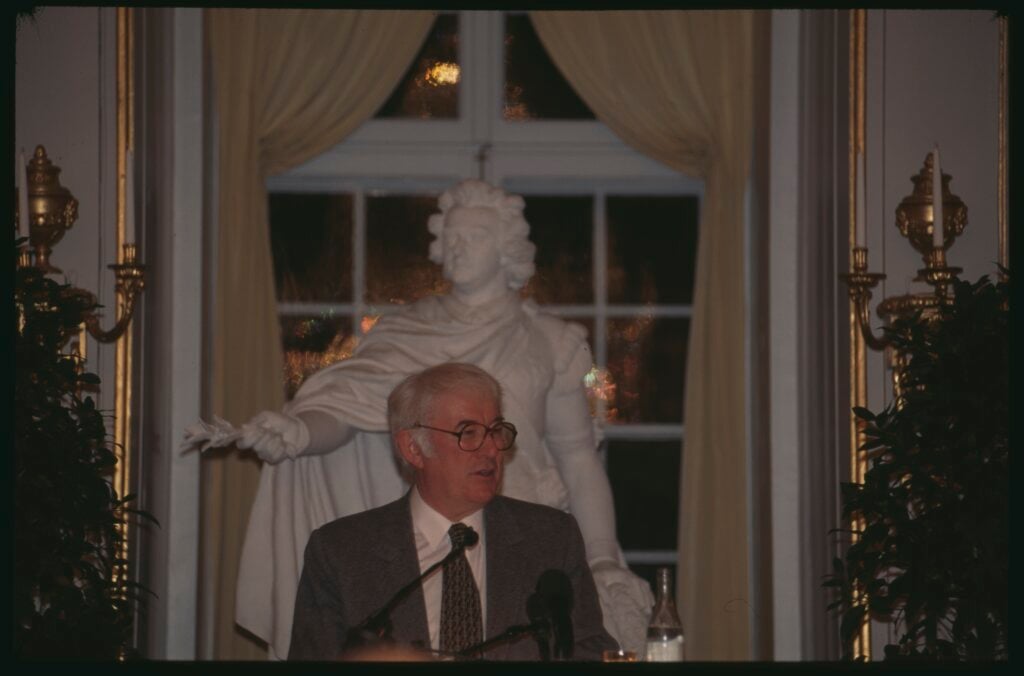
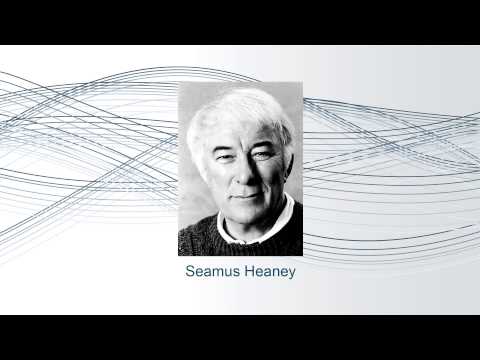
This is also why the archival record matters. The official Nobel Prize YouTube embed below is not a full camera document of the hall. It is an official audio transfer uploaded in 2013, presented over a static portrait card, while the lecture page preserves a still photograph of Heaney at the Swedish Academy from the Lars Aström archive.[1][2] That combination turns the piece into a different kind of historical object. You do not study it for stage movement or audience reaction. You study it for cadence, pacing, and how a public literary argument survives when voice does almost all of the work.
Image context: the cover uses the archival lecture photograph on NobelPrize.org rather than a generic author portrait. That choice matters because this article is about one exact literary event, and the image fixes Heaney inside the ceremonial room where his private vocabulary of childhood listening had to prove itself as public speech.[2]
Historical context: why this lecture had to sound grounded
Heaney's biography helps explain why Crediting Poetry opens where it does. The lecture begins in childhood, with a family farm, a scullery bucket, a railway line, and the household wireless.[2][4] That is not decorative autobiography. It is Heaney's way of showing that poetry begins for him in a divided field of attention: rural intimacy on one side, broadcast history on the other, with language already arriving as sound before it hardens into argument. The Nobel biography underlines how central this double inheritance was for him. His father's cattle-dealing life tied him to an older agrarian world; his mother's family connected him more directly to the industrial Ulster of the linen mills.[4]
That doubleness runs through the rest of his career. Britannica's summary of the books is useful here because it shows how far the early rural precision of Death of a Naturalist and Door into the Dark had already traveled by the time he reached Stockholm.[5] Heaney had written through the pressures of Northern Irish violence, through the denser historical weather of North, and through later books whose language became more spacious without losing pressure.[4][5] By 1995 he was not simply a poet of memory. He was also a poet repeatedly asked what poetry should do in a damaged civic world.
The Nobel biographical page makes that pressure explicit. It describes a society "deeply divided along religious and political lines" and notes Heaney's preoccupation with poetry's responsibilities and prerogatives under those conditions.[4] That phrase is the hinge for the whole lecture. Heaney is not trying to prove that poetry can replace politics, repair history, or purify public life. He is trying to define the narrower but harder task poetry can still perform: preserving exact feeling and exact thought when public language is already overclaimed by factions, slogans, and injury.[2][4]
This is why the lecture keeps returning to examples of balance. Heaney wants forms that can register the hardness of the world while still protecting what he elsewhere calls the vulnerable part of consciousness.[2] The rural opening matters because it establishes receptivity. The later references to Yeats, Wilfred Owen, Mandelstam, Homer, and others matter because they widen that receptivity into an ethics of reading and making.[2][5] The lecture's historical moment is therefore not just "Nobel Prize winner speaks." It is a poet from a place of intense rhetorical pressure explaining, at the height of international recognition, why poetic form still deserves trust.
What the archival recording preserves
Because the YouTube upload is built around a static portrait card, the listener is pushed toward the texture of Heaney's delivery rather than toward spectacle.[1] That turns out to be a strength. Heaney's authority in this lecture does not come from performance flourishes. It comes from a steadiness that lets one sentence settle before the next widens it. The voice moves with enough patience to keep memory, literary criticism, and civic seriousness in one current. In an age of clipped literary clips and overproduced panels, the recording's restraint feels almost methodological.
The lack of moving images also creates an instructive split between sources. The lecture page gives you the still photograph of Heaney at the academy, the transcript gives you the architecture of the argument, and the embed gives you timing, breath, emphasis, and the scale of the pauses.[1][2] Together they show that Crediting Poetry was never only an essay. It was a spoken act of arrangement. Heaney keeps bringing unlike things into one line of force: farm sounds and radio signals, lyric pleasure and historical brutality, moral witness and formal satisfaction.[2]
That matters because the lecture's central claim depends on tone as much as on thesis. If Heaney sounded merely rhapsodic, the civic edge would disappear. If he sounded merely dutiful, the lecture would betray its own defense of poetry. The audio record lets you hear how he avoids both traps. He sounds measured, but not bloodless; ceremonious, but never inflated. The medium is spare, and that spareness ends up proving his point that poetry's power can survive with very little apparatus so long as the language remains proportionate to experience.[1][2]
How Crediting Poetry builds its case
The first major movement of the lecture turns childhood listening into a theory of poetic formation.[2] Heaney remembers the household radio, foreign station names, wartime bulletins, and the sensation of the local world vibrating alongside distant events. That memory matters because it lets him define poetry as a way of holding inwardness open to history without letting history fully colonize inwardness. He does not present childhood as innocence that should be protected from the world forever. He presents it as a chamber where sensations, names, and pressures first became available for shaping.
The next movement raises the stakes. Heaney recounts how his own temper initially favored poems that felt concrete, reliable, and answerable to things as they are, then widens the field through examples from the tradition.[2] This is where the lecture becomes more than memoir. Keats, Hopkins, Frost, Owen, Yeats, and others arrive as tests for what poetry can bear. Heaney's point is not that one school of writing defeats another. It is that the best poems manage a difficult double allegiance: they remain true to the unsympathetic facts of the world while also preserving a note of trust, sweetness, and imaginative rightness that brute fact alone cannot generate.[2][5]
His treatment of Yeats is especially revealing.[2] Heaney is interested not only in historical witness but in the way poetic form can steady a consciousness under pressure. Repetition, rhyme, stanza shape, and tonal balance are not decorative surfaces in this account. They are instruments by which language can resist both sentimental evasion and ideological hardening. That is why the lecture still reads as a major literary statement. It argues that form is part of truth, not a veil laid over truth after the fact.
Seen this way, the lecture also clarifies the Nobel citation. "Ethical depth" in Heaney does not mean correct opinion delivered in elevated diction.[3] It means a disciplined refusal to let moral seriousness cancel lyric complexity, or let lyric pleasure float free of the world's damage. The lecture gives you the blueprint for that refusal. It is calm, learned, and deeply self-aware, but it is never abstract for long. Again and again Heaney returns the argument to sounds, remembered objects, verbal textures, and the physical sensation of words landing in the ear.[2][4]
Why this archive still matters
What survives in this archival bundle is therefore larger than a prize ritual. The image fixes a public occasion. The transcript preserves the argument. The official YouTube upload preserves the voice's composure and pace.[1][2] Taken together, they make Crediting Poetry available as a living explanation of why Heaney mattered: not because he solved the problem of history for poetry, but because he kept showing how a poem might remain porous to history without surrendering its music.
That is why the lecture still feels current. Contemporary literary culture often swings between two bad habits: reducing poems to moral position-taking, or treating style as a sealed aesthetic zone. Heaney's lecture holds open a harder middle. Poetry, in his account, earns its credit when it gives the mind a form sturdy enough to face damage and supple enough to keep human sympathy from freezing over.[2][4][5] The archival recording, precisely because it is so spare, lets that claim arrive without distraction.
Sources
- Nobel Prize, "Nobel Lecture by Seamus Heaney," YouTube video, uploaded August 30, 2013.
- Nobel Prize, "Seamus Heaney - Nobel Lecture: Crediting Poetry" (lecture transcript, event photo, and audio reference).
- Nobel Prize, "Seamus Heaney - Facts" (1995 Literature Prize citation and career summary).
- Nobel Prize, "Seamus Heaney - Biographical" (family background, career context, and public-pressure framing).
- Encyclopaedia Britannica, "Seamus Heaney" (biography, books, and literary positioning).