The opening scaffold scene in The Scarlet Letter is easy to remember as a single emblem: woman, child, crowd, red letter.[1][2] Hawthorne makes it stranger than that. The punishment is public, but the scene never settles into the clean stillness of a moral illustration. Bodies keep shifting, the narrator keeps adjusting distance, and Hester Prynne refuses to become identical with the sign meant to finish her.[1] What looks like a freeze-frame of shame turns out to be a slow-time machine.
That is one reason the novel still bites. Published in 1850 and framed through Hawthorne's retrospective historical imagination, The Scarlet Letter does not treat seventeenth-century Boston as a dead museum of Puritan severity.[2][3][4] My inference from the novel's opening chapters and Hawthorne's Salem context is that he wants punishment to feel both local and belated at once: a civic ritual the crowd thinks it understands, and an old scene that the narrator keeps reopening because its meanings never quite hold still.[1][3][4]
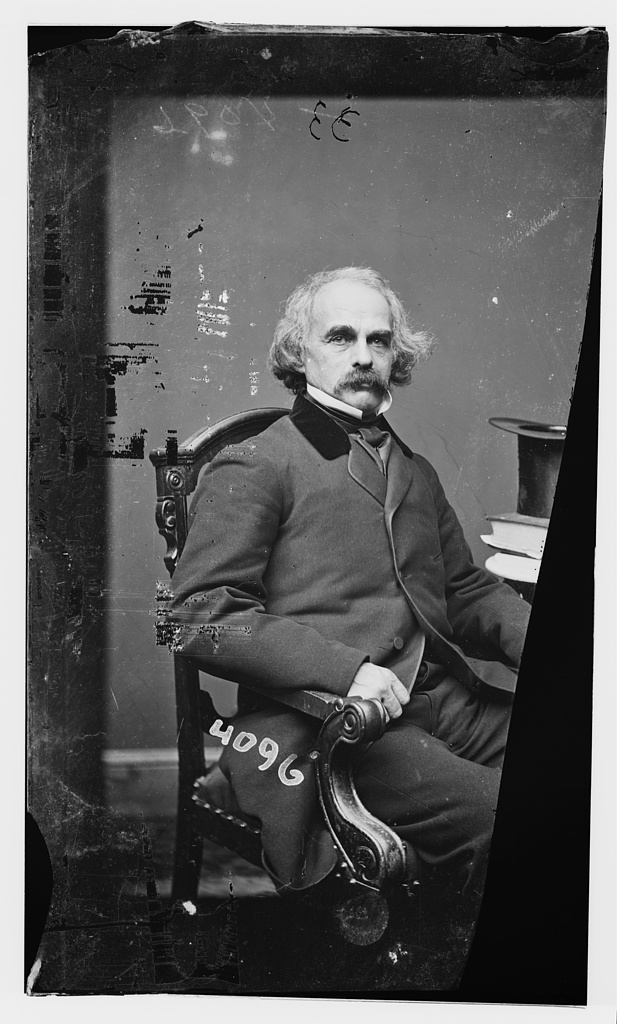
Image context: the cover uses Mathew Brady's 1862 portrait of Hawthorne from the Library of Congress. It suits this essay because the scene's force depends on historical layering. Hester stands inside a seventeenth-century punishment ritual, but the novel arrives through a nineteenth-century mind that turns that ritual into an uneasy archive rather than a finished lesson.[5]
The scene opens with a social machine, not with Hester alone
Hawthorne is exact about where public shame begins. Before Hester fully takes the frame, the novel gives us the prison door and calls it "the black flower of civilized society."[1] The phrase matters because it makes punishment sound cultivated rather than accidental. This is not raw mob violence. It is an institution, grown and maintained, with women in the marketplace already debating what harsher sentence would properly match the offense.[1][2]
That opening pressure changes how Hester appears when she emerges with Pearl. She does not enter a neutral square. She steps into a system already warmed up for interpretation. The crowd wants readability: the scarlet letter should explain the woman, the child should confirm the sin, the scaffold should complete the sentence. Hawthorne grants them the theater, but he also makes theater unstable from the start. Hester appears with "a burning blush, and yet a haughty smile," a combination that prevents the moral spectacle from becoming legible in one direction.[1]
That mixed expression is the first reason the passage stays alive. Shame is there. Defiance is there too. Hawthorne refuses the easier choice between collapse and triumph. Hester is exposed, yet her face keeps producing more than one social meaning at once. The crowd reads disgrace; the narrator keeps showing surplus.
The embroidered letter slows the punishment down
The most famous object in the scene is the badge itself, described as an elaborately embroidered red A worked with gold thread.[1] Readers often treat the letter as a fixed symbol, but in the opening scene it behaves more like interference. The magistrates intend a plain mark of reduction. Hester wears something too vivid, too interpretive, too visibly made. Her needlework does not erase the sentence. It changes its tempo.
That is the crucial scene-level move. Hawthorne understands that public punishment depends on speed. The crowd wants instant conversion from body to meaning. See the badge, know the crime, move on. Hester's letter resists that by becoming an object people must keep looking at. It attracts judgment, but it also attracts attention as craft. That is not a decorative detail. It is the passage's argument about form. The state wants a sign of completed humiliation; Hester appears carrying a sign that has already been worked on, stylized, and made excessive.[1][2]
In other words, the embroidery gives shame duration. The letter does not disappear into function. It keeps reopening the question of who controls the scene's meaning. Hawthorne does not say Hester is free because she can make the badge beautiful. He says something harder: even inside punishment, form remains a field of struggle.
The scaffold works by stretching time, not by ending it
The square is arranged as if shame could be completed in public. Put the offender up, let the town look, attach the sign, pronounce the lesson. Yet the passage feels memorable because it keeps defeating that fantasy of conclusion.[1][2] Hester's own mental movement helps. Hawthorne lets memory, bodily pressure, and sensory overload crowd the instant. She remembers her old life, feels Pearl in her arms, and faces the marketplace all at once.[1] The present does not simplify her. It thickens.
That thickness is why the scene's pacing matters so much. Hawthorne lingers over gestures, over the crowd's stare, over the badge, over the child's presence, over the official demand that Hester name the father. The scaffold should be the place where speech closes the case. Instead it becomes the place where silence acquires force. Hester's refusal to identify Pearl's father does not cancel the legal ritual, but it keeps the ritual from reaching narrative completion.[1]
This is where the child changes the scene's scale. Pearl is not only proof of adultery. She is duration made visible. A crime the magistrates want to frame as past tense is standing in Hester's arms as living continuation. That makes the scaffold feel less like a verdict than like the beginning of an unwanted future. Public shame is supposed to end with exposure; Hawthorne turns exposure into a long afterlife.
Historical distance is part of the scene's heat
Because the novel is narrated through a later consciousness rather than from inside Puritan Boston alone, the scene arrives with a double pressure.[1][3][4] Hawthorne had worked in the Salem Custom House before writing the novel, and the book famously frames itself through an act of archival recovery linked to that world.[3][4] That background matters even in a micro-essay on the opening passage. The scaffold scene is immediate, but it is also already being curated as history.
That distance sharpens rather than cools the episode. The narrator is close enough to feel the cruelty of the crowd and far enough away to make the whole ritual appear strange, almost overdesigned. The result is not antique pageantry. It is moral drag. Hawthorne keeps showing how much ceremony a society requires in order to pretend that one woman's pain can restore order.[1][2][4]
This is why the scene never becomes just "Puritan severity" in the abstract. It is about institutions needing visible bodies, communities needing readable stories, and individuals discovering that silence, posture, and style can still interrupt the story forced onto them. Hester cannot step off the scaffold free. She can, however, prevent the scene from becoming simple.
Why the passage still works in 2026
The opening of The Scarlet Letter still feels modern because it understands that humiliation is social before it is psychological.[1][2] Hawthorne maps the whole apparatus: architecture, spectators, official speech, gendered scrutiny, the craving for confession, the fantasy that one image can finish a person's meaning. Hester's resistance also feels modern because it is partial. She does not win the scene. She complicates it.
That is the real achievement of the passage. The scaffold is built to flatten time and identity into one public lesson. Hawthorne instead gives us a scene where time slows, symbols thicken, and the punished figure keeps exceeding the sentence. Hester stands there marked, visible, and trapped. She also stands there as someone the town has not finished reading. That remainder is why the opening still moves.
Sources
- Nathaniel Hawthorne, The Scarlet Letter (Project Gutenberg ebook).
- Encyclopaedia Britannica, "The Scarlet Letter".
- National Park Service, "Nathaniel Hawthorne" - Salem Maritime National Historical Park.
- Encyclopaedia Britannica, "Nathaniel Hawthorne".
- Library of Congress, "Nathaniel Hawthorne, half-length portrait, seated, facing left" - source page for the Mathew Brady photograph used as the article image.