
On 10 October 1977, Elizabeth Bishop stood before a live audience at New York's 92nd Street Y and began with an apology: she had a slight cold and might be hoarse from time to time.[1] The remark is small, but it turns out to be a useful entrance into the archive. Bishop's voice in this recording does not try to conquer the room. It does not dramatize personality or invite listeners into a confessional performance of private feeling. What it does instead is clarify the artistic method that runs through her poems: exact observation first, emotional recognition later, with the self arriving by indirection rather than by declaration.[1][2]
That matters because 1977 was not just another reading-year for Bishop. It was also the year of Geography III, the late collection that finally pushed her beyond the narrower prestige of being a "poet's poet" and into wider public recognition.[2][4][5] The Academy of American Poets notes that her work avoids explicit accounts of private life and instead concentrates, with unusual precision, on the physical world.[2] In a period when American poetry was often sorted into camps of public statement, private confession, or formal elegance, Bishop kept writing poems that made description itself carry psychological force.[2][5]
The archival record below is especially useful because the 92Y upload does not present the reading as a museum relic. Its description identifies the event as a live Bishop reading recorded on 10 October 1977 and later released as part of the Unterberg Poetry Center's "75 at 75" series, which brought previously unavailable recordings from the archive to a general audience.[1] That provenance matters. This is not a retrospective actor's recreation and not a documentary clip chopped into commentary. It is Bishop's own public voice, preserved from a moment when late style, institutional recognition, and live performance had all come into alignment.
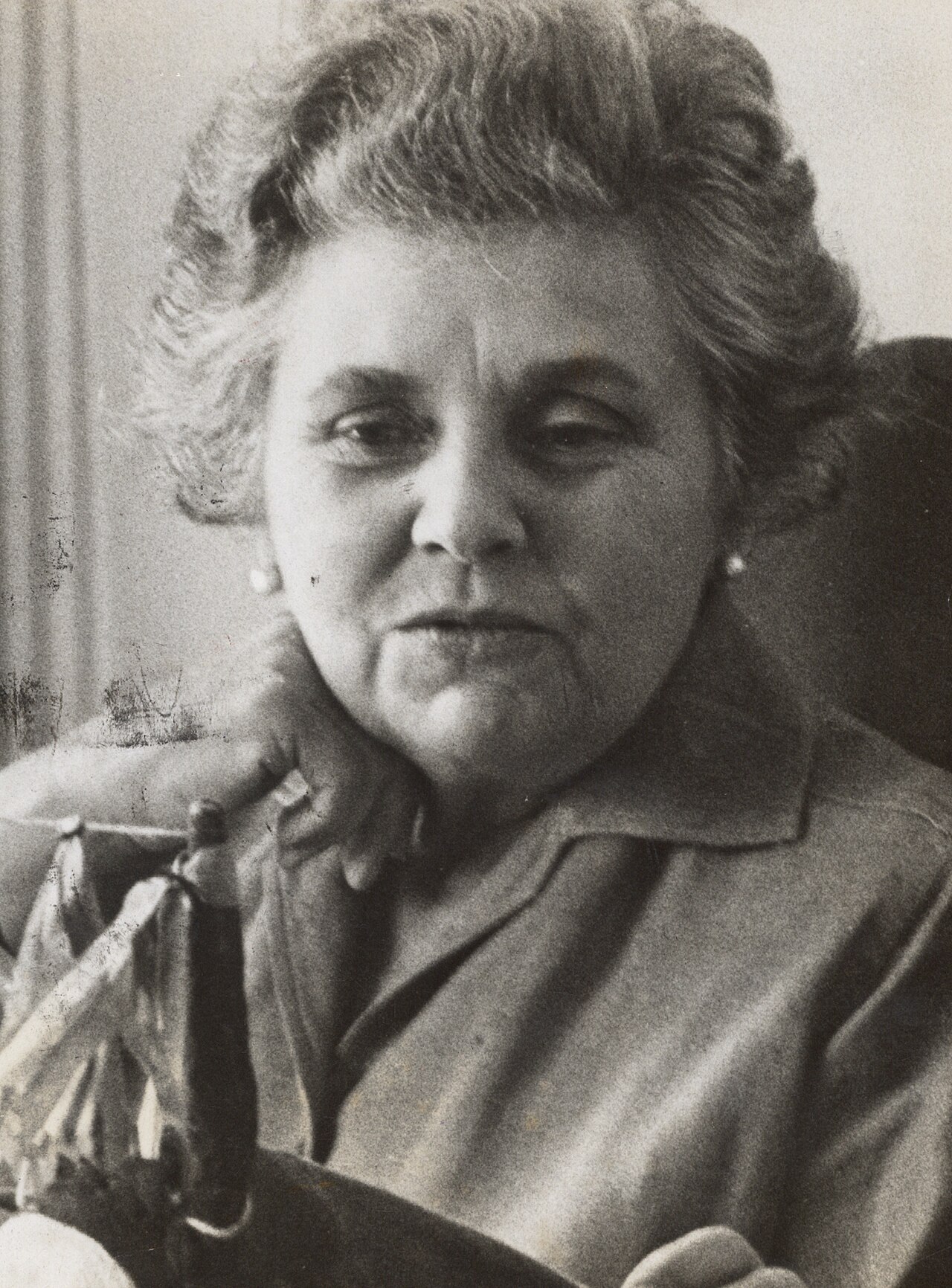
Image context: the cover uses a real 1964 portrait photograph from Wikimedia Commons. That choice fits the article because the point here is not scenic atmosphere but literary presence. The reading shows Bishop as a public craftsperson of tone, pacing, and withheld emphasis, and a documentary portrait serves that argument better than any symbolic illustration would.[6]
Historical context: by 1977 Bishop had become publicly central without becoming confessional
Bishop's biography helps explain why this reading sounds the way it does. Born in Worcester in 1911, shaped by loss early in life, widely traveled, and famously slow to publish, she built a body of work whose surfaces often look cooler and more reticent than those of many contemporaries.[2][5] The Academy of American Poets sets up the contrast plainly: unlike Robert Lowell and other writers associated with confessional practice, Bishop's poems avoid direct disclosure and attend instead to landscapes, objects, weather, travel, and scene.[2] That contrast is often stated so flatly that it becomes misleading, as if Bishop simply removed the self from poetry.
The 1977 reading shows why that shorthand is inadequate. Bishop was never a poet without inwardness. She was a poet who preferred to let inwardness emerge through pressure on things: a map, a fish, a waiting room, a room in Brazil, a cathedral, a moose crossing a road, the angle of a shore, the timing of a cry.[1][2][3] Her poems are full of selves, but those selves become legible by the way attention moves across a scene. Hearing her read makes that method audible.
The timing of the event sharpens the point further. The National Book Foundation notes that Bishop had already won the National Book Award in 1970 for Complete Poems, while Poets.org says that with Geography III in 1977 she was finally established as a major force in contemporary literature rather than only a writer revered by other poets.[2][4] In other words, the archive catches her at a moment of widened public authority. Yet the reading never converts that authority into large self-display. The performance remains measured, almost anti-theatrical, and for that reason all the more revealing.
Video provenance
The embedded video is the official upload from The 92nd Street Y, New York. Its description states that the recording was made on 10 October 1977 before a live audience at the 92nd Street Y and later released through the Unterberg Poetry Center's "75 at 75" archival project.[1] That note gives the clip exactly the kind of provenance an archival spotlight needs: original venue, recording date, and later preservation context through the institution that held the tape.
Close reading: what Bishop's own voice changes
The first surprise comes in the opening minute. After the brief apology about her cold, Bishop says she had not planned to read "In the Waiting Room" but now thinks perhaps she will have to, then explains that she will begin with a few very old short poems before moving to later work and one poem not yet published.[1][3] That little piece of stage management is already pure Bishop. Even in a live room, she arranges sequence, scale, and expectation. The archive starts not with revelation but with ordering.
Her first poem is "The Map," one of the earliest poems she published.[1] On the page, the poem often looks like a classic statement of Bishop's descriptive intelligence. In her voice, it becomes something more diagnostic. She reads without lushness. The line endings stay clean, the pauses are functional, and the poem's pleasure comes from exact placement rather than ornament. That matters because it demonstrates a principle that will govern the rest of the reading: description is not a way of postponing meaning. It is the means by which meaning is made.
The turning point arrives around the 10:17 mark, when Bishop begins "In the Waiting Room."[1][3] This is the obvious place where a reader might expect the performance to become confessional, since the poem stages a child in Worcester discovering, in a dentist's waiting room, the terrifying instability of personal identity.[3] But Bishop does not perform it as a melodrama of exposed selfhood. She keeps the voice level, almost matter-of-fact, and lets the poem's scale-shift do the work. The cry from inside the dentist's room, the magazine photographs, the sudden vertigo of becoming one among others: all of it lands harder because she refuses to over-color it.
That restraint is not emotional absence. It is technical control. The poem's force comes from the fact that Bishop treats metaphysical panic as a disturbance in attention before she treats it as a confession.[1][3] The listener hears a mind moving from surfaces to categories to dread. She does not announce a deep self; she lets one flicker into existence because the observed world has become too charged to remain merely external. In live delivery, that movement becomes even clearer. The archive shows that Bishop's famous reserve was not a refusal of intimacy. It was a way of making intimacy arrive under pressure from objects, voices, and rooms.
The final large movement of the clip deepens that impression. After applause, Bishop says she will read one more, a fairly long poem not yet published, about a place in Brazil roughly halfway down the Amazon.[1] The poem later known as "The Cathedral" enters the archive here as work still in process, still trying out its public sound. This is a crucial detail. It shows Bishop in 1977 not as a finished monument reading only settled classics, but as a living poet testing new architecture in front of listeners. Even here, at a moment when she might have leaned on autobiographical authority, she returns to place, built form, distance, and scene.
That choice says something important about late Bishop. The route toward feeling in her work continues to run through external arrangement. Brazil is not presented as diary material. It appears as a geography of perception, the kind of setting where description can become moral and emotional inquiry without announcing itself as such.[1][2][5] The archive therefore preserves not just Bishop reading well, but Bishop demonstrating her poetics in real time.
Why this archive still matters
The 92Y recording matters because it corrects a lazy binary. Bishop is too often placed on one side of a divide between confessional poetry and impersonal craft, as though the price of her precision were emotional distance.[2][5] What this archive makes audible is a different truth. Bishop's poems are full of inward pressure, but they trust attention more than confession as the medium that can carry it. Her voice onstage does not strip away the poems' masks. It shows that the so-called mask was actually the method.
That is why the 1977 date matters so much. By then Bishop's place in American letters was secure enough to tempt myth-making: the austere perfectionist, the traveler, the late-recognized master.[2][4][5] The archive cuts through that by restoring labor. You hear how carefully she meters emphasis, how little she wastes, how much she trusts syntax, and how decisively she lets the world of objects and settings disclose the human stakes. In a literary culture that still confuses intensity with exposure, this reading remains an education.
Sources
- The 92nd Street Y, New York, "Elizabeth Bishop: Selected Poems | 92Y Readings," YouTube video.
- Academy of American Poets, "Elizabeth Bishop."
- Academy of American Poets, "In the Waiting Room" by Elizabeth Bishop.
- National Book Foundation, "Elizabeth Bishop."
- Encyclopaedia Britannica, "Elizabeth Bishop."
- Wikimedia Commons, "File:Elizabeth Bishop, 1964 (cropped).jpg."