
On February 23, 1977, Joan Didion arrived at San Francisco State University's Poetry Center for what the archive identifies as her first ever public reading.[2] She read the full first part of A Book of Common Prayer, her new novel, and then opened the floor to questions.[2] The five-minute clip embedded below preserves only the response period, but that turns out to be enough. In a remarkably compressed exchange, Didion explains two things readers still flatten when they talk about her work: how reported reality enters fiction, and why a book can carry joy without offering anything like happiness.[1][2]
That is why this small archival fragment matters more than its running time suggests. Later Didion lore often turns her into a finished style object: the immaculate sentence-maker, the cool diagnostician of collapse, the oracle of American unease. The clip resists that flattening. She sounds alert, slightly wary, exact, and very much like a working writer still trying to define the traffic between notebooks, assignments, scenes, and novels.[1] What emerges is not a colder Didion and not a warmer one. It is a more procedural Didion, someone who understands fiction as a place where pressure gathered in public life gets re-rendered into atmosphere, cadence, and moral weather.
The short answer she gives about joy is just as important. When asked whether she is inspired by joy, Didion does not suddenly discover a hidden sunny self for the audience.[1] She says writing is usually done in dread, that a kind of joy comes late in the process, and that the joy in the book is real even though the book is not "happy."[1] That distinction is easy to miss if one reads her only through blurbs about bleakness. In the archive, though, the difference becomes foundational: joy names an energy of perception and form, not a guarantee of ease, redemption, or consoling plot.
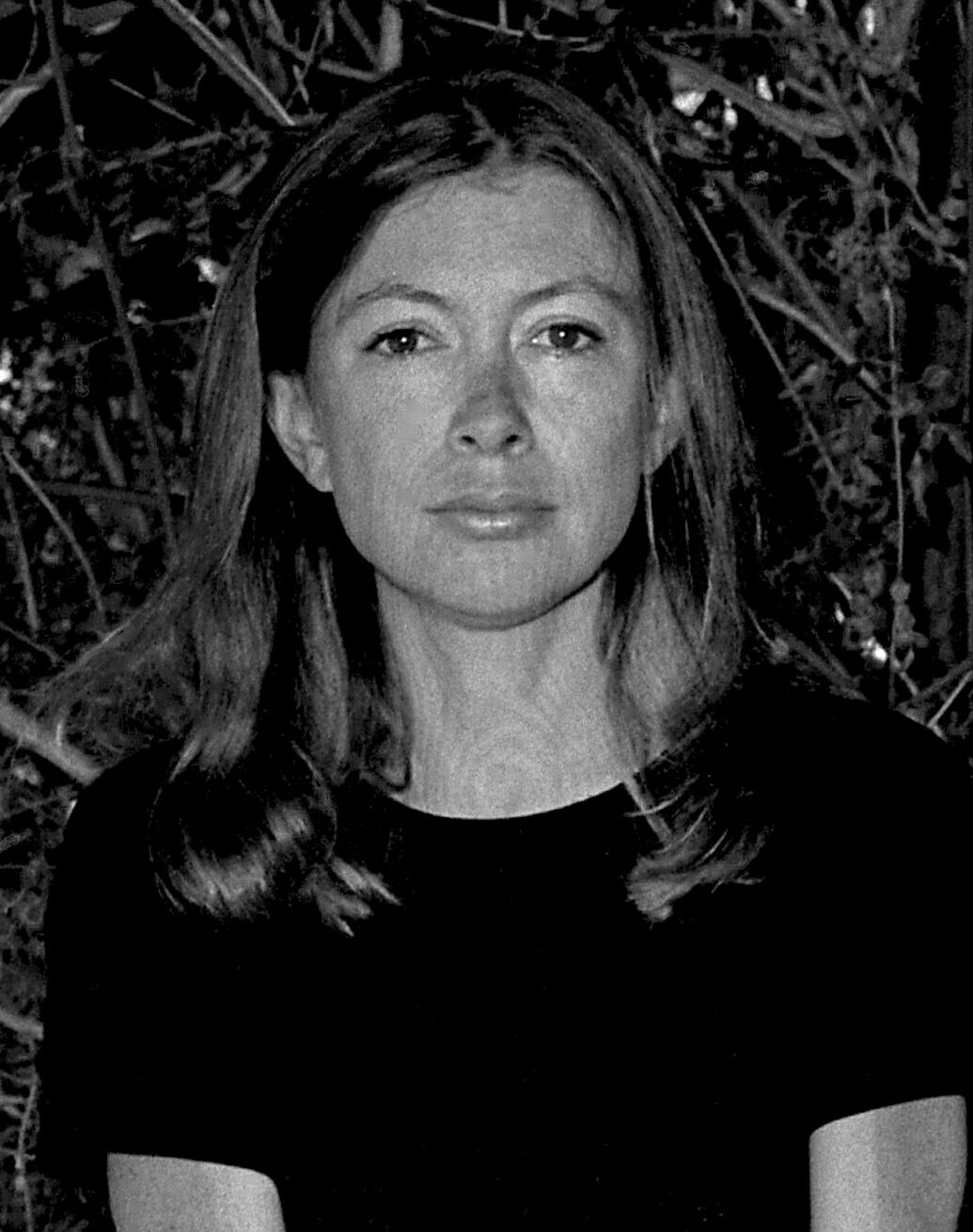
Image context: the cover uses a real 1970 Wikimedia Commons photograph of Joan Didion. That choice fits this piece because the argument concerns literary presence in historical time. The photograph places the 1977 recording back inside an actual career moment, before later myth and retrospective branding hardened around the voice.[5]
Historical context: by 1977 Didion was already a major prose presence, but not yet a public-reading icon
By 1977, Didion's career had already moved across several forms that critics too often separate from each other. The official Joan Didion biography page places her early path through Run River (1963), the essays of Slouching Towards Bethlehem (1968), and the novel Play It as It Lays (1970), while also marking her work as a journalist, novelist, memoirist, essayist, and screenwriter.[4] That range matters here because the Poetry Center exchange is really about form-crossing. Didion is not speaking as a novelist fenced off from reporting; she is speaking as someone for whom the border between factual exposure and fictional design had already become a permanent working condition.
The archive page sharpens the occasion further. It states that Didion read the full Part One, eleven chapters, of A Book of Common Prayer and then entertained audience questions related to fiction, nonfiction, and screenwriting collaboration with John Gregory Dunne.[2] The official book page describes the novel as one of Didion's major works from 1977, placing the event at a midpoint in her career when her nonfiction authority and fiction-making were already tightly braided.[3][4] That makes the recording unusually valuable. It is not a late-career retrospective in which a canonical writer narrates her own legend. It is a live document from the moment when the methods were still actively being tested in public.
The fact that this was her first public reading is not decorative trivia.[2] It changes what the clip means. Didion is not performing the role of a seasoned literary stage presence. She is answering in the wake of that first exposure, with no great appetite for literary theater and no effort to inflate the occasion into a self-mythologizing event. The result is unusually revealing. Because the performance layer is so thin, the writerly assumptions come through with unusual clarity.
Video provenance
The embedded video comes from the official YouTube channel connected to the Poetry Center archive. Its description identifies the clip as a response segment from Didion's first public reading on February 23, 1977, and points readers to the full-program page in the Poetry Center Digital Archive.[1] That archive page provides the fuller provenance an archival spotlight needs: venue, date, the fact that Didion read the complete first section of A Book of Common Prayer, and the note that the surviving audience questions are sometimes difficult to hear even when their shape remains legible in her answers.[2]
Around 0:45, Didion explains that nonfiction does not sit below fiction in her hierarchy
The first answer is the most clarifying. Around the 0:45 mark, Didion says she has always taken nonfiction as seriously as fiction, and that in some ways nonfiction is harder because she "can't make it up": the material is already there, stubborn and intractable, and must somehow be rendered.[1] This sounds simple, but it corrects a common mistake in the reception of her work. Readers often treat the essays as sharp social notice and the novels as some freer, more atmospheric second chamber. Didion's answer suggests a different relationship. The factual world is not a preliminary field report for the fiction. It is already a formal problem.
That emphasis on rendering is essential. She does not describe nonfiction as passive transcription or truth-telling without craft. She describes it as a struggle with resistant material.[1] In other words, the same discipline of arrangement, pressure, omission, and tonal calibration applies on both sides of the genre line. If one keeps that in mind, the false split between "reporter Didion" and "novelist Didion" immediately starts to collapse.
Around 1:24, the clip gives perhaps the cleanest short statement of how Didion turns reporting into fiction
The next move is even better. At about 1:24, Didion says that nonfiction affects her fiction because reporting forces her into situations where she is exposed to things that later turn up in the novels.[1] She does not mean simple disguised reportage. The examples she offers push in the opposite direction. Speaking about A Book of Common Prayer, she says that the feeling of the San Francisco section and of a radical-lawyer figure came not from one transcribed event but from accumulated reporting around the Panthers, the 1968 strike, and the Haight in 1967.[1]
That distinction matters enormously. Didion is describing a transfer of charge, not a transfer of plot. Public events do not enter fiction as evidence files. They enter as pressure systems, idioms, postures, anxieties, and tonal residues. This is one reason her novels can feel politically saturated without reading like romans a clef. The archive catches her saying, in plain working language, that fiction is where historical exposure gets metabolized into mood and structure.[1][2]
Placed against the event context, the answer also clarifies why A Book of Common Prayer belongs exactly where it does in her career. The official book page presents it as a novel of political atmosphere, unstable loyalties, and damaged private life under geopolitical heat.[3] The clip shows how such a novel becomes possible. Reporting does not hand her a set of incidents to recycle. It hands her the temperature of a world, and the fiction discovers a syntax capable of carrying that temperature.
Around 3:35, Didion separates joy from happiness and quietly rewrites her own reputation
The exchange about joy is where the clip becomes more than a craft note. Around 3:35, Didion says she likes writing but does not think it is much fun, and that writing a book usually happens under dread that it will fail.[1] A kind of joy, she says, comes late, toward the end of the process, but it sits very close to something darker.[1] That is already a sharper definition of artistic joy than the one readers often project onto her. Joy is not exuberance. It is a hard-won moment of formal arrival that remains precarious.
She then pushes further. Responding to the suggestion that her work is depressive, Didion says those descriptions surprise her because she is in fact cheerful in ordinary life, takes pleasure in domestic routines, and thinks this particular book is full of joy, even if it is not happy.[1] The distinction is exact enough to function as a reading rule. Happiness belongs to outcome, consolation, and surface emotional verdict. Joy, in Didion's sense here, belongs to the intensity with which experience has been rendered, held, and made legible. A book can stage disorder, violence, exile, or emotional damage and still possess joy if its form has managed to make those conditions fully present.
That answer also helps recover Didion from one of the laziest habits in her reception. Because her prose is controlled and because her subjects are often grim, she is routinely filed under bleakness. The archive gives a finer account. Didion is not denying difficulty; she has just finished speaking about dread.[1] What she rejects is the idea that darkness exhausts the book's emotional register. Joy remains possible at the level of attention, cadence, and compositional exactness. The book does not have to become comforting in order to carry it.
Why this small archive still matters
This clip matters now because it returns Didion to the scale of process. The later cultural image of Joan Didion is powerful but reductive: sunglasses, aphorisms, cool detachment, California apocalypse. The 1977 Poetry Center fragment is smaller, less glamorous, and more useful.[1][2] It shows a writer explaining how observed life becomes fictional atmosphere and how the emotional life of a book cannot be reduced to whether its world is cheerful.
That makes the archival provenance important in a specifically literary sense. Because the event was her first public reading, the recording comes from a moment before the public role had fully congealed.[2] One hears less persona and more method. One also hears a writer refusing two easy separations at once: the separation between nonfiction and fiction, and the separation between dark subject matter and joy. Those refusals are part of what made Didion's prose durable.
The best use of this archive, then, is not nostalgic. It is diagnostic. If you return to Didion after watching it, the right question is no longer whether the work is cold or sad. The better question is how public exposure gets converted into fictional pressure, and how exact form can generate joy even when the world being described offers no happiness at all.[1][3][4]
Sources
- Poetry Center Archive Goes Live!, "Joan Didion, 1977, responding to her audience after her first public reading — The Poetry Center," YouTube video.
- Poetry Center Digital Archive, "Joan Didion: February 23, 1977" (full program page, event description, and provenance).
- Joan Didion Official Website, A Book of Common Prayer (official book page for the 1977 novel read at the event).
- Joan Didion Official Website, "About Joan Didion" (career timeline and major works).
- Wikimedia Commons, "File:Didion1970 (cropped).jpg" (source page for the archival photograph used as the article image).