A leaf takes very little time to fall. Adelaide Crapsey gives it five lines. Her “November Night” begins by asking us to listen, then withholds the visible cause of the sound until almost the end. Before there are leaves, there is a noise; before there is a recognizable autumn scene, there are ghosts. The poem is small enough to take in at a glance, but its order makes that glance insufficient.[1]
Crapsey's gift was to make a short poem contain an interval. Reading three of her cinquains together, we can hear different uses for that interval: a sound finding its source, a sentence waiting for its subject, a mind trying to imagine a touch it could bear. The compression keeps feeling in motion.
The poet who counted
Born in 1878 and raised in Rochester, Crapsey graduated from Vassar in 1901. She taught literature and history, studied in Europe, and took up a position teaching poetics at Smith College in 1911. During her years abroad she pursued an intensive investigation of English meter, including work at the British Museum. Poetry was an object of sustained professional attention well before her own collection appeared.[2]
Her research involved counting and comparing words. As Vassar's account explains, she examined the proportions of shorter and longer words in writers including Tennyson and Swinburne, and investigated the relation between ordinary spoken accent and stress in verse. This was patient, quantitative work on how language behaves when arranged in lines.[3]
That background changes what we hear in a cinquain. Crapsey's familiar pattern expands through four lines and then contracts sharply in the fifth. “November Night” follows a syllable sequence of two, four, six, eight, two. But counting alone misses the performance: stresses, pauses, and the placement of a sentence across those lengths determine how the poem moves.[1][3]
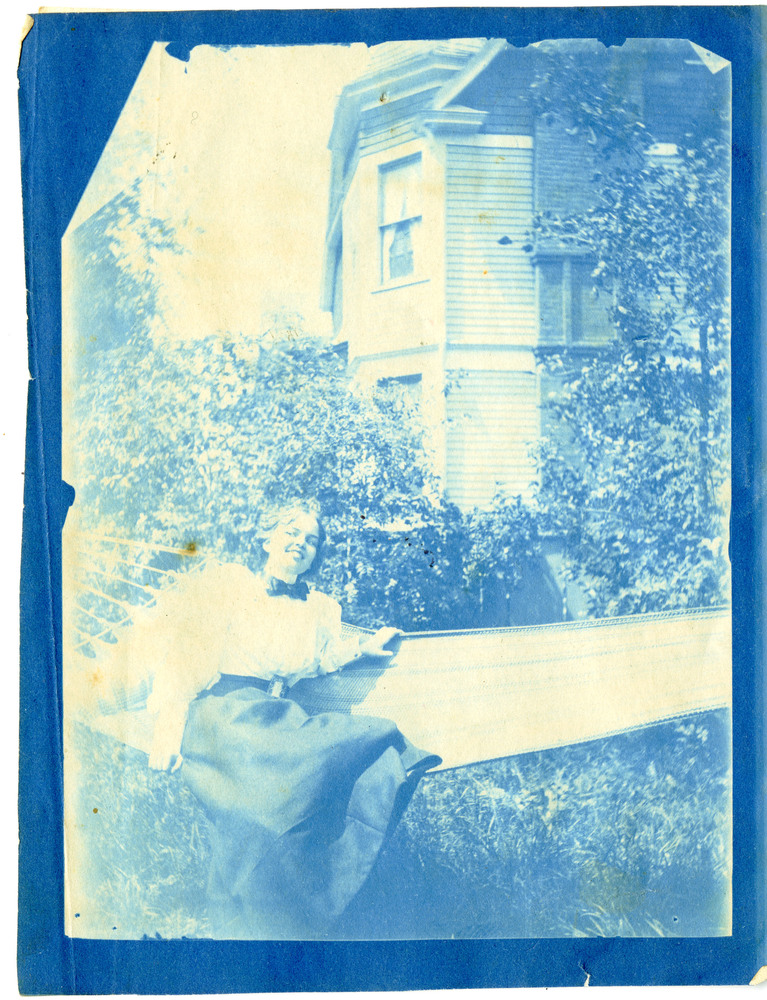
In the archival photograph accompanying this essay, Crapsey sits smiling in a hammock at Alice Ward's Rochester house. A white blouse catches the light; behind her, foliage crowds a wooden bay window. The university gives no date for the photograph.[6] It offers a moment of sociability alongside the record of study and teaching.
Waiting for the leaves
Here is “November Night” in full:
Listen . . .
With faint dry sound,
Like steps of passing ghosts,
The leaves, frost-crisp'd, break from the trees
And fall.[1]
The opening imperative recruits a listener. The next two lines describe a sound and supply a comparison while postponing its source. We are asked to attend before we know what deserves attention.
When the leaves finally appear in line four, the sentence can begin its physical action. That line is the longest, and its clustered consonants make the detachment feel brittle. Yet the fall itself belongs to the shortest closing line. Read aloud, the poem seems to spend more time preparing our hearing than completing the movement.
I hear the ghosts as a temporary uncertainty carried into an ordinary scene. The leaves explain the noise, but the comparison remains audible after the explanation. The poem has trained us to hear a slight disturbance as a passage out of sight.
The moon arrives last
“Niagara,” subtitled “Seen on a Night in November,” uses the same small space to look up:
How frail
Above the bulk
Of crashing water hangs,
Autumnal, evanescent, wan,
The moon.[4]
The title supplies a vast landmark. The opening supplies fragility, but withholds the thing that is fragile. For three lines, the waterfall occupies the middle of a sentence whose subject has yet to arrive. Even the verb leaves something hanging in the grammar.
Line four stretches the wait through three adjectives. Its long words slow the approach to the two brief words that finally name the moon. The sentence's inversion makes the reader experience suspension before identifying the suspended object.
This is a surprising way to write a famous spectacle. The poem acknowledges the water's weight and noise, then gives its final attention to the pale thing above it. Smallness becomes a choice about where to look. My reading is that the ending quietly rearranges the scene's hierarchy: the most forceful presence does not receive the last word.
A touch that cannot be light enough
In “The Guarded Wound,” the opening condition begins an experiment in reducing pressure. Imagine a touch lighter than a flower petal resting on grass. Could that be gentle enough? The answer interrupts the fourth line: “oh still too heavy it were,” followed by “Too heavy!” in the fifth.[5]
The repeated judgment changes the purpose of the short ending. Nothing drops into place; no hidden object is identified. Instead, the speaker has exhausted a comparison without finding a tolerable measure. The final line sounds like the point at which elaboration becomes impossible.
The title promises a wound, but the poem never describes an injury or identifies the person who might touch it. That omission leaves the imagined contact suspended between physical pain and emotional exposure. We can hear the refusal without inventing a complete medical or romantic history for its speaker.
Across these poems, a shared outline permits distinct experiences. The closing line can complete an action, disclose a subject, or repeat a protest. Knowing its small size in advance does not tell us what it will do.
The life attached to the book
Crapsey was diagnosed with tuberculosis in 1911, left teaching as her health deteriorated, and spent time at Saranac Lake. She died in Rochester on October 8, 1914. Verse appeared the following year; A Study in English Metrics followed in 1918. Both the poems and the research reached readers as work left behind.[2]
The early framing encouraged an intimate identification of book and death. In his October 1915 foreword, preserved in the later edition cited here, Claude Bragdon calls the volume a “funeral urn.” Jean Webster's accompanying essay joins praise for Crapsey's compression to an account of her illness.[1] Those tributes helped preserve her work while also giving readers a powerful script for approaching it.
Vassar's later profile explicitly challenges that sentimental emphasis and restores her technical ambition to the foreground.[3] The poems reward the adjustment. Their endings are deliberate decisions about syntax, sound, and attention. A reader can acknowledge the circumstances of their making while remaining curious about the craft.
Return to the leaves after reading the life, and listen to how long they take to fall. Crapsey has made room inside five lines for us to wait.
Sources
- Adelaide Crapsey, Verse, Alfred A. Knopf, 1926 edition, digitized by Project Gutenberg — “November Night,” lines 1–5; Claude Bragdon's October 1915 foreword; Jean Webster's March 1915 introductory essay.
- Academy of American Poets, “About Adelaide Crapsey” — education, teaching, metrical research, illness, and publication history. The biographical prose gives her death correctly as October 8, 1914; the page's lifespan heading has a conflicting year.
- Vassar Encyclopedia, “Adelaide Crapsey ’1901” — quantitative research on meter, the role of stress in the cinquain, and the biographical framing of her reception.
- Adelaide Crapsey, “Niagara, Seen on a Night in November,” lines 1–5, Niagara Falls Poetry Project — text attributed to the 1922 Knopf edition of Verse.
- Adelaide Crapsey, “The Guarded Wound,” lines 1–5, Academy of American Poets — complete poem, published in 1915.
- University of Rochester, Rare Books, Special Collections, and Preservation, “Women and the Arts,” in We Want More and We Will Have It: Women Running Rochester — provenance and identification of the undated cyanotype of Crapsey at Alice Ward's house.