Robinson Crusoe is often remembered as a man, an island, and a long improvisation with tools. That is true as far as it goes, but it undersells the book's strange durability. Defoe did not merely invent a famous castaway. He built a narrative machine that later writers, publishers, filmmakers, educators, and critics could keep refitting: remove Crusoe from the Caribbean and put him in a Swiss family, a children's abridgment, a space mission, a colonial counter-narrative, or a psychological survival story, and the engine still turns.
The machine has several moving parts. First comes separation from ordinary society. Then come inventory, shelter, calendar, labor, fear, spiritual accounting, property-making, and the arrival of another human being who changes solitude into hierarchy, companionship, translation, and moral trouble. Britannica's account of the novel stresses its 1719 publication, its enduring figures of Crusoe and Friday, and its immediate afterlife in imitations and later riffs across books and films.[2] That afterlife is not accidental. It grows from the form.
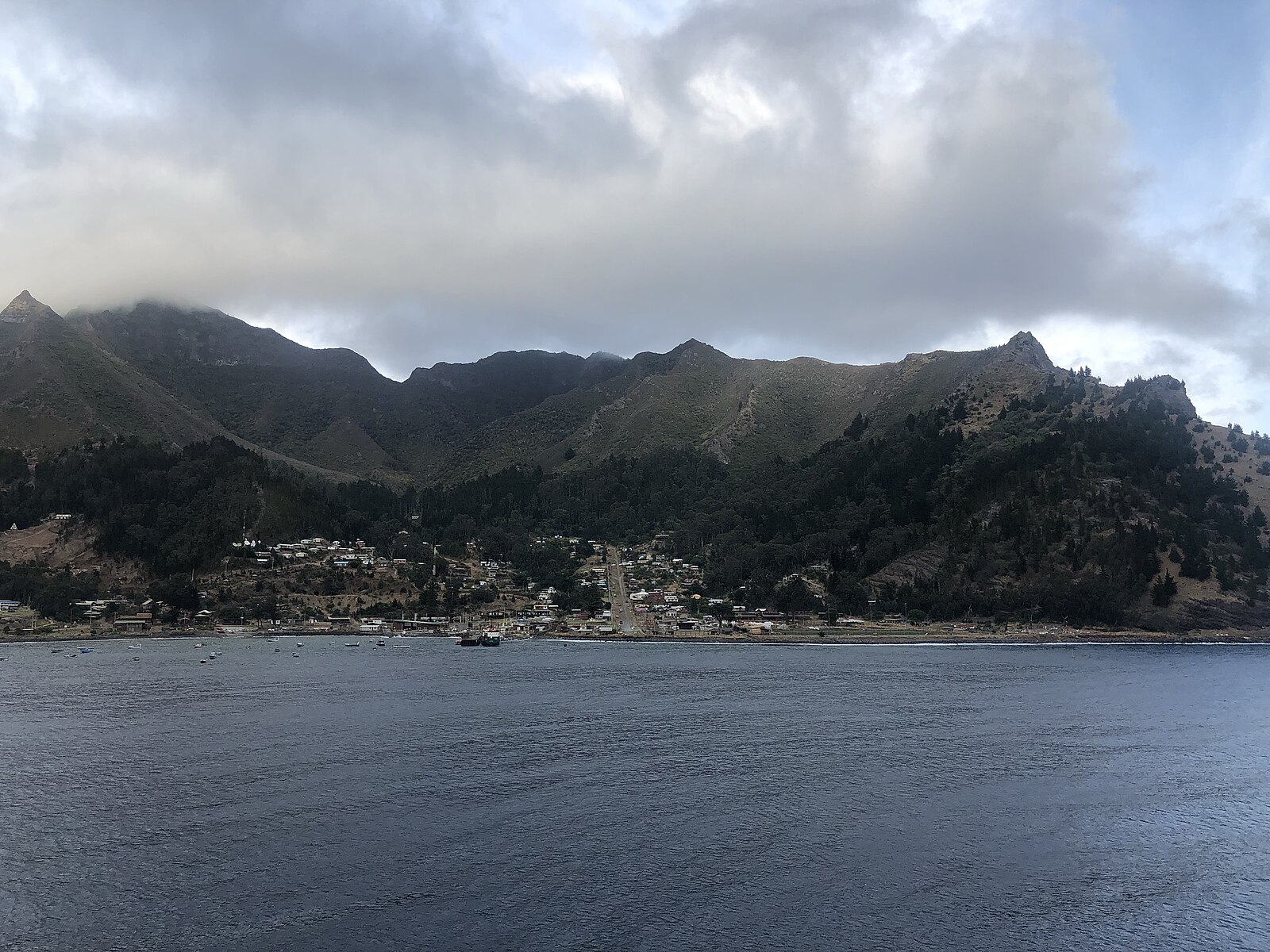
A photograph of San Juan Bautista on Robinson Crusoe Island matters for the same reason. It is not Defoe's fictional Caribbean, yet its bay, settlement, slopes, and maritime distance show why the Crusoe afterlife keeps needing visible ground. The story becomes portable only because the island can feel both specific and abstract: a named place, a vantage point, a working edge between sea and shelter, and a surface on which readers imagine inventory, danger, and order.[6] Later adaptations inherit that double contract. They want the thrill of invention, but they also want the reader or viewer to feel that survival has been placed, witnessed, and made usable.
The island teaches plot by making labor visible
Crusoe's island is not simply empty space. It is a workshop with weather. Defoe's narrator survives by turning panic into lists, materials into systems, and accident into routine. The famous appeal of the book lies partly in watching a person make a life from salvage: a dwelling, a storehouse, a calendar, a boat, a field, a set of habits. Project Gutenberg's text preserves the practical density of that voice, which keeps returning to work, measure, repair, and self-audit.[1]
That practicality explains why the story could travel into children's literature so easily. A child reader can follow the sequence: what do you have, what do you need, what can be made, what must be feared, what rule should be learned? The Baldwin Library's research materials note the collection's strength in comparative editions of Robinson Crusoe, including roughly 300 editions.[4] That number is a bibliographic clue to the book's afterlife. Crusoe became not only a novel to read, but a reusable lesson in resourcefulness, discipline, and world-making.
Yet the labor is never innocent. The same routines that make Crusoe sympathetic also make possession feel natural. He names, fences, stores, counts, commands, and eventually treats the island as a domain. The word "my" gathers force. That is why the book keeps producing both adventure adaptations and critical rewritings. A survival plot says: watch a human being make order. A colonial reading asks: who gave him the right to call that order his?
Friday is where the machine stops being simple
If Robinson Crusoe were only about solitude, its afterlife would be narrower. Friday changes everything. He gives the plot dialogue, rescue, danger, gratitude, instruction, dependency, affection, and domination. He is the figure who lets adaptations decide what kind of story they are really telling.
In older adventure versions, Friday often becomes a sign that Crusoe has moved from survival to mastery. The island ceases to be only a test of endurance and becomes a miniature society with Crusoe in command. But later readers cannot encounter that arrangement innocently. The name Friday itself is a reduction: a calendar label in place of a prior identity. Defoe's book makes that naming feel narratively efficient; modern afterlives can make it feel violent.
This is why the Robinsonade remains more than a desert-island template. Britannica defines the robinsonade as fiction written in imitation of Defoe's novel and centered on castaway survival.[3] But the genre's deepest inheritance is not just marooning. It is the problem of making a world while pretending that the world was waiting to be made. Once Friday enters, the island reveals that survival stories are also social stories. They ask who works, who names, who teaches, who obeys, and whose history begins only when the narrator notices it.
Good adaptations know that Friday is not an accessory. If he is flattened into helper, the story becomes a fantasy of self-reliance that secretly depends on someone else's submission. If he is given interiority, resistance, or prior culture, the whole machine changes pitch. The plot can still move, but it no longer confirms Crusoe's account of himself so easily.
The genre survives because it can change planets
The Robinsonade is portable because the island is less a place than a situation. Isolation plus scarcity plus intelligence can move almost anywhere. A desert island is only the classical version. A remote valley, a hostile planet, a post-disaster shelter, a lifeboat, or a technological habitat can all reproduce the same structure. What matters is the pressure of limited resources and the demand that a human being build a livable system from fragments.
The Cambridge Companion to Robinson Crusoe frames the novel's afterlife across translations, cultural migrations, and media such as film and television.[5] That breadth points to the book's unusual adaptability. Many classics survive because of character or style. Robinson Crusoe survives because it offers a scenario that can be abstracted without becoming empty. Keep the inventory, the routine, the threat, the moral self-justification, and the encounter with another person, and the form remains recognizable.
Science fiction especially understands this. Move Crusoe into space and the island becomes a planet, a capsule, or a damaged habitat. The theological vocabulary may fade, but the structure remains: the stranded person must make an environment legible, convert leftovers into infrastructure, and keep despair from breaking sequence. Modern survival narratives often replace providence with engineering, but the old rhythm persists. The castaway asks not only "How do I live?" but "What does my survival prove?"
That question is the book's most adaptable pressure point. For Defoe's Crusoe, survival can be read through providence, punishment, repentance, and deliverance; he calls disobedience a kind of "original sin" and repeatedly turns practical experience into spiritual accounting.[1] Later versions can secularize that pattern into psychology, grit, capitalism, empire, trauma, environmental adaptation, or technical competence. The machine accepts new fuel.
A children's classic and a critical problem can be the same book
The afterlife of Robinson Crusoe is split because the original is split. It can be read as adventure, spiritual autobiography, practical manual, colonial fantasy, economic fable, and myth of individualism. None of these readings cancels the others. They coexist because Defoe's method is so concrete. Crusoe does not merely announce values; he performs them through labor and narration.
That concreteness made the book easy to abridge. A children's edition can keep the storm, wreck, goats, footprint, Friday, and rescue while thinning out spiritual anxiety, slavery, plantation economics, and imperial entitlement. An anti-imperial rewriting can do nearly the reverse: keep the island and Friday while making Crusoe's narration the thing under investigation. A film can privilege spectacle, fear, and companionship. A school edition can turn the book into a lesson about early prose fiction. A critical essay can treat the same scenes as evidence of modern property-thinking.
This flexibility is not always flattering to the novel. Sometimes the afterlife has softened it into a cheerful self-help myth: a resourceful man works hard and conquers difficulty. That version misses the book's unease. Crusoe's confidence is built beside terror, guilt, violence, extraction, and selective blindness. His practical intelligence is real, but so is his talent for making possession sound like destiny.
The best afterlives keep both sides alive. They preserve the pleasure of method: the shelf made from wreckage, the meal secured after uncertainty, the calendar scratched against formless time. But they also ask what kind of self is being produced by all that order. Crusoe survives the island by making it readable. The cost is that he also makes other lives readable only in relation to his own story.
Why Crusoe still returns
Robinson Crusoe keeps adapting because it solves one problem and opens five more. How does a person live after catastrophe? How does work become meaning? When does survival become ownership? What happens when another person enters a story that has mistaken solitude for innocence? What must later tellings restore after the original narrator has named too much too quickly?
That is why the island is a machine rather than a backdrop. It takes cultural anxieties and turns them into tasks. In 1719, those tasks could be framed through providence, trade, travel writing, colonial expansion, and spiritual self-examination.[1][2] In later centuries, they could be reframed through childhood instruction, empire critique, psychology, cinema, television, and speculative survival.[3][5]
The durable fantasy is not simply being alone. It is being alone with enough materials to make the world answer. The durable critique is that the world may answer in voices Crusoe has not learned to hear. Between those two forces, the story keeps finding new islands.
Sources
- Daniel Defoe, Robinson Crusoe. Project Gutenberg text, used for textual reference and short quoted phrases.
- Encyclopaedia Britannica, "Robinson Crusoe" - publication history, plot overview, themes, and selected afterlives.
- Encyclopaedia Britannica, "robinsonade" - concise genre definition and relation to Defoe's novel.
- University of Florida, Baldwin Library of Historical Children's Literature, "Research" - collection context and note on roughly 300 editions of Robinson Crusoe.
- Cambridge University Press, The Cambridge Companion to Robinson Crusoe record/chapter listing - scholarly context for genre, cultural migration, translation, and media afterlives.
- Wikimedia Commons, "File:Robinson Crusoe Island shipboard View of the town of San Juan Bautista.jpg" - source page for the real Robinson Crusoe Island cover photograph.