Most difficult books ask for stamina. Fernando Pessoa's The Book of Disquiet asks for a stranger courtesy: stop trying to conquer it. Do not enter it as a novel with a concealed plot, a diary with one stable self, or a philosophical system whose scattered pieces will finally click shut. Enter it as a desk drawer: receipts, drafts, overheard weather, office fatigue, sudden metaphysical clarity, and the same soul returning under different light.
That is why a reader's guide is more useful than a plot summary. The book's center is not an event but a posture. Its main late voice, Bernardo Soares, is identified by Casa Fernando Pessoa as an "assistant bookkeeper in the city of Lisbon," living and working in Rua dos Douradores after 1929.[2] The job matters. Soares is not a prophet on a mountain. He is a clerk, a watcher of small routines, someone whose imagination expands because the outer life remains deliberately narrow.
The first rule, then, is simple: read for pressure, not progress. A fragment may seem to repeat a previous mood, but repetition is one of the book's forms of thought. New Directions describes the complete English edition as a chronologically arranged work spanning Pessoa's writing life, most of it under Soares, and first published in Portuguese only in 1982, forty-seven years after Pessoa's death.[1] That long delay is not incidental background. It explains why the book feels discovered rather than built, as if the reader has arrived after the author and editor have both left the room.
Start With The Office, Not The Abyss
The wrong first move is to treat The Book of Disquiet as pure despair. Yes, it is melancholy, inward, and often exhausted. But its best pages are not vague gloom. They are precise acts of noticing under the conditions of a small workday. The book's darkness has furniture: ledgers, windows, rented rooms, streets, neighbors, commercial language, and the tiny humiliations of wage life.
Soares's office identity keeps the prose from floating away. He observes because he cannot fully act. He dreams because his social role is modest. He turns ordinary sensation into intensity because the ordinary is what he has been given. When New Directions quotes the line "Everything interests me and nothing holds my attention," it catches the book's operating rhythm: perception rushes outward, then slides away before it can become possession.[1]
Read a page with that rhythm in mind. Ask not "what happened?" but "what has attention done here?" Pessoa's sentences often begin from a small external cue and move inward until the cue becomes a metaphysical instrument. A street is no longer only a street. It becomes the test of whether consciousness can bear reality without converting it into dream.
This is also why the book is companionable despite its loneliness. It gives exquisite dignity to the mental weather of people who live mostly through attention. The reader who has ever stared from a workplace window and felt the whole day become theatrical will recognize Soares before understanding him.
Treat Bernardo Soares As A Reading Device
Pessoa's authorship is famously plural. The Poetry Foundation notes that in 1914 he developed major heteronyms such as Alberto Caeiro, Ricardo Reis, and Alvaro de Campos, each with a distinct style and life; later he created Bernardo Soares, the semi-heteronym associated with the expansive journal that became The Book of Disquiet.[4] That term, semi-heteronym, is not a decorative label. It tells the reader how close and how far to stand.
Soares is not simply Pessoa confessing in a thin mask. Nor is he a fully independent fictional character like a conventional narrator in a novel. Casa Fernando Pessoa makes the distinction directly: Vicente Guedes, an earlier projected author of the work, is a heteronym, while Bernardo Soares is a semi-heteronym.[2] The book therefore asks us to read selfhood as a calibrated distance. The voice is intimate, but not reducible to biography.
That solves a common frustration. If a fragment contradicts another fragment, do not rush to accuse the book of inconsistency. The contradiction may be the unit of truth. Soares is a way of letting moods think in public without pretending they form one continuous doctrine. Pessoa's invention of authorial masks turns inwardness into a small theater, and Disquiet is the theater's backstage ledger.
The practical reading move is to keep two columns in mind. In one column, the literal situation: clerk, Lisbon, fragment, desk, window, habit. In the other, the performance of a self that knows it is being written. The energy of the book comes from the interference between those columns.
Read In Sessions, Not Marches
Because the work is fragmentary, completion can become a trap. Casa Fernando Pessoa's account of the first edition stresses that the official Portuguese publication arrived in 1982 through editorial organization and transcription after Pessoa's death.[3] New Directions' complete edition makes another editorial choice by presenting the texts chronologically.[1] These facts matter for the reader: there is no single author-approved final path through the book.
That does not mean the work is shapeless. It means its shape is archival, cumulative, and weather-like. A reader may take twenty pages at a time, or five fragments before sleep, or return to a section after months away. The book tolerates interruption because interruption is part of its birth. It was not left as a polished cathedral. It was left as a field of pages whose order remains an interpretive act.
This freedom should not become laziness. The fragments reward close attention to recurring motifs: sleep, bookkeeping, dreaming, city light, mirrors, uselessness, theatrical identity, and the strange moral pressure of doing nothing. Mark recurrence. Notice when dream becomes escape and when it becomes method. Notice how often boredom is not empty but overfull, a condition in which the self hears itself too loudly.
One useful entry sequence is to read for place first. Track every reference to Lisbon streets, rooms, weather, and windows. Then reread for voice: how often does Soares turn a physical scene into a sentence about existence? Finally, reread for authorship: when does "I" sound like confession, when like performance, and when like a mask that has forgotten it is a mask?
Do Not Smooth Out The Boredom
The book can be tedious, and that is not always a flaw. Some fragments feel like returning to the same room in the same hour. But the repetition trains the reader to notice fine gradations. Pessoa is not interested only in spectacular despair. He is interested in the almost invisible shifts between boredom, reverie, self-disgust, pride, tenderness, and theatrical detachment.
That is where the prose becomes most modern. The Poetry Foundation connects Pessoa's flexible identity and rejection of ordinary authorship to later concerns about the constructed self.[4] But The Book of Disquiet is not a theory lecture in disguise. Its modernity is experiential. It catches the self before it has explained itself, while it is still drafting, retracting, posing, and becoming embarrassed by its own pose.
If you smooth out the boredom, you miss the craft. The flatness of office life gives the sentences their resistance. The dreamer needs the ledger. The metaphysical flight needs the rented room. The grand inward claim needs the small social fact that the speaker will probably have to return to work.
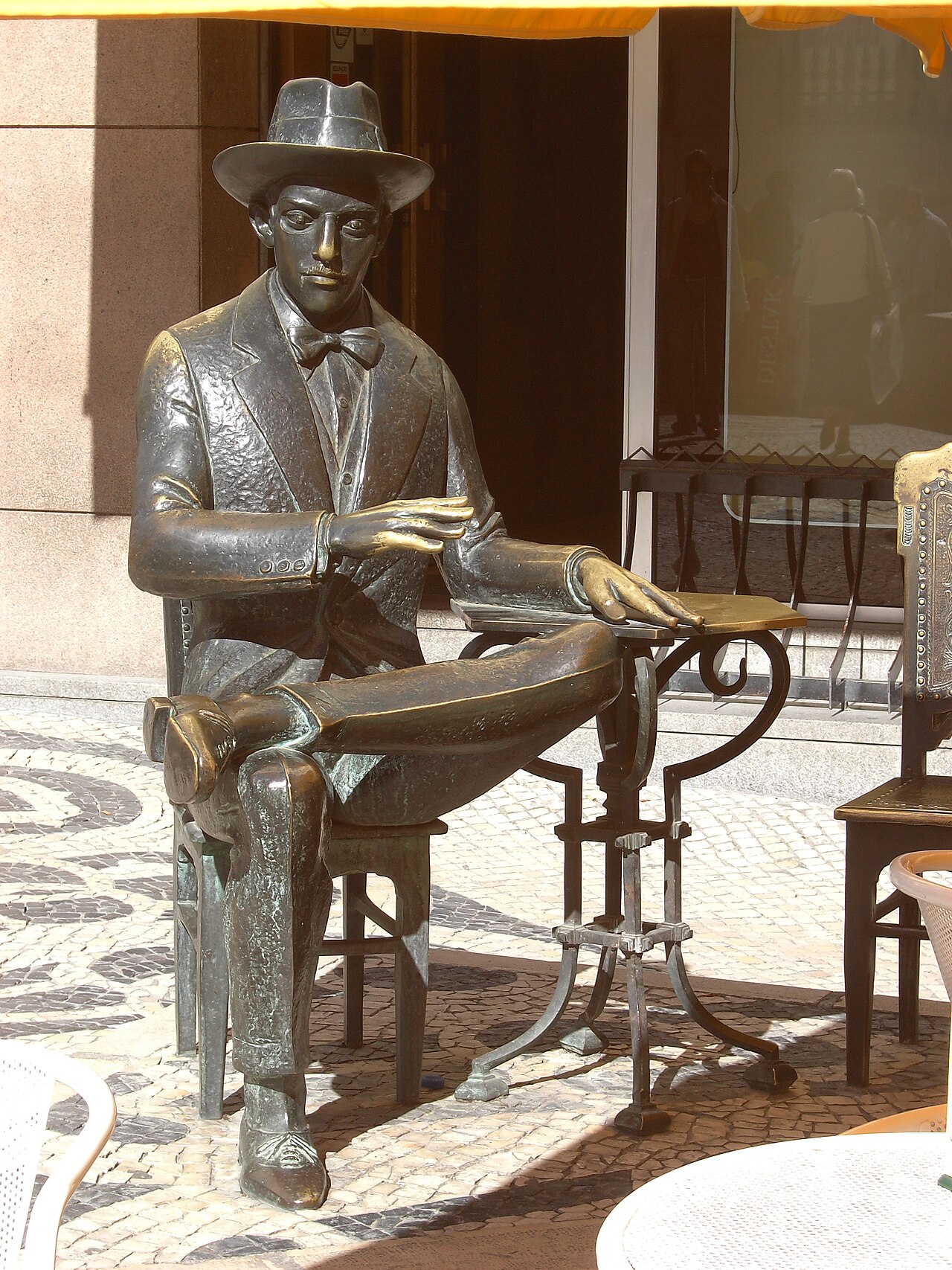
That tension is why Pessoa's Lisbon matters as more than scenery. The A Brasileira statue in the lead image can look tourist-familiar now, but it points toward the public-private geography of Pessoa's afterlife: cafes, city streets, literary memory, and the spectacle of a writer who turned anonymity into a form of abundance.[5] The seated figure is apt because Disquiet is not a heroic journey. It is a book of staying put until the inner weather becomes vast.
The Payoff Is A New Pace Of Attention
The reward of The Book of Disquiet is not that it becomes easy. It is that it changes the reader's pace. After enough fragments, the book makes ordinary consciousness feel less continuous and more edited. A mood is a paragraph. A street is an argument. A stray perception is not a detail but a test of how much unreality the real world can hold.
That is the best reason to read it slowly. Pessoa's book does not need the kind of admiration that turns it into a monument of sadness. It needs a reader willing to accept incompletion as a live form. The book's first official edition came nearly half a century after the author's death, and later editions still keep arguing with its order.[1][3] The instability is part of the work's identity, not a defect to be repaired.
Start anywhere, but start modestly. Read one fragment as if it were a room. Read another as if it were a ledger entry whose real account is spiritual. Let Soares be close enough to wound and distant enough to remain an invention. Above all, do not ask the book to move forward before you have learned how it stands still.
That is its peculiar gift. The Book of Disquiet teaches reading as a form of patient unrest: not finishing the self, not solving the city, not escaping the office, but discovering how much can happen inside a pause.
Sources
- New Directions, The Book of Disquiet: The Complete Edition; publisher page for the Margaret Jull Costa translation edited by Jeronimo Pizarro, edition data, and quoted sample line.
- Casa Fernando Pessoa, "Who wrote it?"; authorship history, Vicente Guedes, Bernardo Soares, and the Rua dos Douradores bookkeeper context.
- Casa Fernando Pessoa, "The first edition"; publication history of the 1982 Atica edition and its editors/transcribers.
- Poetry Foundation, "Fernando Pessoa"; biographical overview, heteronyms, Bernardo Soares, and Pessoa's posthumous reception.
- Wikimedia Commons, "File:Lisboa-Pessoa-A Brasileira-1.jpg"; Nol Aders photograph of Fernando Pessoa's statue outside A Brasileira, source for the article image.