Robert Frost is easy to remember badly. The schoolroom version turns him into a genial New England oracle who wrote about woods, walls, roads, birches, snow, and private choice. The counter-version is now almost as familiar: Frost was darker than the greeting-card Frost, more ironic, more dramatic, less comforting than his reputation. Both versions are useful up to a point. The archival value of seeing and hearing him in a 1952 interview and reading is that it breaks the shortcut. Frost does not appear as a simple rustic sage or as a hidden modernist in disguise. He appears as a performer of difficulty, using ordinary talk to make uncertainty feel conversational.[1][2]
That matters because Frost's poems often work by making plainness unstable. The Academy of American Poets biography places his public identity in a familiar frame: rural New England, colloquial speech, metrical command, and four Pulitzer Prizes across a long career.[2] But the poems themselves rarely let "plain" mean simple. Mending Wall begins with a force that does not love a wall, then stages a neighborly ritual in which repair and skepticism keep walking side by side.[6] The Road Not Taken looks like a clean decision poem until the speaker admits the roads were "as just as fair" and "worn them really about the same," making the later claim of decisive difference feel like a story imposed after the fact.[4]
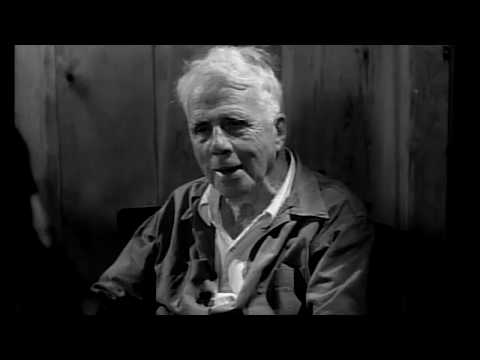
The 1952 footage catches that tension in person. The YouTube upload identifies the program as a Robert Frost interview plus poetry reading, with Frost in the public role that late-career America loved to assign him: elder poet, rural witness, speaker of apparently homespun truth.[1] Yet the interesting thing is not the scenery or the celebrity. It is the way Frost's voice makes a sentence seem to settle while quietly keeping a second pressure alive. He speaks as if the thought is arriving casually, but the pauses and turns are part of the thought. The performance teaches the viewer to distrust the idea that informal speech is unmade speech.
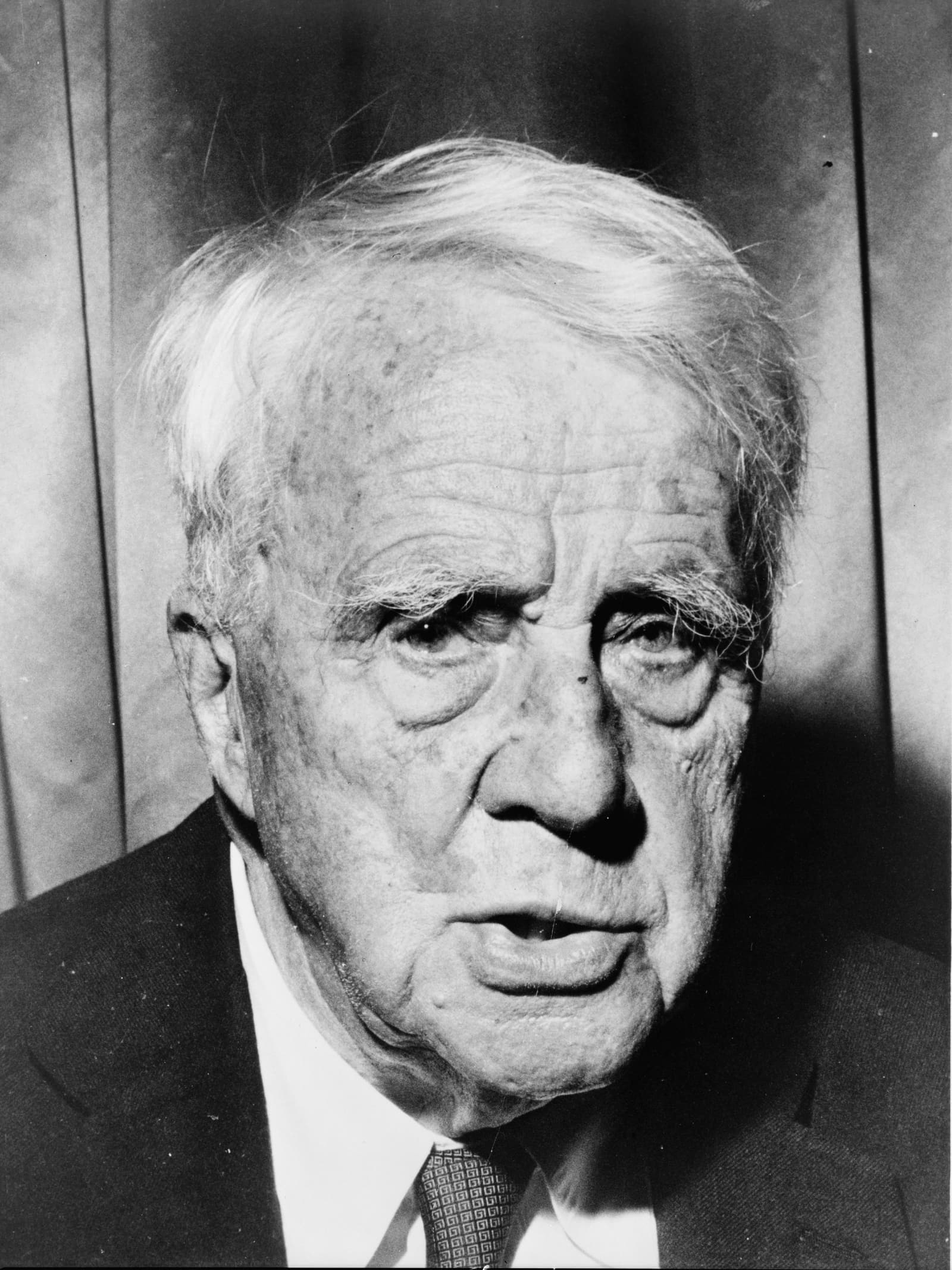
Image context: the cover image is a real archival press photograph, not a diagram, illustration, poster, or generated visual. The later-life portrait belongs here because Frost's public afterlife depends on recognizability: white hair, lined face, formal clothes, and the uneasy authority of a poet America kept asking to sound like itself.[7]
The 1952 Recording
The embedded video is the Manufacturing Intellect YouTube upload titled "Robert Frost interview + poetry reading (1952)." It presents archival television-era material rather than a modern explainer: Frost is not being interpreted over a montage, and the poems are not surrounded by classroom graphics. The viewer meets the old performance conditions directly enough to notice how much of Frost's literary identity was carried by tone, timing, and self-presentation.[1]
What the footage gives that a printed page cannot is Frost's control of apparent looseness. His public manner can look unguarded: half anecdote, half correction, a little amused by solemnity. But that ease is not the opposite of craft. It is craft in another register. Frost's best-known poems often depend on a speaker who sounds trustworthy while revealing that trust is one of the poem's problems. When a poem seems to say, "Here is a road, here is a wall, here is a bent tree," the visible world is already becoming argument.
Take The Road Not Taken. David Orr's essay for Poets.org is useful because it preserves the poem's long public problem: readers love it as a banner of individual choice, while its actual evidence keeps undercutting that confidence.[3] In print, the undercutting is grammatical and structural. In a reading voice, the undercutting becomes social. Frost can let the famous road seem momentous while also making the hesitation audible. The poem is not only about choosing. It is about the human need to turn choice into a coherent story afterward.[3][4]
That is why the archival Frost is not merely "authentic" Frost. He is a Frost who understands audience expectation. A printed speaker can say one thing and imply another; a public reader can do the same with pace. The camera shows the body doing what the poems do formally: offering a surface of reasonableness while allowing contradiction to remain in the room.
The same pattern holds in Birches. The poem begins with a visible rural image, then corrects itself: a boy's play is one explanation, but ice storms are another. The poem wants the fantasy of swinging and also the factual discipline of weather.[5] Its remembered line, "One could do worse," is not a slogan of escape so much as a carefully lowered claim. Frost's voice helps the reader hear the modesty of that landing. The poem does not abolish earth for heaven, or fact for desire. It lets imagination climb, then makes it come back.
Mending Wall is even more openly dramatic. The poem's two men are not simply a wise speaker and a foolish neighbor. The wall is damaged by seasonal force, repaired by inherited habit, mocked by one voice, defended by another.[6] Frost's public persona often tempted audiences to treat him as the speaker who has the better line. The archival recording pushes against that temptation because the living Frost sounds less like a verdict machine than a dramatist of opposed impulses. He knows the pleasure of the aphorism and the danger of believing aphorisms too quickly.
This is the central reason the 1952 material still matters. It shows that Frost's "plain speech" is not transparent glass. It is a stage. The old man at ease before the camera is not simplifying poetry for mass culture; he is demonstrating how mass culture can mistake ease for simplicity. His voice sounds accessible because the poems need access. Their pressure comes afterward, when the accessible phrase refuses to settle into one meaning.
Why The Footage Still Matters
Frost's legacy has been unusually vulnerable to quotation. A few lines detached from their poems can make him sound like a poet of sturdy resolution, neighborly wisdom, or self-reliant choice. The archive restores motion. It lets the viewer see a public poet managing the gap between fame and difficulty: he gives the audience a recognizable Frost, then lets that Frost become less stable than expected.
For readers now, the best use of the video is not to hunt for the "correct" Frost behind the poems. It is to watch how performance and text teach the same lesson. Frost's poems endure because they make ordinary American speech carry more than ordinary American certainty can bear. In 1952, on camera, the method is visible: a casual sentence, a pause, a familiar poem, and then the small disturbance that keeps the familiar from becoming safe.[1][2]
Sources
- Manufacturing Intellect, "Robert Frost interview + poetry reading (1952)," YouTube video.
- Academy of American Poets, "Robert Frost" (biography, publication overview, awards, and bibliography).
- David Orr, "The Road Not Taken: The Poem Everyone Loves and Everyone Gets Wrong," Academy of American Poets.
- Robert Frost, "The Road Not Taken," Academy of American Poets poem page.
- Robert Frost, "Birches," Academy of American Poets poem page.
- Robert Frost, "Mending Wall," Academy of American Poets poem page.
- Wikimedia Commons, "File:Robert Frost NYWTS 2.jpg" (New York World-Telegram and Sun / Library of Congress photographic source for the article image).