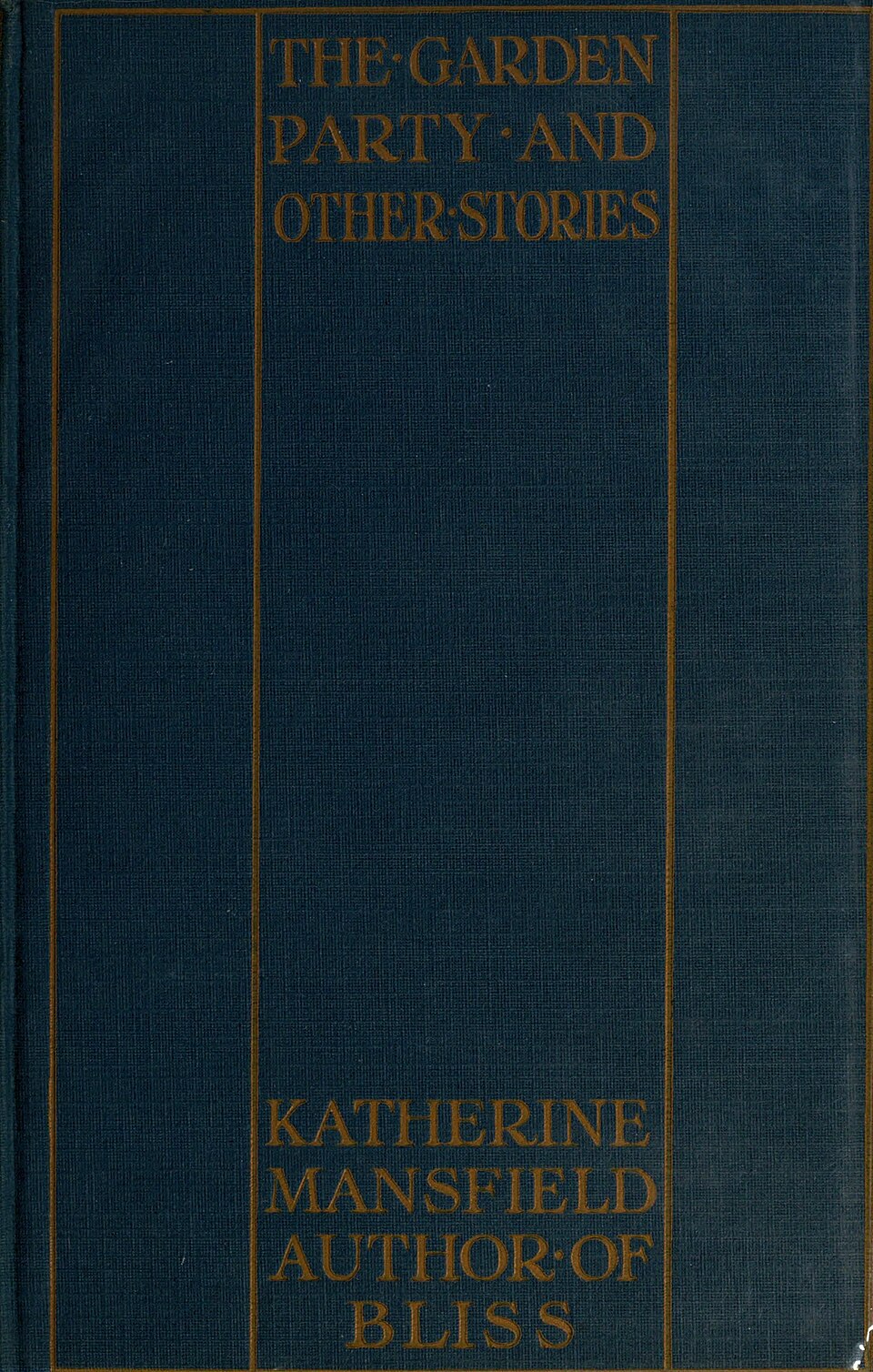
Katherine Mansfield's "The Garden Party" is often introduced as a story about class awakening: Laura Sheridan helps prepare an upper-middle-class garden party, hears that a working man has died in the lane below, wants the party stopped, is overruled, and later carries leftovers to the dead man's house.[1] That summary is accurate, but it risks making the story sound more morally settled than it is. Mansfield does not write Laura as a clean convert from privilege to knowledge. She writes a girl whose sympathy is real, unstable, theatrical, generous, and quickly absorbed by the house that formed her.
The story's brilliance lies in how little it preaches. It lets arrangements do the work: the marquee is moved, lilies arrive, sandwiches are cut, a band is expected, and a hat changes what Laura can feel. The dead carter, Mr. Scott, enters the story not through melodrama but through the logistics of a party that has already gathered momentum. Sympathy has to compete with weather, food, family tone, and the glamour of being dressed for the afternoon.[1]
That is why the route matters. Laura's moral imagination begins in the garden, stalls in the mirror, and is tested only when she walks downhill with the basket. The movement from house to lane is not simply a change of setting. It is the story's method for showing how class becomes geography.
The party starts by making labor disappear
Mansfield opens on a perfect morning, but the perfection is already social. The party looks natural because other people are making it so. Workmen arrive to place the marquee; servants and family members move through kitchen and lawn tasks; food appears in an escalating rhythm. The house can seem effortless only because effort has been distributed and softened into background service.[1]
Laura's first burst of feeling comes when she deals with the workmen. She wants to be natural with them, even comradely. She admires their ease, especially compared with the manners of the young men she knows. The response is sincere, but it is also aesthetic. Laura does not yet understand the workmen as people inside a structure of class dependence. She experiences them as a refreshing style of being. Mansfield makes that mistake attractive before she makes it inadequate.
The garden itself cooperates with the illusion. It is full of air, light, flowers, and movement, a place where hierarchy can briefly look like charm. The party's economy is visible everywhere, but it does not yet feel violent. The flowers are too beautiful, the morning too alive, the family too busy with taste. Mansfield's pressure comes from allowing that beauty to be persuasive. She knows that class comfort works partly by making itself feel like good weather.
The arrival of the lilies sharpens the point. They are excessive, gorgeous, and almost absurdly well-timed. Laura has a moral question forming, but the house keeps producing objects that answer feeling with display. The story does not need a villain to silence her. It has abundance.
"Stop the garden-party?" is a serious sentence in the wrong room
When news of Mr. Scott's death arrives, Laura's first impulse is startlingly clear: the party should stop.[1] This is not a childish whim. It is the one response that treats death as a fact capable of interrupting pleasure. Her family hears the same fact differently. For them, the accident is sad, but it belongs down there, in the lane, outside the social radius of sandwiches, guests, and music.
Jose's answer is important because it does not sound cruel to itself. She frames cancellation as extravagance, almost bad manners toward the party's own order. The dead man is near enough to be inconvenient but not near enough to become socially binding. Mansfield's class satire is exact here: the Sheridan household can acknowledge misfortune while refusing its claim on the afternoon.
The question of proximity becomes slippery. The cottages are "just below," yet socially remote.[1] The house stands above them, not only physically but narratively. News travels upward; leftovers will travel downward. What cannot travel easily is obligation. Laura feels the distance collapse for a moment, while the rest of the family immediately rebuilds it.
This is why the story is more unsettling than a simple indictment of snobbery. Laura's family is not incapable of emotion. They are capable of emotion in managed forms: sympathy after the party, a basket as gesture, a softened errand, a phrase of regret. What they resist is interruption. Their world can absorb death as an occasion for charity more easily than as a command to change plans.
The hat repairs the party by repairing Laura
Mrs. Sheridan's hat is one of the story's cruelest instruments. Laura enters her mother's room still troubled; she leaves altered by her own reflection. The famous plea, "Forgive my hat," is funny because Laura half-knows that the hat has compromised her.[1] She has not reasoned herself out of protest. She has been redressed.
That moment is not a cheap attack on feminine vanity. Mansfield's point is subtler. Clothing is a social technology. The hat gives Laura a role to inhabit: daughter of the house, beautiful party girl, someone meant to receive admiration rather than remain morally inconvenient. The mirror does not erase Mr. Scott. It re-centers Laura inside the Sheridan world.
The story's gender politics are folded into this class mechanism. Laura is sensitive, but she is also trained to experience herself as an object in a scene. Her mother does not argue abstractly that class hierarchy must be preserved. She offers beauty, timing, and maternal tact. The hat says: return to the picture.
Katherine Mansfield House & Garden's biographical page describes Mansfield as best known for Modernist short stories and notes that she published The Garden Party and Other Stories in 1922.[2] The hat is a perfect example of that modernist compression. It is one object, but it carries family authority, feminine performance, class continuity, and Laura's own susceptibility to being pleased. Mansfield makes an accessory do the work a speech would have spoiled.
The basket turns sympathy into an errand
After the party, Mrs. Sheridan has another inspiration: send the leftovers to the Scotts.[1] This is a socially acceptable version of Laura's earlier impulse. The party will not stop for death, but death may receive the party's remains. The gesture is kind and ghastly at once.
The basket matters because it converts moral unease into delivery. Laura is allowed to act, but only after the action has been domesticated. She will not confront the party's premise; she will carry its surplus. In that sense, the basket is the hat's companion object. The hat restores Laura to the party; the basket sends her out from it without requiring the house to revise itself.
Mansfield's timing makes the errand worse. The party has already happened. The sandwiches and cakes are no longer part of a living abundance; they are leftovers. The dead man's family receives not solidarity but an afterimage of celebration. The Sheridan house calls it sympathy because that is the form of sympathy it can imagine.
Yet the story does not let the reader dismiss Laura. She is embarrassed by the errand and partly aware of its indecency. She feels the basket as an awkward object, something her own class has placed in her hands. That awkwardness is one of her best qualities. She has not escaped privilege, but she can feel its props becoming strange.
Katherine Mansfield House & Garden notes that The Garden Party and Other Stories appeared in 1922 and included several of Mansfield's best-known stories, among them "At the Bay," "The Garden Party," and "Miss Brill."[4] The collection's force comes partly from this repeated attention to surfaces that suddenly fail: social visits, clothes, rooms, meals, and performances that reveal more than their users intend. In "The Garden Party," the basket is the failed surface par excellence. It is meant to signify care. It also exposes distance.
Downhill is the story's hardest grammar
The walk to the Scotts' cottage is the story's true close reading of class. Laura does not simply cross a boundary; she descends. The Sheridan house, with its garden and music, sits above. The cottages lie below, in a lane whose scale and texture do not answer to party aesthetics. Mansfield turns geography into syntax: above/below, garden/lane, music/silence, plenty/need, display/body.
The downhill movement also strips Laura of interpretive control. In the garden she could imagine herself generous and exceptional. In the lane she becomes conspicuous. Her hat, so persuasive in the mirror, now feels wrong. She is overdressed for grief, and the story lets her feel the violence of that mismatch without giving her a clean way to solve it.
This is where Mansfield's modernism becomes moral rather than merely stylistic. The Katherine Mansfield House & Garden biography places her between Wellington, London, Europe, and a circle of twentieth-century writers who recognized her brilliance.[2] The label matters here only if it helps us see method. Mansfield does not resolve Laura's experience into a lesson. She makes perception flicker under pressure.
Inside the dead man's house, Laura sees the body and is startled by its calm. The moment can sound dangerously aesthetic if paraphrased too quickly: the dead man appears peaceful, removed from the party's agitation. But Mansfield is not saying poverty is redeemed by beautiful death. She is showing Laura reaching the limit of her available language. Faced with a fact her class training cannot organize, Laura falls into broken speech.
Her unfinished "Isn't life" is one of the great incomplete sentences in the short story.[1] It is not wisdom. It is the failure of a girl who has seen something real and cannot yet say what it means. Laurie, her brother, finishes nothing for her. The story closes on recognition without articulation.
The story refuses to flatter sympathy
The easiest version of "The Garden Party" would make Laura's feeling triumph over her family's callousness. Mansfield refuses that comfort. Laura is more open than the people around her, but openness is not freedom. She can be moved by workmen, checked by death, seduced by a hat, burdened by a basket, and shaken by a corpse all in one afternoon. That inconsistency is not a flaw in the characterization. It is the point.
Katherine Mansfield House & Garden's account of Mansfield's Swiss period notes that in 1921, while seeking treatment for tuberculosis, she wrote several of the stories now central to her reputation, including "At the Bay," "The Garden Party," and "The Doll's House."[3] The biographical pressure should not be overread, but it helps explain the urgency of the late craft. Mansfield writes as if ordinary surfaces have very little time to reveal what they hide.
In "The Garden Party," sympathy is not rejected. It is tested. Laura's compassion matters because it registers a real disturbance in the Sheridan order. But the story will not let compassion congratulate itself for existing. Feeling can be genuine and still arrive wrapped in the wrong hat, carrying the wrong basket, too late in the day.
That is Mansfield's hard gift. She makes the reader feel the loveliness of the party and the obscenity of its continuance without pretending those perceptions cancel each other neatly. The garden is beautiful. The dead man is dead. The sandwiches are cut. The band plays. Laura walks downhill.
The final discomfort is that the story's path remains open behind her. The Sheridan house is still there. The lane is still there. Sympathy has made the journey once, but nothing in the story proves it will know how to live there. Mansfield leaves us with the distance, because the distance is the truth.
Sources
- Katherine Mansfield, The Garden Party, and Other Stories, Project Gutenberg eBook page and HTML text for "The Garden Party" and cited passages.
- Katherine Mansfield House & Garden, "Katherine Mansfield," biography with Wellington, London, modernist short-story, and publication context.
- Katherine Mansfield House & Garden, "100 Years of Mansfield and Switzerland," on Mansfield's 1921 Swiss period and the composition of several late stories.
- Katherine Mansfield House & Garden, "And Other Stories," centenary note on the 1922 publication of The Garden Party and Other Stories and its best-known stories.
- Wikimedia Commons, "File:The Garden Party (Mansfield) cover.jpg," source page for the 1922 Constable edition cover scan used as the article image.