A flower breaks before the hero arrives. In the opening chapter of Charlotte Mary Yonge's The Heir of Redclyffe, Amy Edmonstone carries in a camellia she has carefully brought into bloom. Philip Morville takes it from her: “It is too heavy for you.” The blossom strikes a table and falls. Amy makes light of the accident; her brother sees her blinking away a tear.[1]
Philip apologizes. The small disaster hardly makes him a villain. Yet it establishes a habit that will become disastrous: he can be so certain he knows what someone needs that he takes the matter out of her hands. The novel's most searching question is how that certainty might change. Regret will prove easier than listening.
Published in 1853, The Heir of Redclyffe became a bestseller. Hilary Clare's account of Yonge for Winchester Cathedral records its appeal even to soldiers in the Crimean War, a useful corrective to the author's later reputation as a writer chiefly for girls.[2] Its attraction includes romance, a family feud, and a deathbed. The moral argument also happens in rooms where people interrupt, tease, and rearrange one another's lives.
This essay discusses the ending.
The comfort of knowing better
Philip has the great advantage of sounding reasonable. Guy Morville, his younger cousin and the heir to Redclyffe, has a temper he fears. The contrast encourages other people to treat Philip as an authority and Guy as a problem. When Guy's unexplained financial arrangements become grounds for suspicion of gambling, Philip's judgment helps separate him from Amy.[1]
The danger lies in the unequal scrutiny. Guy's impulses require examination; Philip's motives appear to arrive already examined. A reputation for self-command becomes permission to command other people. Yonge makes this persuasive enough to be uncomfortable. We can recognize the appeal of the person who seems able to settle a difficult question.
Chapter 20 supplies an exquisite miniature of the resulting self-deception. Philip and Laura, Amy's elder sister, are secretly engaged. Walking together, he chooses the more public path to sustain his conviction that he is “doing nothing in an underhand way.”[1] The location supplies him with an alibi. He treats visibility as honesty while withholding the information that would let the family understand what it sees.
Notice how little conscious lying this requires. A concealed attachment becomes, in Philip's account of himself, a demanding exercise in patience and responsibility. The more elevated the description, the harder it becomes to ask whether anyone else has been deceived.
Gavin Budge's study of the novel connects Philip's rationalizing to its religious argument: his reasoning protects him from recognizing motives that are apparent to others. Budge also insists that Yonge's detailed domestic realism belongs with her Tractarian Christianity, rather than being an accidental achievement beneath a religious message.[3] On this reading, the ordinary evasions matter because conscience must work through them. Conviction does not exempt a person from self-examination.
A novel might have helped
Yonge gives this serious problem a wonderfully comic literary form. Philip discourages Laura from reading novels; they nevertheless conduct a secret engagement. In chapter 32, Amy suggests that fiction might have helped her sister understand the situation she was entering.[1]
The joke gives reading a practical moral use. A story lets us see the distance between what a character says an arrangement means and what it asks other people to endure. Laura has plenty of Philip's explanations available. What she lacks is a vantage point outside them.
Clare Walker Gore's 2014 essay treats this attention to reading as evidence of Yonge's formal sophistication. She argues that the book combines Gothic romance and domestic realism while making the interpretation of stories part of its ethical action.[4] That helps explain why its moral seriousness can remain playful. Readers may enjoy the lovers' predicament while noticing how badly the lovers describe it.
Even Amy's insight is tested. As she criticizes Philip, Guy asks her to consider the difficulty of his confession.[1] Being correct about another person's fault can become its own pleasure. The conversation asks whether exposure will lead to help or simply furnish a satisfying verdict. Yonge allows the accusation to be justified without making accusation the end of moral attention.
The generous command
Guy nurses Philip through a fever and dies after falling ill himself. Philip survives to face the injuries he has done; after the birth of Guy and Amy's daughter, the estate passes to him under its male succession arrangements.[1] The result is painfully ill-suited to a tidy system of rewards. His repentance cannot restore the person who saved him.
Then, in chapter 40, Philip returns to the drawing room. The neglected plants recall Amy's old care for her camellia. He remembers the flower and confronts the much greater loss that has changed her life. Holding her baby, he weeps.[1]
The return to that room gives the opening accident a new weight. What once looked like a minor failure of helpfulness becomes a measure of how much Amy has had to absorb. But Yonge refuses to let tears certify that Philip has learned everything.
He proposes to transfer Redclyffe to the child. “It is to be done,” he announces. Amy refuses. She says the arrangements were anticipated, the child is already provided for, and Guy wanted Philip to continue his work on the estate. When Philip describes the inheritance as a burden, she tells him to “carry it.”[1]
His offer has a serious claim to generosity. It would also let him choose the form of his punishment and require Amy to accept it. The commanding grammar survives his change of heart. He still begins by declaring what someone else must allow him to do.
Amy's answer is deliberately practical. She discusses management, provision, and her husband's wishes. These details interrupt the grandeur of renunciation. Philip must attend to an actual recipient who has reasons for refusing the gift.
There is a limit to this resolution. The novel preserves a landed order in which the estate follows the male line, and Amy's argument accepts that order. Readers need not regard those arrangements as just to recognize the force of the conversation. Its ethical achievement is narrower: Philip finally lets another person's judgment alter his chosen act of goodness.
He keeps the property and abandons the renunciation he wanted. Yonge presents that surrender of his own plan as the harder sacrifice.[1] The change is easy for the outside world to mistake for advantage. It produces no impressive public proof of virtue.
That quiet exchange gives the broken camellia its answer. Amy no longer has to soften the consequences of Philip's intervention while he explains what is best. She speaks, he listens, and the help she has declined stays in his hands.
Sources
- Charlotte M. Yonge, The Heir of Redclyffe (1853), especially chapters 1, 20, 32, 35–36, and 40. Project Gutenberg text; the camellia, concealed engagement, discussion of novels, Guy's death, and Philip's proposed renunciation.
- Hilary Clare, “Charlotte Mary Yonge, 1823–1901: A Victorian Novelist in Her Bicentenary Year” (2023), pp. 1–3. Winchester Cathedral; publication, readership, and religious context.
- Gavin Budge, “Realism and Typology in Charlotte M. Yonge's The Heir of Redclyffe,” Victorian Literature and Culture 31.1 (2003), pp. 193–223, especially pp. 193–194 and 214–215. University of Hertfordshire repository copy; religious realism and Philip's rationalizations.
- Clare Walker Gore, “‘Setting Novels at Defiance’: Novel Reading and Novelistic Form in Charlotte M. Yonge's The Heir of Redclyffe,” Nineteenth-Century Gender Studies 10.1 (Spring 2014), especially paragraphs 1–6 and 14–16. Critical afterlife, genre, and reading as an ethical practice.
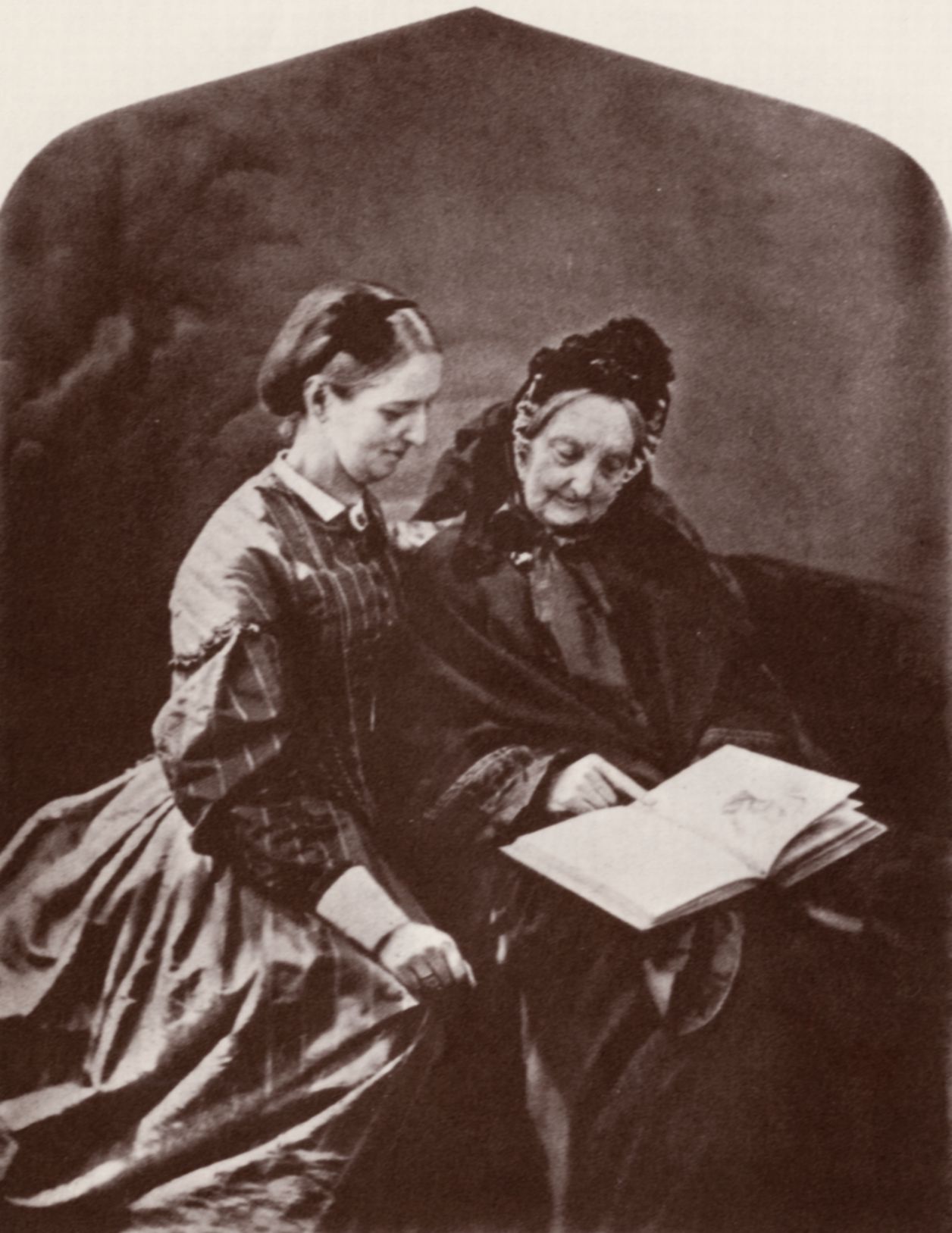
- Lewis Carroll, Charlotte Mary Yonge with her mother (1866). Wikimedia Commons file record, “Carrol, Lewis — Frau Yonge und ihre Tochter Charlotte (Zeno Fotografie)”; photographic reproduction from Zeno.org.