Samuel Taylor Coleridge's The Rime of the Ancient Mariner looks, at first, like a sea story. A wedding guest is stopped; an old sailor begins; the ship sails south, freezes, breaks free, wanders under supernatural pressure, and somehow returns. That itinerary is vivid enough that the poem can survive in memory as albatross, thirst, corpses, spirits, and moral. But the structure is stranger than a voyage narrative. It is a trap that keeps changing shape.
The first trap is social. The Wedding-Guest is on his way to a feast, a public ritual of joining, kinship, music, and ordinary time. The Mariner detains him with an eye and a story; the guest's body remains near the wedding, but his attention is removed from it.[1] From that point on, the poem makes reading feel like forced listening. The guest is not choosing an aesthetic experience. He is being held.
That matters because the poem's famous events are already framed as aftershock. The albatross has long since been killed. The crew has long since died. The ship has long since come home. What remains is compulsion: the Mariner must repeat the story when the "woful agony" returns, and someone else must receive it.[1] The poem is therefore not built around what happens at sea alone. It is built around the difficulty of finishing what has already happened.
The Frame Is The First Net
The Wedding-Guest frame does two formal jobs at once. It gives the reader a listener inside the poem, and it makes that listener visibly resistant. He wants to attend the wedding, hears the bassoon, imagines the bride entering, and keeps trying to rejoin the human ceremony he came for.[1] Each interruption reminds us that the Mariner's tale is not free-floating lyric memory. It is a speech act that displaces another event.
Coleridge strengthens that displacement by making the frame return at moments of pressure. The guest's fear, impatience, and fascination become a rough barometer for the story's force. When he panics at the Mariner's appearance, the poem turns his response into a reader's question: is this man alive, dead, cursed, or merely terrible at ordinary conversation? The frame keeps the supernatural from becoming stage scenery. It makes the supernatural enter a social room.
Britannica's account of the poem emphasizes the young sailor's crime, suffering, and eventual redemption, and that summary is useful as a plot skeleton.[4] But the frame complicates any clean redemption arc. If the Mariner were simply redeemed, why does he keep seizing strangers? If the moral were settled, why does the telling still wound him and alter the listener? The guest leaves "a sadder and a wiser man," but the poem gives no easy measure for that wisdom.[1]
Ballad Speed Makes Causality Feel Unstable
The second trap is rhythmic. Coleridge borrows the speed, repetition, and abruptness of older ballad form, then uses them to make causality feel both obvious and uncertain. The albatross appears; the sailors welcome it; the Mariner shoots it. The chain looks simple because ballad narration moves with frightening economy. Yet the poem never gives the murder a psychological explanation that would tame it.
That lack is the point. The Mariner's action is structurally central because it is morally immense and psychologically under-explained. A realist novel might spend chapters preparing motive. Coleridge lets the shot arrive with terrible plainness. The form refuses to let us hide inside motive. We are left with act, consequence, and repetition.
The poem's most remembered phrases work the same way. "Water, water, every where" is almost childish in its repetition, but the surrounding situation makes the music punitive rather than simple.[1] The line's pattern enacts excess without relief: too much water, no drink, too much world, no mercy. Ballad clarity becomes a pressure chamber.
This is why the poem's archaic surface is not ornamental. British Library commentary notes that early readers and reviewers found the original 1798 style bewildering, and Coleridge later revised spellings, cut lines, and added the 1817 marginal gloss.[2][3] The oldness of the voice is part of the machine. It makes the story feel inherited, sung, and half-ritualized before the reader can convert it into modern case history.
The Gloss Explains And Fails To Explain
The 1817 marginal gloss is the poem's third trap because it promises control. A margin usually steadies a text: it identifies, clarifies, cross-references, or moralizes. Coleridge's gloss does some of that. It tells us when the spirit follows, when the curse works, when expiation seems to occur. British Library's introduction notes the gloss's line that "The curse is finally expiated," while asking whether the margin should be treated as Coleridge's authority or as another fictional layer.[2]
That question is crucial. The gloss can sound like an official explanation, but it often makes the poem feel more uncanny, not less. Its prose is calm where the poem is fevered. Its causality is tidier than the experience it annotates. Instead of closing the poem, it creates a second voice hovering beside it, as if the Mariner's story has already become an object scholars, editors, priests, or later readers are trying to discipline.
The result is a poem with two kinds of time on the page. The verse moves as immediate ordeal: thirst, heat, death, prayer, sleep, return. The gloss moves as retrospective classification. Between them sits the reader, forced to decide whether explanation has arrived or whether explanation is another symptom of the need to make disaster legible.
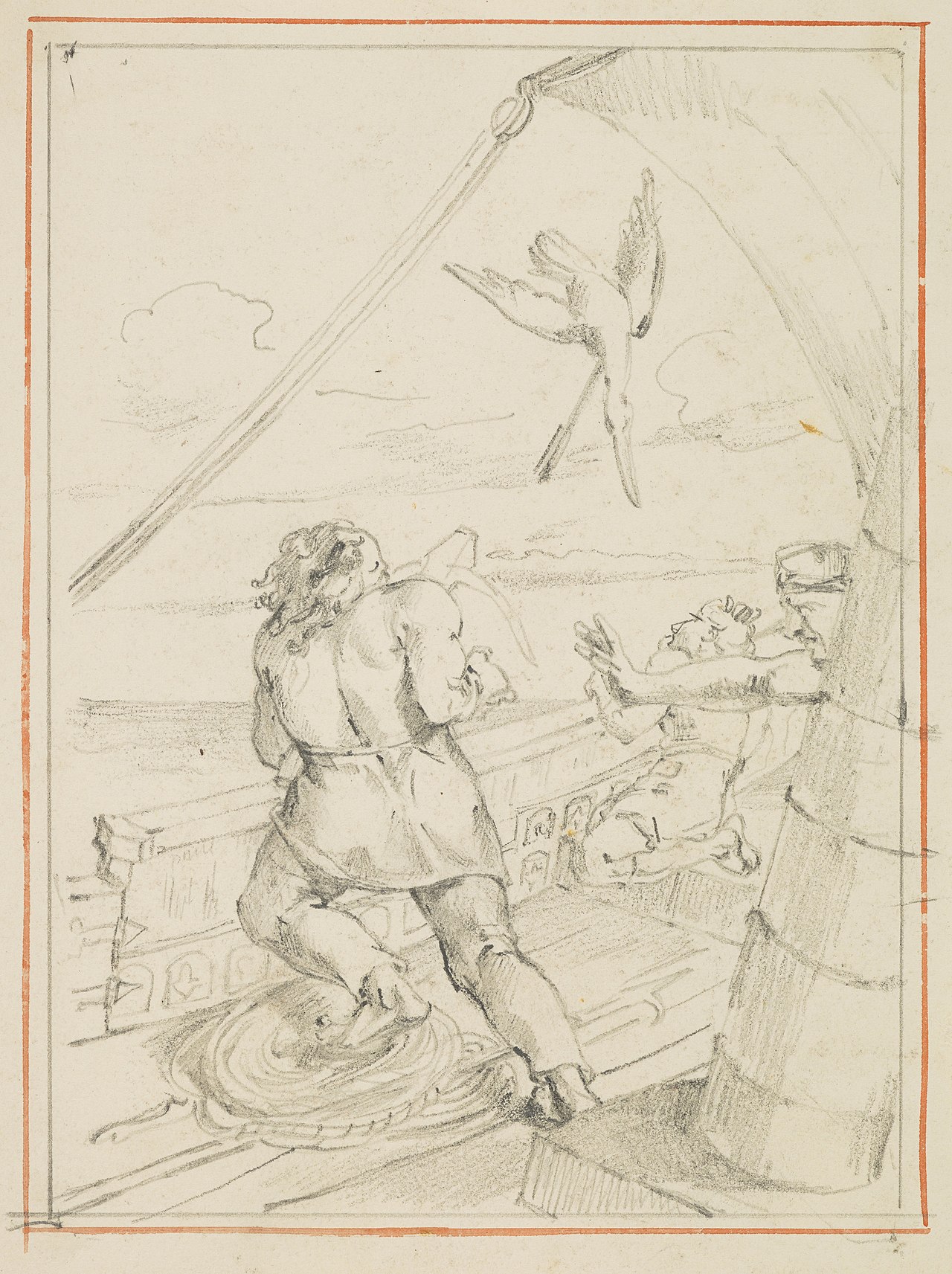
That is also why David Scott's early illustration of the shooting is such a fitting image for the poem's afterlife.[5] A single visual moment seems to identify the crime. But the poem itself will not let that moment stay single. The shot becomes a bird around the neck, a crew's accusation, a field of dead eyes, a prayer that finally comes, a habit of retelling, and a lesson that may or may not be adequate to the terror that produced it.
The Return Does Not Restore Ordinary Time
The fourth trap is the ending. Structurally, the ship's return should close the voyage. Land appears, harbor lights arrive, familiar figures come into view. In an adventure narrative, return converts danger into experience. In Coleridge's poem, return opens the final wound. The Mariner survives, but survival means repetition.
This is where the wedding frame becomes indispensable. The guest has missed the feast's full innocence. He wakes the next morning altered, separated from the communal pleasure he had intended to join.[1] The Mariner's tale has reproduced its own displacement in miniature: a man is pulled out of ordinary life, made to listen, then returned changed but not comfortably healed.
The British Library's work page places the poem in the context of Lyrical Ballads in 1798 and notes its long revision history, including Coleridge's continued work on the poem until near the end of his life.[3] That publication history mirrors the poem's internal structure. The Rime is itself a retold, revised, glossed, re-entered work. It does not simply narrate compulsion; it became a literary object through repeated acts of framing.
The final moral about loving all creatures is therefore both necessary and insufficient. Necessary, because the poem does move toward a recognition that blessing the water-snakes breaks the deadlock of disgust and isolation.[1][2] Insufficient, because the form refuses to let moral statement erase trauma, arbitrariness, or the ongoing violence of narration. The Mariner's wisdom is real, but it does not free him from telling.
Read this way, The Rime of the Ancient Mariner is not great because it has a memorable symbol. It is great because every formal layer turns symbol into recurrence. The wedding frame catches the listener. The ballad meter catches the reader's ear. The unexplained shot catches the moral imagination. The gloss catches the desire to interpret. The ending catches return itself and makes it another beginning.
That is the poem's hard pleasure. It moves like a voyage, but it works like a trap. Once the Mariner starts speaking, no one simply attends the wedding again.
Sources
- Samuel Taylor Coleridge, The Rime of the Ancient Mariner, Project Gutenberg ebook page; full text used for scene references and short quotations.
- The British Library, "An introduction to The Rime of the Ancient Mariner"; Seamus Perry on sin, suffering, salvation, revision, and the marginal gloss.
- The British Library, "Samuel Taylor Coleridge's 'The Rime of the Ancient Mariner'"; publication context, sources, reception, revision history, and manuscript/document context.
- Encyclopaedia Britannica, "The Rime of the Ancient Mariner"; plot, publication, and literary context overview.
- Wikimedia Commons, "File:The Mariner shoots the Albatross.jpg"; archival photographic reproduction of David Scott's 1831-1832 illustration, source for the article image.