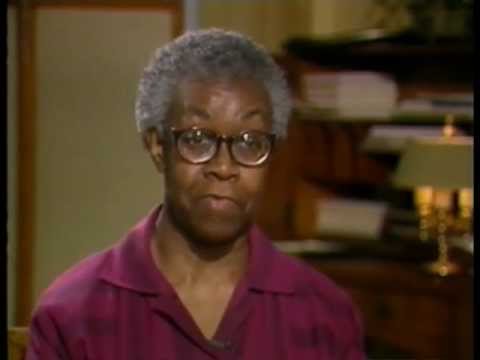
In 1986, Gwendolyn Brooks sat for HoCoPoLitSo's The Writing Life, a half-hour literary interview series built around writers speaking with other writers about craft and process.[1][2] The format matters. Brooks is not being converted into a monument or a schoolroom unit. She is in conversation with Alan Jabbour, then director of the Library of Congress's American Folklife Center, and poet E. Ethelbert Miller, director of Howard University's African American Resource Center.[1] The room is modest, but the literary pressure is high: Brooks has to answer as a public elder without letting the poem vanish behind reputation.
That tension is exactly why the footage is worth watching now. Brooks had already become a major institutional figure by the mid-1980s. The Academy of American Poets notes the span clearly: A Street in Bronzeville in 1945, Annie Allen in 1949, the Pulitzer Prize, the 1960 publication of The Bean Eaters, the 1967 Fisk conference turn toward a more openly Black Arts-era public role, Illinois poet laureate in 1968, and appointment in 1985 as the first Black woman to serve as Consultant in Poetry to the Library of Congress.[3][4][5] The archive catches her at the point where honor has accumulated, but the poem's mechanism is still small enough to hold in the mouth.
The central object is "We Real Cool." The poem is so short that cultural memory can flatten it into attitude: seven pool players, a quick collective swagger, the famous closing fall.[3] Brooks's live explanation does something better. It restores the poem as timing. The repeated "we" is not only a pronoun. It is a tiny social engine, a group sound that arrives after each sentence and keeps the players leaning on one another until the poem's last turn makes the cost audible.[1][3][4]
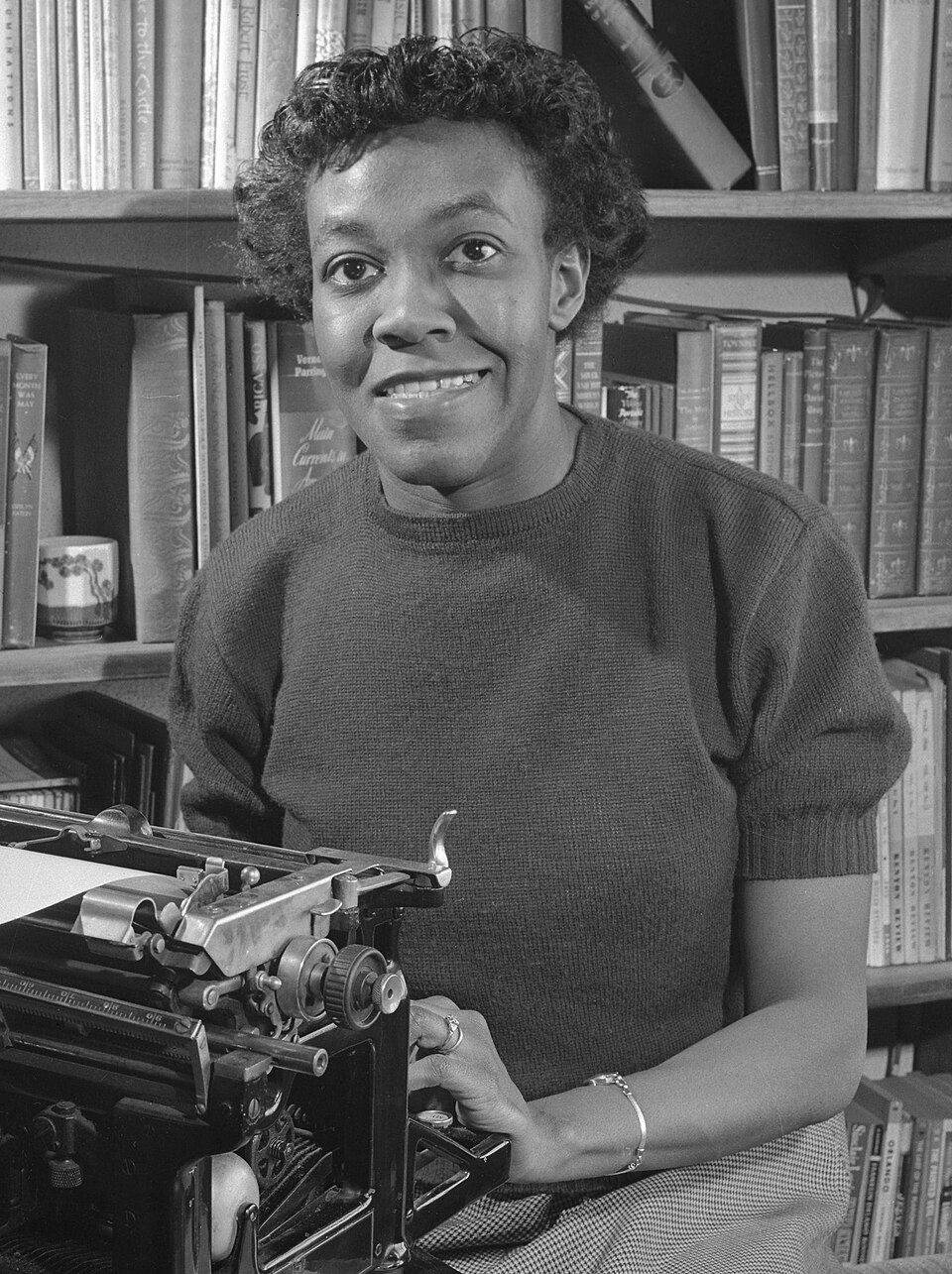
*Image context: the cover uses a real 1950 archival portrait from Wikimedia Commons, distributed by ACME after Brooks won the Pulitzer Prize for *Annie Allen.[6] A prize photograph might seem too official for a poem about pool players, but the contrast is useful. The video shows Brooks refusing to let public honor smooth out the street-level exactness that made her work last.
Historical context: by 1986, Brooks had become an institution without giving up the neighborhood sentence
Brooks's public position in 1986 was the result of several overlapping histories. She was the poet of Bronzeville's interior rooms and South Side streets, the first Black writer to win a Pulitzer Prize, a mentor and participant in Black Arts-era literary networks, and a figure of civic service through workshops, readings, and youth poetry contests.[4][5] That range can make her sound too large to read closely. The archive corrects the scale. Brooks keeps bringing authority back to small technical decisions: where the voice falls, how a line turns, why a phrase should not be overexplained.
Poets.org places "We Real Cool" in The Bean Eaters and prints the poem with the line-end pattern that made it famous: almost every short sentence is followed by the next "We."[3] The Library of Congress catalog record for Brooks's September 30, 1985 reading confirms that Brooks herself kept returning to the poem in public performance; its contents list "We Real Cool" at minute 21:09 in a reading by the newly appointed Consultant in Poetry.[4] The HoCoPoLitSo clip belongs to that same late-public phase, but with one advantage. It does not only preserve the reading voice. It gives Brooks space to talk about why the voice has to work that way.[1][2]
That is important because "We Real Cool" is often taught as though its meaning were immediately available: school refusal, nightlife, bravado, danger, death. Those readings are not wrong, but they can make the poem feel like a sociological caption. Brooks's own performance reveals the subtler achievement. She makes syntax behave like group behavior. The young men seem bound together by the repeated pronoun, but that togetherness is unstable. The "we" sounds confident, then slightly compulsive, then finally exposed.
Video provenance
The embedded video is HoCoPoLitSo's YouTube upload of The Writing Life episode featuring Brooks.[1] HoCoPoLitSo's archive page describes the series as a writer-to-writer talk show and specifically notes Brooks reciting "We Real Cool" among the digitized episodes.[2] The video itself supplies the immediate broadcast frame: Brooks in conversation with Jabbour and Miller in 1986.[1] Together, those sources give the clip the provenance an archival spotlight needs: series context, institutional channel, named interlocutors, and a date close to Brooks's Library of Congress appointment.[1][2][4]
The line-end "we" is a social sound before it is an idea
What the clip makes newly available is not a secret interpretation. It is an audible grammar. Brooks explains and performs the "we" as a light, lingering attachment at the line edge, not as a heavy slogan.[1] That matters because the poem's entire moral intelligence depends on not overloading the pronoun too early. If "we" is shouted as defiance, the poem becomes flatter. If it is swallowed, the social pressure disappears. Brooks keeps it quick enough to sound casual and exposed enough to sound necessary.
This is where the poem's typography and performance meet. On the page, the repeated "We" hangs at the end of a phrase and seems to push the next action forward.[3] In the voice, it becomes breath. The group has to keep saying itself into existence. "We real cool" is not simply a boast; it is a completed pose followed by an afterbeat that reveals dependence.[3] Each return of the pronoun says: the group is the style, the shelter, and the trap.
Brooks's brilliance is that she does not need to lecture the reader about that trap. The form does the work. The boys' actions are clipped, parallel, and exciting; the sentences snap shut almost before moral commentary can enter.[3] Yet the repeated pronoun keeps refusing closure. It makes the poem feel like a chain of breathy recommitments, as if each action requires group confirmation. The final "Die soon" lands harder because the expected afterbeat is gone.[3] The group voice has reached the place where it can no longer extend itself.
Brooks's public modesty is part of the craft lesson
The interview also matters because Brooks does not perform difficulty as prestige.[1] Her manner is plain, even lightly amused. That plainness can mislead a viewer into thinking the craft point is small. It is not. She is explaining how a poem of fewer than thirty words can turn enjambment into social psychology. The lesson is severe precisely because the language is simple.
That quality runs through Brooks's larger career. The Academy biography stresses both technical mastery and civic range: more than twenty books, the Black Arts turn, workshops from her home, public readings, and work with younger writers.[5] The HoCoPoLitSo recording condenses that career into a pedagogical moment. Brooks is not guarding the poem as private property. She is showing how it works, almost as if handing the reader a small machine and saying: listen to the hinge.
That career frame helps explain the interview's lack of grandstanding. Brooks's authority does not require a mystical aura around the author. It comes from exactness, discipline, and a habit of treating young or ordinary speech as worthy of the most precise formal attention.[1][5]
Why this archive still matters
The clip matters because it protects "We Real Cool" from two weak afterlives. One turns the poem into a classroom emblem of bad choices. The other turns it into pure style, all snap and no consequence. Brooks's own voice refuses both. She lets the poem stay cool enough to remain seductive and fatal enough to remain honest.[1][3] The point is not to scold the pool players from above. The point is to make the reader hear how group glamour can become a rhythm one cannot easily exit.
That is why the archival footage belongs in literary history, not only in author biography. It shows Brooks reading her own lineation as a live acoustic event. The poem's intelligence is not hidden behind the words; it is in the pause after them, in the slight suspension of "we," in the way a pronoun can become camaraderie, mask, meter, and warning at once.[1][3][4]
Seen from 2026, the 1986 interview also restores a useful model of literary authority. Brooks had the prizes, the appointments, and the public stature.[4][5] Yet the archive's strongest moment is still microscopic: a poet explaining how to hear one small word at the edge of a line. That is the durable lesson. Brooks's greatness does not float above craft. It arrives through craft so exact that a line break can make a whole social world speak.
Sources
- HoCoPoLitSo, "Gwendolyn Brooks," The Writing Life, YouTube video.
- HoCoPoLitSo, "YouTube Channel" (archive overview noting The Writing Life episodes and Brooks reciting "We Real Cool").
- Academy of American Poets, "We Real Cool" by Gwendolyn Brooks (poem text and publication note from The Bean Eaters).
- Library of Congress, LCCN record for "Gwendolyn Brooks reading from her poetry" (1985 Archive of Recorded Poetry and Literature record, including "We Real Cool" at minute 21:09).
- Academy of American Poets, "Gwendolyn Brooks" (biography, bibliography, and institutional career notes).
- Wikimedia Commons, "File:Gwendolyn Brooks ACME 1950.jpg" (source page for the lead photograph).