Samuel Taylor Coleridge's Kubla Khan is often introduced through its legend before it is heard as a poem: dream, opium, interruption, lost lines, fragment. That legend matters because Coleridge himself helped attach it to the published work, and because the poem reached print in 1816 with a preface that frames it as an unusual survival rather than an ordinary finished lyric.[2][3] But the legend can also make the poem sound like an accident with pretty scenery. The better first move is to listen to the structure. Kubla Khan is not shapeless. It is a poem of three architectures: the ruler's decree, the earth's eruption, and the poet's desired song.[1][3][4]
Those architectures never settle into one another. The imperial opening imagines command as design: a dome, a measured enclosure, a river routed through a named paradise. Then the ground itself answers with pressure, chasm, fountain, and prophecy. Finally the poem turns toward a speaker who wants to recover music powerful enough to rebuild the dome in air. The result is a fragment, but not a failed fragment. Its incompletion is part of its method. The poem keeps making form visible at the moment form threatens to dissolve.[1][3]
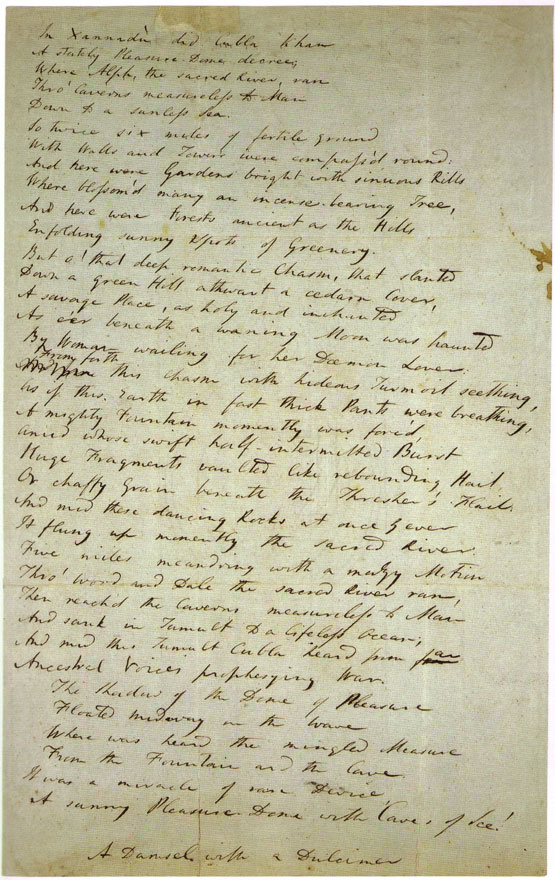
Image context: the cover is not a decorative bookish scene. It is an archival manuscript image of Coleridge's poem, described by Wikimedia Commons as a draft dated between 1797 and 1818.[5] That material trace suits a poem whose afterlife depends on the tension between manuscript survival, printed framing, and a form that seems to have arrived already interrupted.
1. The decree gives the poem its first kind of form
The opening gesture is architectural before it is descriptive. Kubla does not merely possess Xanadu; he commands a structure into being. The famous "stately pleasure-dome" is therefore a political object as much as a fantasy image.[1] It begins with decree, enclosure, and design. A ruler's will tries to turn landscape into pattern.
Coleridge makes that pattern seductive because he lets sound do part of the building. The repeated open vowels, the chime of place name and title, and the pressure of the line endings make the dome feel less like a static palace than like an acoustical event. Even before the sacred river enters, the poem has begun to build by cadence. Britannica's short account rightly notes the poem's exotic imagery and rhythmic power, but rhythm is not ornament here. It is the first visible sign that command in this poem is never just visual. Authority has to become sound before the reader feels it as form.[3]
Yet the opening also installs a limit inside that command. The river runs through "caverns measureless to man" and goes down to a "sunless sea."[1] Those two phrases are enough to weaken the ruler's map. The dome may be decreed, the gardens may be girdled, but the water system under the poem exceeds human measurement. The first architecture therefore contains its own counterforce. The poem's surface offers design; its depth announces that design is partial.
That is why the pleasure dome should not be read as a simple emblem of successful imagination. It is already compromised by what it cannot contain. The opening section lets human or imperial art draw a circle, then sends the river through spaces where the circle loses jurisdiction.
2. The landscape breaks the ruler's form without becoming chaos
The middle movement changes the poem's physics. The measured estate gives way to a "savage place," a chasm, a fountain, and violent energy rising from below.[1] This section can feel like a sudden switch from palace picture to Gothic landscape, but formally it is more precise than that. The poem is not abandoning structure. It is replacing one kind of structure with another.
The first section is built by decree and enclosure; the second is built by pressure and release. The fountain erupts, fragments are thrown upward, the river is forced through a broken course, and the poem's music becomes heavier and more convulsive. Coleridge turns landscape into a system of stored energy. The earth is not passive matter waiting for Kubla's design. It has its own grammar: recoil, burst, descent, return.
This is where the poem becomes more than a dream postcard. Britannica's biography of Coleridge places Kubla Khan in relation to his mythological and psychological interests, especially the question of human genius.[4] The middle section is central to that question because it refuses to let genius mean smooth creation alone. Creation here has a violent underside. The dome exists beside ancestral warning; pleasure is shadowed by war; the ordered river still comes from a chasm whose force cannot be politely landscaped.[1][4]
The phrase "ancestral voices prophesying war" matters because it brings time into the architecture.[1] The poem is no longer only spatial: dome, river, caves, sea. It now contains memory and prediction. Voices from before speak toward danger ahead. That temporal pressure makes the pleasure dome newly unstable. Kubla's decree may found an estate, but the poem's deeper structure includes a past and future that no estate can fully master.
3. The final turn makes the poet the risky architect
The last section is the strangest because the poem suddenly changes its center of gravity. Kubla recedes. The landscape recedes. A speaker remembers a "damsel with a dulcimer" and imagines that, if he could revive her music, he could build the dome again through song.[1] The poem has moved from imperial architecture to geological architecture to poetic architecture.
That movement is the key to its form. The ruler builds by command. The earth builds by eruption. The poet would build by recovered music. Each mode makes something real, but each is unstable. Command cannot measure the caves. Eruption cannot become habitable order by itself. Song depends on a remembered sound the speaker may not be able to summon again.
This is why the final fantasy is thrilling and dangerous at once. If the speaker could recover the music, he says, the dome would rise in air. That phrase often gets treated as a triumphant image of imagination. It is partly that. But it is also an image of non-material form, a building made of cadence, belief, and the listener's response. The poem asks whether art can remake a lost vision without pretending to possess it as a ruler possesses land.
The answer remains suspended. The imagined audience would respond with "holy dread" because the inspired maker has consumed the "milk of Paradise."[1] That is not ordinary applause. It is ritual caution. The poet who can rebuild the dome in air is not merely charming; he is marked off, circled, feared. Coleridge lets poetic power look close to enchantment, but he also makes it socially dangerous. The inspired figure does not rejoin the room easily.
4. The fragment is the structure, not a defect outside it
The Morgan Library's record for the 1816 volume is useful because it reminds us that Kubla Khan entered print as part of a material book, after a preface, and beside Christabel and The Pains of Sleep.[2] The poem's aura of dream survival did not float free from publication. It was staged, printed, framed, and preserved. That does not make the dream story false; it makes the poem's afterlife more interesting. The fragment became a literary object because print gave interruption a durable form.[2][3]
Read closely, the poem justifies that durability. Its three-part movement does not need a conventional ending to feel complete in pressure. It begins with a dome that seems finished but is undermined by immeasurable depth. It shifts to a landscape that seems chaotic but has its own eruptive order. It ends with a poet who seems ready to restore the vision but can only imagine the conditions under which restoration might happen.[1]
So the fragment does not leave us with mere absence. It leaves us inside a theory of making. Human power draws boundaries; natural power breaks and feeds them; poetic power tries to remake both as audible form. The poem's incompletion keeps those powers from collapsing into a single moral. We do not get a tidy doctrine of imagination. We get a working surface where empire, earth, memory, and music keep pressing against one another.
That is why Kubla Khan still feels fresh after the anecdote has been repeated too many times. The poem is not great because someone interrupted it. It is great because interruption became legible as form. Coleridge made a fragment that keeps asking what kind of making can survive when decree fails, when landscape erupts, and when the song that might rebuild everything can only be remembered as a possibility.[1][3][4]
Sources
- Samuel Taylor Coleridge, Coleridge's Ancient Mariner and Select Poems, Project Gutenberg ebook page, including the full text of "Kubla Khan."
- The Morgan Library & Museum, Christabel; Kubla Khan, a vision; The pains of sleep collection record, London: Bulmer, 1816.
- Encyclopaedia Britannica, "Kubla Khan" (publication date, fragment framing, and critical reception summary).
- Encyclopaedia Britannica, "Samuel Taylor Coleridge" (biographical and intellectual context for the poem).
- Wikimedia Commons, "File:KublaKhan.jpeg" (source page for the archival manuscript image used as the article image).