Cathleen stops her spinning wheel to listen. Nora has brought home a shirt and a stocking taken from a drowned man, and the sisters must discover whether the clothes belonged to their brother Michael. Their mother is resting in the next room. Even before anyone names a fresh disaster, the opening of J. M. Synge’s Riders to the Sea makes a household regulate its noise: voices lower, work pauses, someone listens at a door.[1]
That attention to sound helps explain the play’s remarkable second life in music. Ralph Vaughan Williams retained its dialogue almost unchanged for his operatic setting, first performed at the Royal College of Music in 1937.[2][3] The interest lies in what can change while so many words remain. Synge gives us people straining to hear what is happening outside. The opera gives that outside a continuing presence of its own.
This essay discusses the endings of the play and opera.
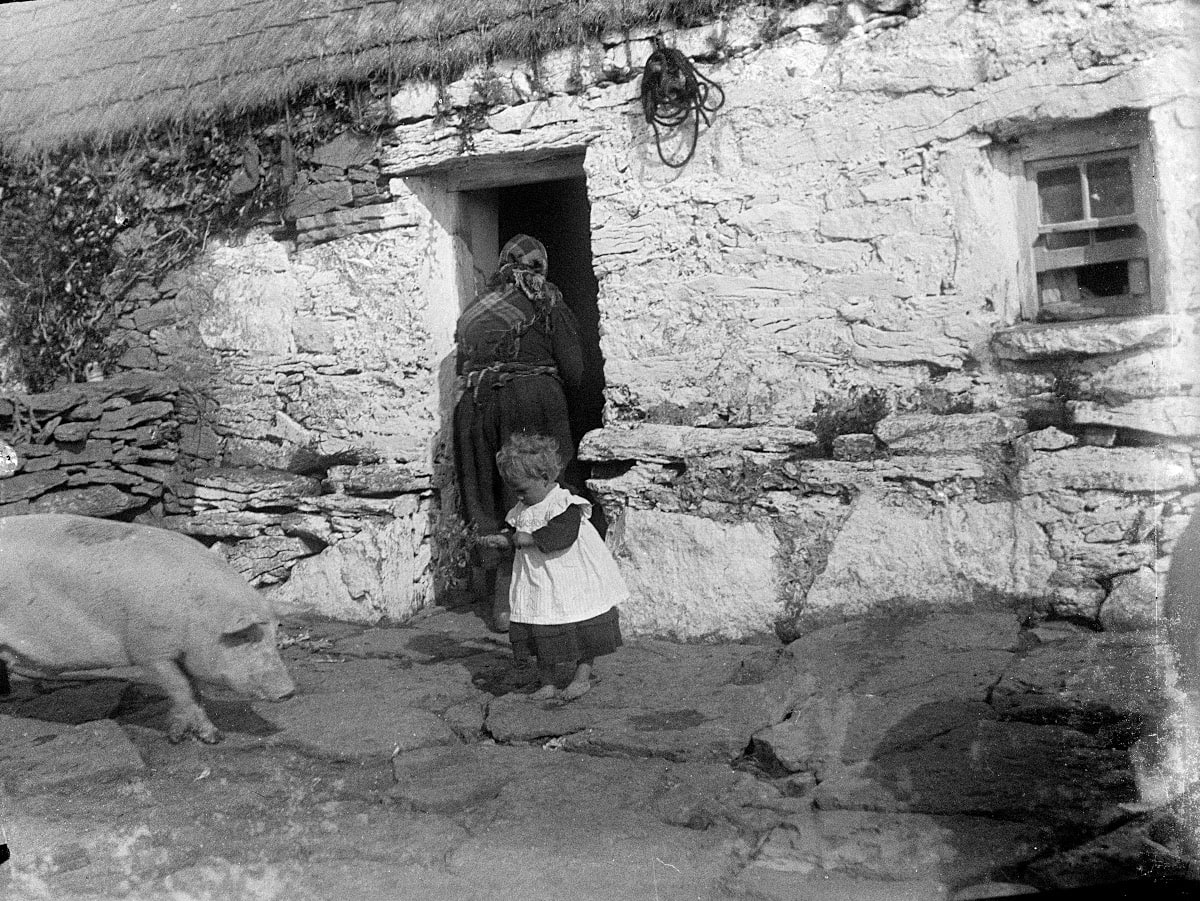
Synge’s photograph gives those surroundings a particular address. The play, first performed in Dublin in 1904, locates its kitchen more broadly on an island off Ireland’s west coast. Its opening directions specify nets, oilskins, a spinning wheel, and new boards against the wall. The room contains both the means of making a living and the materials for a coffin.[1][4]
A length of rope brings the two purposes into conflict. Maurya’s son Bartley needs it for a halter so he can take horses to market. His mother wants it kept for Michael’s burial. Neither use is fanciful; both belong to the household’s work. The argument makes leaving home more complicated than a young man ignoring an omen. Bartley speaks of the boat’s infrequent sailing and the possibility of a good sale. Maurya knows what the voyage may cost.[1]
The writing stays close to these competing necessities. A cake is baking while the family argues. After Bartley leaves, his sisters realize they have forgotten to give him bread. Their worry has interfered with the practical act that might have expressed their care. Cathleen sends Maurya after him with food and another chance to offer a blessing. The scene gives love something to carry.
When the sisters finally open the concealed bundle, the flannel cannot settle Michael’s identity: many men buy the same cloth. Nora recognizes the stocking through the stitches she herself dropped while knitting it. The certainty comes from an imperfection known to the person who made it. A garment’s history of care becomes evidence of death.[1]
Synge lets the discovery produce an outcry, then interrupts it with listening. Cathleen hears someone on the path. The clothes are hidden again, and Nora is told to turn away from the light so her mother will not see that she has been crying. Grief must manage its appearance before it has had time to spend itself. These movements give the play a rhythm that music can inherit: an utterance gathers force, breaks, and makes room for something approaching.
Maurya returns with the bread still in her hand. Asked what happened, she keens before she can explain. Cathleen wants an answer, and the audience wants one too. But the sound arrives before the information. Later, while Maurya recalls earlier drownings, the daughters hear crying from the shore. Women enter as she describes women entering years before. The remembered procession and the present one begin to occupy the same doorway.[1]
Vaughan Williams’s adaptation makes that relation between a visible room and an audible world especially tangible. The American Guild of Musical Artists lists the opera’s women’s chorus as offstage throughout. Its unseen singers are a different theatrical resource from the individual characters we can watch speaking.[3] In this reading, the arrangement enlarges the space of mourning: a voice need not belong to a visible body to be present in the room. It develops a possibility already active in Synge’s directions, where the daughters hear a cry before they can identify its cause.
The chorus also complicates the familiar description of Maurya’s ending as acceptance. In the play, she says, “there isn’t anything more the sea can do to me.” Her freedom from that fear has been purchased by the loss of every son whose return she awaited. Soon she imagines the sleep she can finally have, even if the surviving household has almost nothing fit to eat. The calm is real, but it carries hunger inside it.[1]
Nor does Synge allow the funeral to become entirely ceremonial. The boards are ready; the nails have been forgotten. Nora mistakes her mother’s quiet for evidence that she loved Michael more than Bartley. Cathleen answers with the exhaustion of an old woman who has already been mourning for days. These exchanges keep several explanations of silence alive. It may be composure, fatigue, or simply an absence of anything left to say.[1]
The opera omits the exchange about nails. That small cut matters: the play interrupts lament with a job that still needs doing; the adaptation moves more directly through Maurya’s leave-taking.[1][2]
At the end of the opera’s printed text, the chorus’s wordless cries alternate with Maurya’s closing speech. After her final sentence, the stage darkens, wind blows the door open, and the sea becomes audible again; the chorus follows.[2] That addition changes the boundary of the ending. In my reading, the water’s return does not refute Maurya’s hard-won rest. It makes us hear that her rest and the world’s continuation can coexist. The sea has not agreed to stop because she has finished speaking.
Synge’s curtain falls after Maurya kneels. Vaughan Williams opens the door once more. Returning from the adaptation to the play, it becomes harder to treat its quiet as an empty space waiting to be filled with music. The kitchen has been listening all along. The opera leaves us listening after the woman at its center has found her last words.
Sources
- J. M. Synge, Riders to the Sea. Project Gutenberg, ebook 994 — complete one-act play, opening performance notice, dialogue, and stage directions.
- Chandos, Vaughan Williams: Riders to the Sea / Flos Campi / Household Music, CHAN 10870 — Simon Mundy’s notes, pp. 5–6, and the opera’s printed text, especially pp. 33–35.
- American Guild of Musical Artists, “Riders to the Sea” — premiere venue and year, role classifications, and the offstage women’s chorus.
- Nicholas Grene and James Little, “The Journey of ‘The Playboy’.” The Library of Trinity College Dublin, Google Arts & Culture — “Synge’s Western World: Aran,” including Synge’s photograph of McDonagh Cottage, c. 1898–1900.