An invitation to adventure arrives with a shopping list. Carruthers, a bored young Foreign Office employee, has agreed to join an old acquaintance for a sailing holiday. The reply asks him to “please bring a No. 3 Rippingille stove.” Before he can become useful to his country, he must become useful to somebody's boat.[1]
That is an inviting way into Erskine Childers's The Riddle of the Sands, first published in 1903. Its reputation as a foundational spy novel can make the reader expect a secret at every turn; the Vintage Classics edition still introduces it through its place in the history of espionage fiction.[2] Yet much of its pleasure lies in watching two people learn to work together. The unfamiliar sailing vocabulary belongs to that process. You can begin without knowing what every rope does.
This guide follows the opening and the voyage's first phase of exploration, leaving the final discoveries and their resolution for your own reading.
Let Carruthers get things wrong
Read the first three chapters as a comedy of disappointed expectations. Carruthers imagines yachting as a service someone else provides: comfortable quarters, meals, a crew. Davies imagines a companion who can help. Neither quite understands how differently the other has interpreted the invitation.[1]
The difference becomes wonderfully physical in Chapter III. Sent below to find lunch, Carruthers opens the wrong locker and gets varnish on his hands. The beer lives among the ballast. When he opens a cupboard, plates and knives slide out into his arms. His irritation has a practical cause, and Childers lets us enjoy it before asking us to judge him. A person can be absurdly entitled and still have a reasonable objection to being covered in varnish.[1]
Notice, too, how early his certainty begins to soften. Watching Davies at the helm, he starts to wonder whether his practiced judgment of other men has missed something. He eventually asks, “Can't I be of any use?” The question is modest, but it changes his position in the scene: he has begun to imagine himself as a participant.[1]
Keep that change in mind when the sailing becomes difficult. Carruthers's ignorance gives an inexperienced reader company. His embarrassment supplies the emotional stakes of learning.
Look for the boat's particular advantages
The Dulcibella initially disappoints Carruthers as accommodation. Chapter IV invites a different assessment. Davies spreads out his charts and describes the Frisian coast, where islands and submerged banks surround channels that can be difficult to follow. What Carruthers sees as desolation, Davies recognizes as a place worth exploring.[1]
“All sand,” Davies says enthusiastically. His delight is a small comic shock. The word that makes the landscape sound empty to his guest makes it full of possibility to him.[1]
Here the boat's shallow draught and flat bottom begin to matter. Draught means how much depth a vessel needs to float; a boat needing less water has more possible routes through the shallows. Davies also explains that grounding can be manageable in suitable conditions. The qualification matters. Later passages distinguish a tolerable wait on sheltered sand from a dangerous stranding exposed to breaking water.[1]
For a first reading, follow what each feature permits. When the centreboard is mentioned, notice whether it is lowered to improve the boat's sailing or raised for shallower water. When a depth is called out, ask whether it gives the crew room to continue. The vocabulary becomes easier to retain once it changes an action.
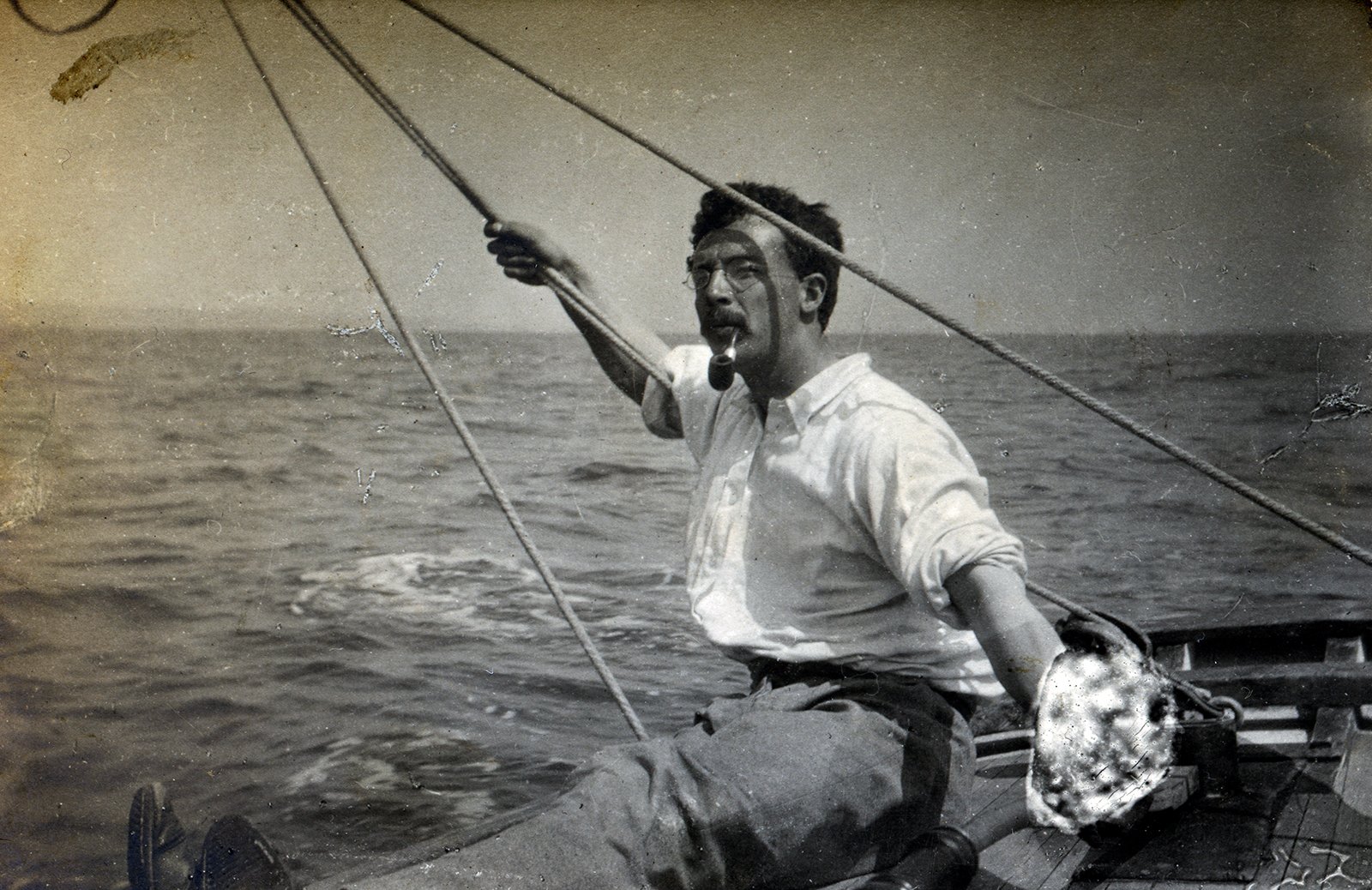
Childers had a practical connection to this world. Royal Museums Greenwich catalogs his Vixen journal for voyages to the Baltic and along the south coast between August 1897 and May 1899.[3] The accompanying photograph shows him aboard Vixen in the Solent in 1898, pipe in his mouth, within the close quarters of a small yacht.[4] That material setting helps explain why the novel makes so much of fittings, storage, and the body's awkward movements.
Use the charts when a decision needs them
Choose an edition that retains the maps and charts; the free illustrated Gutenberg text includes them.[1] Their presence can look like an entrance examination. Treat them as something to consult when the prose gives you a reason.
Begin with the broad route: the men meet in the Baltic, then travel toward the North Sea coast and its tidal sands. You need not memorize every island before setting out. In Chapter XI, Carruthers himself declines to reproduce every intricacy for the general reader. The narrative makes room for someone whose interest is still catching up with the sailors' expertise.[1]
The more useful question is often temporal: what can they do now? A channel may contain enough water at one state of the tide and become impassable at another. Current can assist a passage or oppose it. A route on paper therefore needs to be read alongside the hour, the weather, and the vessel attempting it.[1]
Childers turns this into a striking lesson in Chapter XII. With the yacht aground and the banks exposed, the men walk along a channel to examine the route they will sail when the water returns. Later, their observations help them through a scene whose visible landmarks have changed. The waiting has produced knowledge.[1]
Pause there long enough to picture the transformation. A place that looked like a temporary obstacle becomes a surface they can inspect on foot. Then that surface disappears. The suspense comes partly from having seen what the water is hiding.
Listen for two kinds of competence
Davies can handle a boat far better than he can always explain himself. Carruthers, socially fluent and comfortable in German, begins with skills whose value his miserable arrival has obscured. Their early exchanges are full of uneven information: one man takes practical knowledge for granted, while the other tries to infer intentions from an unfinished account.[1]
Chapter III offers a useful warning against making Davies infallible. He hands Carruthers a chart without understanding how little the newcomer can read it. Shortly afterward, the yacht scrapes the bottom. The scene joins skill to fallibility and shows why knowing how to do something differs from knowing how to teach it.[1]
Watch the changing balance of their conversations. When does Carruthers stop using cleverness to protect his dignity and start using it to clarify their situation? When does Davies need someone to question an assumption? Those shifts give the partnership a shape you can follow even when a particular maneuver remains difficult to visualize.
By Chapter XIII, Carruthers can describe real gains in handling ropes, taking bearings, and judging wind and tide. He still declines to call the sea his natural element.[1] The admission leaves room for the reader, too: useful understanding can arrive without effortless mastery.
Keep the national argument in view
The preface presents Childers as an editor assembling testimony, diaries, and charts. That is part of the novel's fiction. Its documentary manner encourages us to regard the adventure as information that deserves public attention.[1]
The framing has a purpose. In Chapter XIII, Davies argues that coastal defense requires people who know particular waters and can improvise with small craft. The story's pleasure in acquired skill is being recruited into a national argument. Its March 1903 postscript makes the appeal to British preparedness explicit.[1]
Read those claims as the novel's political case, not as independent confirmation of an actual invasion scheme. The opening's casual racial hierarchy and Carruthers's assumptions about class also belong to the world from which that case emerges. His education broadens some of his sympathies without automatically dissolving the book's imperial outlook.[1]
Leave the postscript until after the story on a first reading. For now, the stove is enough of an introduction. A man goes abroad expecting to be looked after; gradually he learns to look, listen, and lend a hand. By the time a difficult passage becomes exciting, the book has taught you enough to feel what might go wrong.
Sources
- Erskine Childers, The Riddle of the Sands (1903), Project Gutenberg — illustrated primary text; preface, Chapters I–IV and XI–XIII, and March 1903 postscript.
- Penguin / Vintage Classics, The Riddle of the Sands — publication history and the publisher's presentation of the novel's place in espionage fiction.
- Royal Museums Greenwich, “Yacht VIXEN journal — voyages to the Baltic and along the south coast, 11 August 1897–1 May 1899,” RCC/2 — archival evidence of Childers's sailing.
- Photo Museum Ireland, Photo Album of the Irish, “Erskine Childers smoking a pipe on board the yacht Vixen. Solent, UK, 1898” — archival photograph and identification.