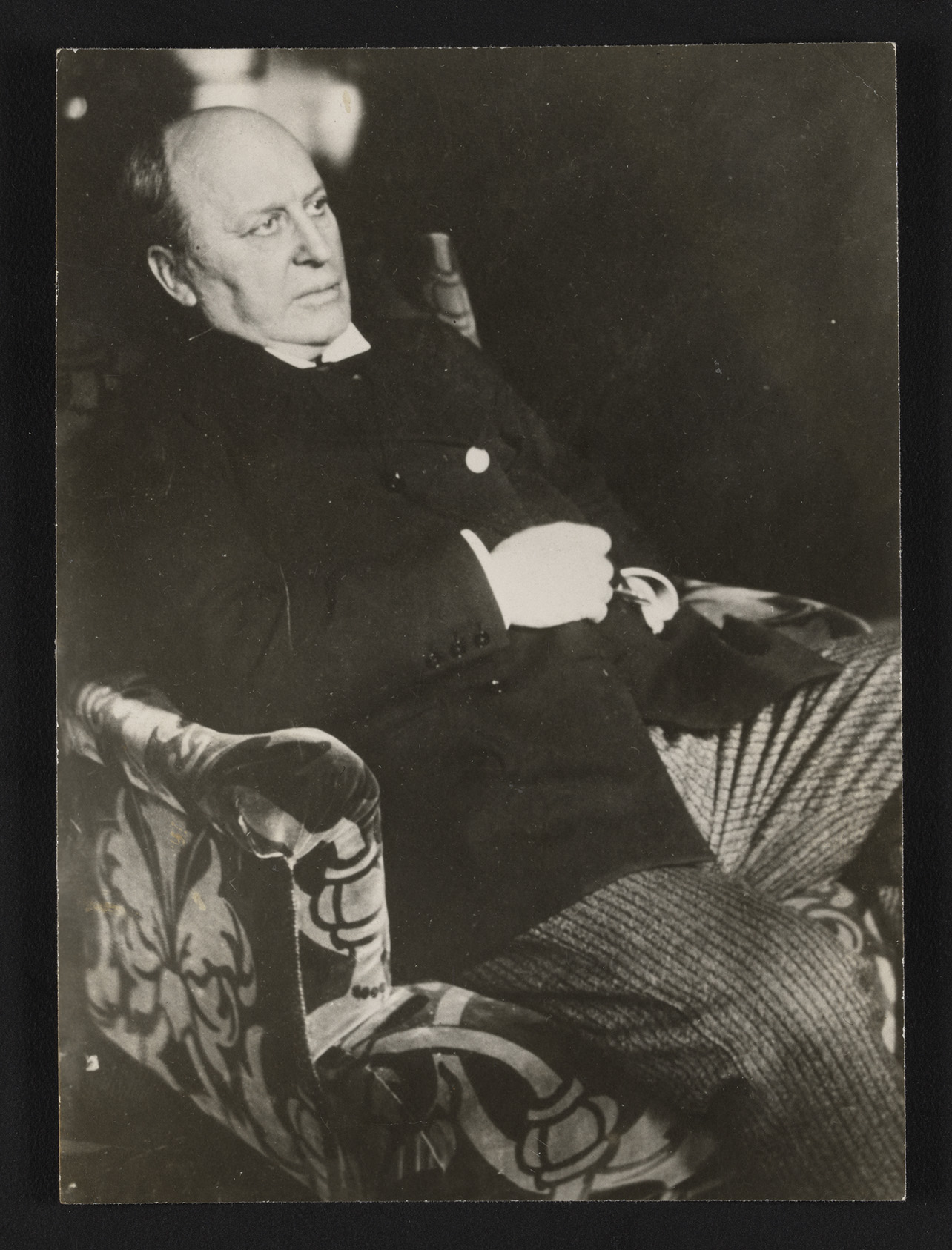
The first misunderstanding in Henry James’s “The Real Thing” concerns who will pay whom. A distinguished couple enters an artist’s studio. He imagines a portrait commission. They want employment as models. When Major Monarch hopes they can “make it pay,” the narrator briefly hears a touching concern for his own earnings. He has already inspected their clothes, bearing, and apparent social position. Their purpose escapes him.[1]
That little comedy establishes the story’s voice. This illustrator can turn an impression into a polished judgment before anyone has finished explaining. His sentences are entertaining because they move so confidently; they become troubling when we notice how often confidence arrives ahead of knowledge. James lets us enjoy the performance while learning to hear its evasions.
First published in American newspapers and Britain’s Black & White in 1892, the story grew from an incident related by the illustrator George du Maurier. An impoverished couple had approached him for modeling work. James’s notebook made their predicament a conflict between social accomplishment and professional skill. The story itself appeared with illustrations: readers encountered its argument about representation inside the very trade it examines.[2]
The parenthesis keeps his hands clean
In section I, the artist notices the Major’s well-fitted coat and graying moustache, then interrupts himself to explain that his professional interest is neither a tailor’s nor a barber’s. The clarification is unnecessary for identifying his occupation. It is very useful for placing him socially.[1]
He wants the freedom to scrutinize bodies without being mistaken for someone who dresses or grooms them. The aside draws a small boundary around the prestige of his looking. It also recruits the reader: we are expected to appreciate why the distinction matters. His wit offers us a seat beside him before we have considered where the visitors must sit.
Once he understands their request, he cannot comfortably say the word for their proposed occupation. Their gentility makes models seem an unsuitable label. The same man who has confidently classified their appearance finds his speech breaking down when their need crosses his categories. James makes the hesitation audible in the interrupted dialogue.[1]
The narrative is retrospective, which complicates the comedy. The speaker sometimes admits that he understood something only later. He is capable of revising himself. But admitting an earlier mistake can also make a storyteller seem especially trustworthy: he has confessed this much, so perhaps we will accept his next judgment without inspection. The voice gives us reasons both to follow and to question it.
A whole life, inferred from luggage
At the beginning of section II, the narrator imagines the Monarchs’ former existence in country houses. The repeated “I could” introduces rooms, shooting parties, clothing, servants, and luggage. We receive an impressively furnished past. We have not received independent testimony that it happened in exactly this way.[1]
The distinction matters because the prose is so good at making inference feel visible. His inventory turns class recognition into apparent intimacy. Knowing the right sort of umbrella begins to look like knowing the person who carries it. He even brushes past the cause of their lost income while elaborating the surfaces of their former comfort. The pattern of his attention becomes more revealing than any single insult would be.
James also lets the artist’s language catch him in a quieter contradiction. He detests amateurism, yet feels the need to qualify his satisfaction with his experienced model Miss Churm as “perhaps ignobly.” Her competence ought to settle the question for a professional. The qualification suggests that hiring her still feels, on some level, socially beneath him.[1]
This is my reading of the aside, rather than an explicit confession by the character. The evidence is its placement: a declaration of professional principle is followed almost immediately by embarrassment about the person who fulfills it. His taste has not escaped the hierarchy he finds so disabling in the Monarchs.
Miss Churm would like some heat
Miss Churm enters section II carrying a wet umbrella, having taken an omnibus and walked the remaining distance. Asked to pose as a Russian princess and look over someone’s head, she replies, “I’d rather look over a stove.”[1]
Her sentence is wonderfully economical. She accepts the theatrical business while pointing out a bodily inconvenience that its glamour does not remove. The narrator can imagine dangerous aristocratic beauty; the woman creating it is cold. Her joke briefly makes the working conditions more interesting than the role.
James marks her speech with Cockney spellings. That device can make her an object of class amusement, and the narrator plainly enjoys her as such. Yet she also gets practical intelligence and comic timing. She understands that modeling demands movement between identities, and anticipates the difficulty of making Mrs. Monarch do it. Her voice earns authority through what it can identify and accomplish.[1]
The artist’s technical problem remains real. In section III, he reports that different poses produce essentially the same Mrs. Monarch; in section IV, his publishers criticize drawings in which the couple appears. The story supplies professional grounds for replacing them. Recognizing his snobbery does not require pretending they are successful models.[1]
That is what gives the voice its pressure. He has a defensible decision to make and indefensible habits of making other people legible. James keeps both in the room.
The last sentence will not close the account
Near the end, Mrs. Monarch adjusts Miss Churm’s hair, improving the appearance of the woman who has displaced her. The Major finds washing-up to do. Their willingness to serve overturns the stiffness that has frustrated the illustrator, but it cannot secure the future they need. He briefly employs them as servants, then pays them to leave.[1]
The narrator suddenly wishes he could paint a particular glance Mrs. Monarch gives him. This is a more individual subject than the polished social type he identified at the door. His attention has found something his customary work struggles to contain. Even then, he registers the discovery as a possible picture.
Kenneth Bernard’s 1962 reading makes this difficulty central. He argues that the encounter exposes the artist’s limitations: compassion reveals a human reality deeper than the attractive fictions he has been manufacturing. On that account, commercial success can coexist with an unsettling recognition of artistic inadequacy.[3]
The ending leaves room for that interpretation without giving the narrator a certificate of moral improvement. He obtains the remaining illustration work. His friend Hawley maintains that the Monarchs have permanently damaged his art. The narrator answers conditionally—“If it be true”—before accepting the cost “for the memory.”[1]
The qualification preserves his right to doubt the professional verdict. The final phrase admits that something other than professional advancement now counts. Neither gesture cancels the fact that the couple has disappeared from his life. He retains the experience; their subsequent circumstances remain unknown.
James’s finest reversal is therefore a matter of voice. The man who began by turning appearances into certainties ends with a conditional sentence. He has not stopped judging. He has learned to leave one judgment unfinished.
Sources
- Henry James, “The Real Thing,” sections I–IV, in The Real Thing and Other Tales (Macmillan, 1893); Project Gutenberg transcription of the 1893 edition, used for quotations and textual analysis.
- Library of America, “The Real Thing,” Story of the Week (April 11, 2021); publication history, du Maurier’s anecdote, and James’s notebook account of the story’s conception.
- Kenneth Bernard, “The Real Thing in James’s ‘The Real Thing,’” BYU Studies 5, no. 1 (1962), pp. 31–32; an interpretation connecting compassion with the illustrator’s artistic limitations.
- Vanderbilt University Library, “[Photograph of Henry James],” Please Continue: Literary Correspondence as Conversation; William M. Vander Weyde’s 1905 photograph at Lamb House, from the Ralph Morrissey Collection.