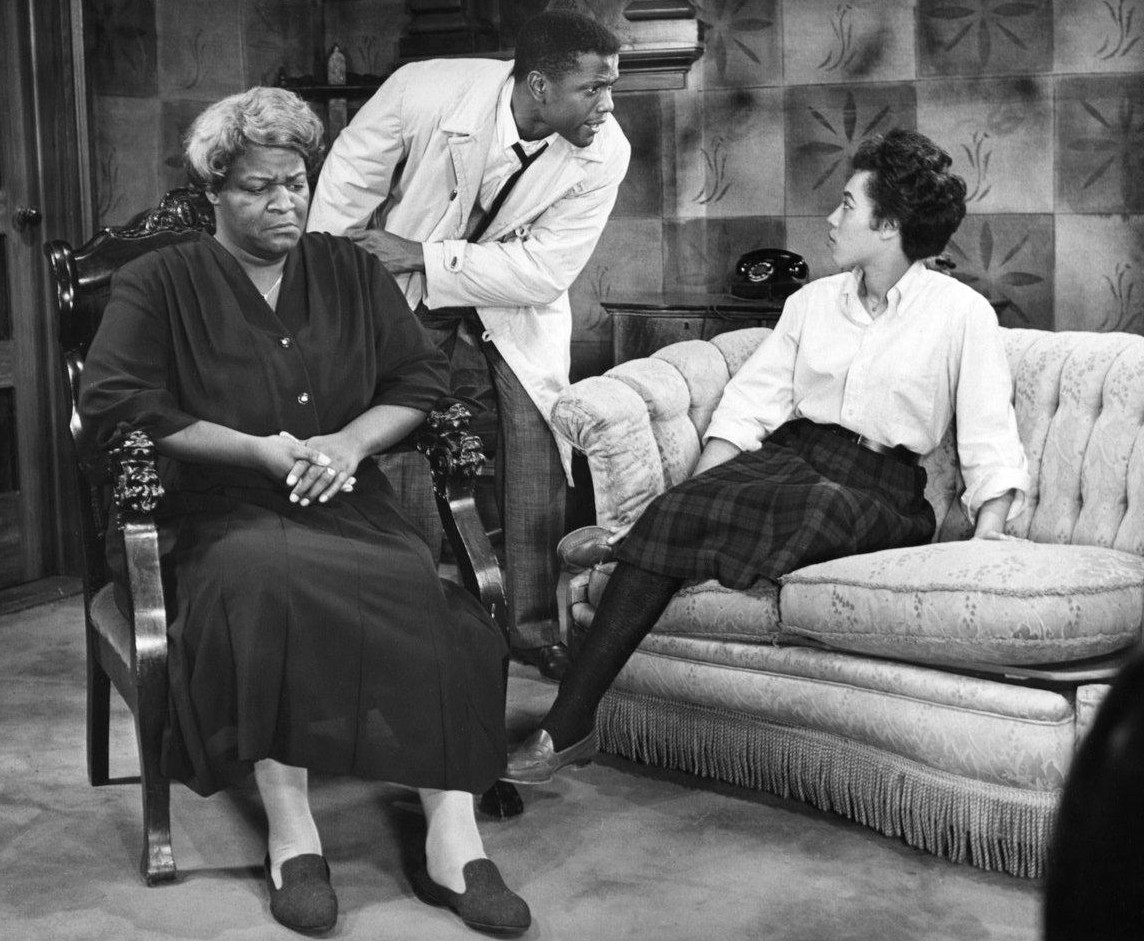
A Raisin in the Sun keeps returning because it does not ask each new audience to admire a historical landmark from a distance. It asks them to sit inside a room where every dream has to pass through rent, fatigue, furniture, gender, race, and a check that cannot possibly solve what everyone needs from it. The Younger apartment is the play's durable machine. It is small enough for realism, but large enough to hold the American dream while showing exactly where that phrase starts to split.
Concord's licensing synopsis still gives the basic design cleanly: three generations of the Younger family on Chicago's South Side, each reading the same insurance money through a different future.[1] Lena wants a house; Walter Lee wants business ownership and manhood that is not measured by chauffeuring someone else; Beneatha wants medical school and a self not pre-trimmed for respectability. Ruth wants air, rest, and a livable family. Travis, sleeping in the living room, turns all those adult claims into a spatial fact before anyone makes a speech.
That is why the apartment matters more than scenery. In a weaker play, the cramped room would simply symbolize poverty. Hansberry makes it an arena of interpretation. The same walls that expose deprivation also make family relation unavoidable. People overhear, interrupt, cook, dress, wait, wound one another, and still have to cross the same floor. The apartment is not only what the Youngers need to escape. It is the pressure chamber in which they discover what kind of escape would still leave them intact.
The Room Makes Money Speak Several Languages
The plot can sound deceptively simple: the family receives an insurance payment after Big Walter's death, and the money forces decisions.[1] But the money is never only money. It is labor converted into a delayed test. It carries the dead father's body, Lena's memory, Walter's humiliation, Beneatha's training, Ruth's exhaustion, and the landlord's world outside the door. Everyone is right about part of it, which is why the conflict stays alive.
Walter Lee's hunger is easy to flatten into foolishness because the liquor-store plan fails so badly. Hansberry does not let him off, but she also refuses to make him merely ridiculous. His desire for ownership comes from a real wound: he is tired of being useful in other people's cars and invisible in his own house. When Ruth tells him to "eat your eggs," the line works because breakfast has become a whole theory of containment.[1] Domestic routine keeps the day moving, but it also tells Walter that his appetite is inconvenient before it is examined.
Lena's dream is more grounded, but it is not simple either. A house promises yard, light, and privacy; it also moves the family into Clybourne Park, where white neighborhood resistance turns home ownership into confrontation.[1][4] The Library of Congress account of Hansberry v. Lee clarifies why that plotline could not be merely invented atmosphere. Hansberry's own family had challenged a racially restrictive covenant in Chicago, and restrictive covenants worked by tying property to racial exclusion even before later cases changed the legal landscape.[4] The play compresses that history into a living room, so that housing law becomes family weather.
Adaptation Begins With The Fact That The Set Must Be Rebuilt
The original Broadway production opened on March 11, 1959, with Lloyd Richards directing and a cast that included Sidney Poitier, Ruby Dee, Claudia McNeil, Diana Sands, Ivan Dixon, Louis Gossett, and John Fiedler.[2] Playbill's Broadway archive shows the later revivals as well: the play was not sealed inside its first triumph, but returned in 2004 and 2014 as Broadway kept testing the room against new audiences.[2]
That return is built into the work. Every revival has to answer practical questions that are also interpretive questions: How worn is the furniture? How close are the beds? Does the apartment feel lovingly kept, brutally overused, or both? How visible is the world beyond the door? A production cannot treat those choices as decoration. If the room feels too cozy, the pressure softens. If it feels too bleak, the comedy and tenderness disappear. The set must hold scarcity without denying life.
The 1961 film proves another version of the same point. Britannica identifies it as Daniel Petrie's film adaptation of Hansberry's play, with the story centered on the insurance money and the family's conflict over how to use it.[6] Film can move differently from theater, but Raisin resists being opened up into spectacle. Its strongest cinematic value still comes from faces and bodies negotiating the same domestic limits. The camera can look more closely, but the argument remains architectural: who gets room to stand, speak, withdraw, or return?
The 1970s musical Raisin makes the afterlife even clearer because it changes the medium without changing the central engine. Concord describes the musical as based on Hansberry's play and notes its Tony-winning Broadway life.[5] Song can lift feeling into public rhythm; it can let Walter's hunger, Lena's steadiness, Beneatha's searching, and Ruth's ache expand beyond ordinary speech. Yet the musical still depends on the apartment's basic pressure. Music does not erase the room. It releases what the room has been holding.
The Play Refuses A Single Dream
The title points back to Langston Hughes's question about a "dream deferred," but Hansberry's drama is not a one-dream play.[1][2] That is the source of its adaptability. Each era can recognize a different Younger without betraying the work. A housing-crisis audience may feel Lena's down payment first. A labor audience may hear Walter's rage at service work. A feminist audience may track Beneatha's refusal to become someone else's ornament. A family audience may see Ruth carrying the cost of everyone else's urgency.
Beneatha is especially important to the play's survival because she prevents the apartment from becoming a simple morality contest between maternal wisdom and male impatience. She wants medicine, argument, style, African inheritance, and room to revise herself. Her line, "I want so many things," is not girlish excess; it is the play announcing that aspiration can be plural without being frivolous.[1] Beneatha's presence keeps the family future from being reduced to one house, one business, one marriage, or one respectable script.
This is also why the play's ending is stronger than uplift. Walter's final refusal of Lindner's buyout matters, but it does not solve the danger ahead.[1][4] The family will move. The neighborhood's hostility will not vanish because the scene has achieved dignity. Hansberry gives the audience a moral action, not a guaranteed happy ending. The line of movement is outward, but the cost of that movement remains visible.
The Gordon Parks Foundation's short feature captures the historical scale of the opening: Hansberry made Broadway history in 1959 with a play about a Black working-class Chicago family, directed by Lloyd Richards, and commercially centered on Black life.[3] That history matters. But if A Raisin in the Sun were only important as a first, it would now belong mainly to theater chronology. Its afterlife is larger because the play made a form that can keep receiving pressure.
The apartment is that form. It can absorb changing conversations about redlining, wealth gaps, Black theater, maternal authority, masculinity, education, assimilation, and the market price of dignity. It can do that because Hansberry never lets an issue float free of the table, the couch, the check, the plant, the door, or the child sleeping where a private room should be.
That is why the play survives adaptation. The dream changes shape every time the room is rebuilt. What does not change is the test Hansberry designed: put a family in a space too small for their futures, give them money that carries love and damage together, send a polite representative of exclusion to the door, and watch whether dignity can become action before the moving men arrive. The result is not a museum piece. It is an apartment that still knows how to measure a country.
Sources
- Concord Theatricals, A Raisin in the Sun by Lorraine Hansberry - official licensing synopsis, character frame, and setting summary.
- Playbill, A Raisin in the Sun Broadway production archive - original 1959 production, cast, and Broadway revival records.
- The Gordon Parks Foundation, "A Raisin In The Sun" - concise historical framing of the 1959 Broadway opening and its theatrical significance.
- Library of Congress, "Hansberry v. Lee: The Supreme Court Case that Influenced the Play 'A Raisin in the Sun'" - restrictive covenant and family-history context.
- Concord Theatricals, Raisin - musical adaptation page noting its basis in Hansberry's play and Broadway afterlife.
- Encyclopaedia Britannica, "A Raisin in the Sun" - 1961 film adaptation overview and plot summary.
- Wikimedia Commons, "File:A Raisin in the Sun 1959 3.JPG" - source page for the 1959 Friedman-Abeles production photograph used as the cover image.