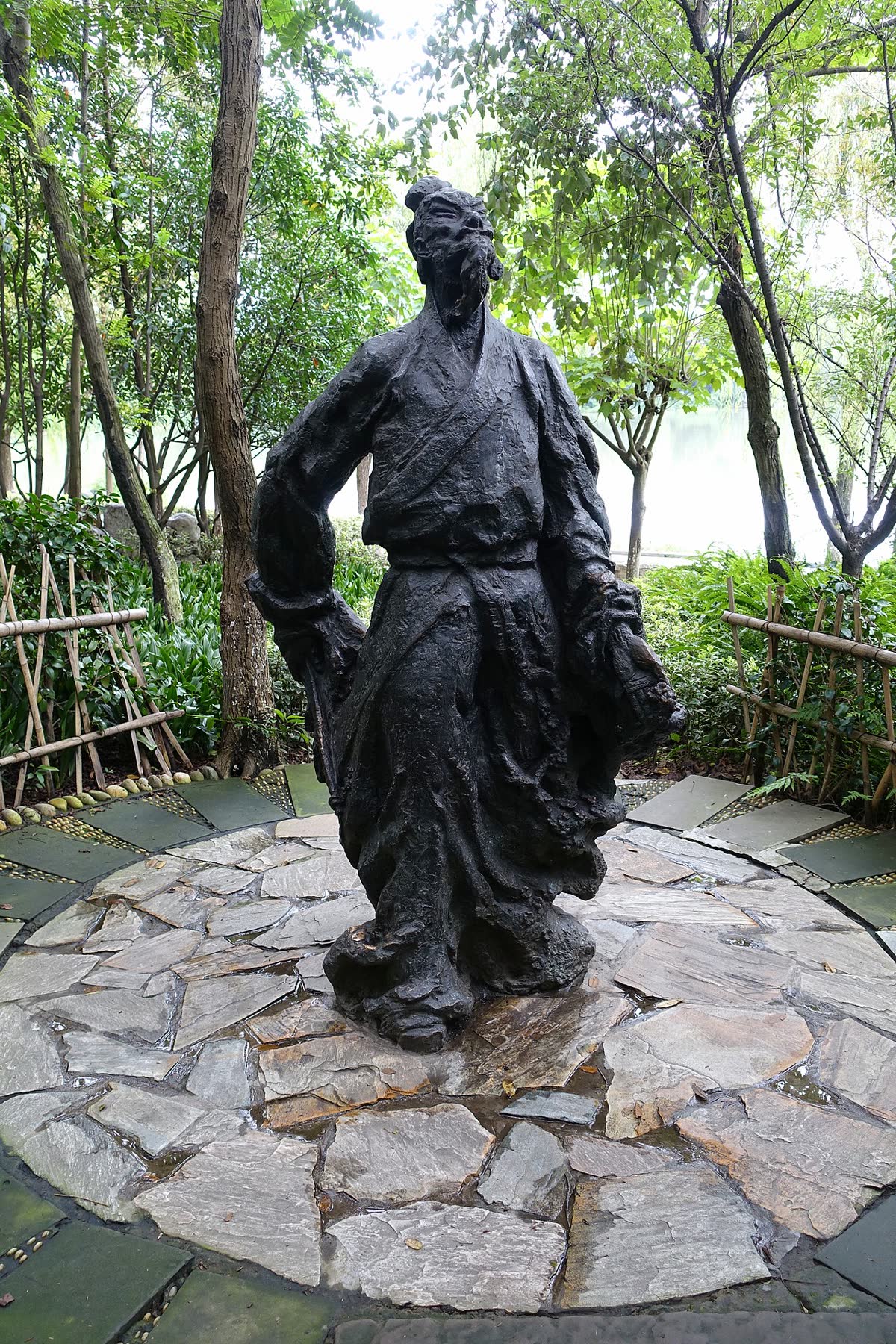
Du Fu's "Spring View" is only eight lines long, but it is one of those poems whose first sentence seems to carry a whole historical weather system. The country is broken; the mountains and rivers remain. Spring has come to the city; grass and trees are deep. A translator can make those two couplets sound scenic, patriotic, elegiac, or almost reportorial. The hard part is keeping them all at once.
The Chinese Text Project preserves the poem in the Quan Tangshi tradition, and Columbia's Asia for Educators presents it as "Spring Gaze," with characters, romanization, word meanings, and a literary translation by Pauline Yu.[1][2] Those tools are useful because "Spring View" is a poem where translation trouble begins before interpretation does. Classical Chinese compresses grammar so tightly that English must keep choosing what the original can leave suspended: who feels, what acts, whether flowers shed tears or make the speaker shed them, whether the city is merely in spring or has been overtaken by spring.
That suspension is the poem's pressure. Du Fu wrote from within the violence of the An Lushan rebellion: his life, like the country's, was overturned after 755, and the occupied capital of Chang'an became the background for this poem's devastated seeing.[3][4] Yet "Spring View" does not begin with a battle scene. It begins with survival as an accusation. Mountains and rivers remain, but their remaining does not console. They make the nation's break more visible.
"Nation Broken" Is Not A Slogan
The first five-character line, guo po shan he zai, is often rendered near literally: nation broken, mountains rivers remain.[1][2] English wants to smooth that into a sentence, but the unsmoothed order matters. "Nation" and "broken" collide before the reader gets anything stable to stand on. Only after the break do mountains and rivers appear.
That sequence changes the emotional logic. If a translation begins too gently, with "though" or "yet" doing early explanatory work, it risks turning the line into consolation: the state is damaged, but nature endures. Du Fu's line feels harsher. East Asia Student's literal annotation makes the pressure visible character by character: nation, broken, mountain, river, exist.[3] The endurance of the landscape is not a remedy. It is the frame in which political collapse becomes visible. The mountains and rivers have not saved the human order; they have outlasted it.
The word "nation" also has to carry more than modern nationalism. The poem is anchored in the Tang world of capital, dynasty, duty, family separation, and literary office-seeking. Berkshire's encyclopedia entry notes Du Fu's strong moral engagement and the later Chinese habit of calling him both "Poet Sage" and a maker of "poetry history."[4] "Spring View" earns that reputation not by giving a historian's account, but by letting one damaged view hold public disaster and private depletion together.
Spring Makes Ruin More Severe
The second line is easy to prettify: spring in the city, grasses and trees deep. But the word "deep" should not become merely lush. In an occupied capital, deep vegetation suggests abandonment. Spring keeps working, which means human order has stopped keeping pace with it.
That is the poem's first great translation trap. In pastoral poetry, growth often promises renewal. Here it measures neglect. If English says "the city blooms," the line becomes too pleasant. If it says "weeds overrun the city," it may become too explanatory. The best version needs the discomfort of both: spring is genuinely spring, but its abundance has become evidence that streets, courtyards, and civic routines have failed.
Columbia's presentation identifies the poem as regulated verse and places it within the formal world of Tang poetry, where pattern, tonal discipline, and couplet structure matter.[2] That formal control is part of the irony. The city is out of joint, but the poem is not. Du Fu does not imitate collapse through looseness. He makes collapse more painful by placing it inside a form that can still hold.
Who Is Crying, The Flowers Or The Speaker?
The third and fourth lines are the translator's most delicate ethical choice. A literal path can make flowers splash tears and birds startle the heart.[1] Another path makes the speaker, moved by the times and hating separation, cry at flowers and flinch at birds. The difference is not cosmetic. It decides where grief lives.
If flowers cry, the world has been personified into mourning. If the speaker cries at flowers, ordinary beauty has become unbearable. Classical Chinese allows that ambiguity to shimmer longer than English usually can. The translator should resist choosing too tidily. The lines work because feeling moves across the boundary between person and scene. Flowers do not simply symbolize grief; they trigger it, absorb it, and seem stained by it. Birds do not merely sing; their sound hits a nervous system already tuned to alarm.
This is where Du Fu's compression becomes more than technical brilliance. The literal glosses in East Asia Student's annotation show how few grammatical bridges the Chinese gives English: feel-time-flower-splash-tears; hate-separation-bird-startle-heart.[3] "Spring View" turns that openness into trauma grammar. The poem does not stop to say, "I am projecting my sorrow onto the natural world." It lets the projection happen as syntax.
Beacon Fires And Family Letters
The middle of the poem then narrows from capital landscape to wartime communication. Beacon fires have continued for months; a family letter is worth ten thousand in gold.[1][2] The couplet is famous because it joins the public and domestic scales without transition. War is not background; it is the reason a letter becomes treasure.
"Ten thousand gold" should not be translated as a realistic price. It is value under conditions of severed knowledge. A message from home is priceless because it answers the only question a displaced person cannot answer by looking: are they alive? The line's force depends on the disproportion. In ordinary conditions, a letter is paper. In civil war, it becomes almost a bodily extension of the absent family.
This is also why "Spring View" is not just patriotic lament. Du Fu's public grief keeps becoming domestic fear. The state is broken, the capital overgrown, the times unbearable, birds alarming, beacons persistent, letters precious. Each step brings history closer to the body.
The Hairpin Is The Final Translation Test
The last couplet can sound almost comic if mishandled: white hair scratched shorter, nearly unable to hold a hairpin.[1] It is not comic relief. It is humiliation reduced to a small physical fact. The public catastrophe has arrived at the scalp.
English versions sometimes struggle here because the hairpin is culturally specific. Explain too much, and the image becomes a footnote wearing a costume. Explain too little, and modern readers may miss the emotional scale. The point is that anxiety has thinned the speaker's hair so much that even ordinary self-presentation threatens to fail. The body can no longer maintain the sign of composure.
That ending matters because it refuses heroic posture. Du Fu does not close by becoming a prophet above ruin. He closes as a man worrying his own head, aged by public disaster and private fear. The poem's greatness is not that it enlarges him into an emblem. It lets a whole crisis become visible in the almost embarrassing gesture of scratching at thinning hair.
What English Should Preserve
A strong English translation of "Spring View" has to preserve four tensions.
First, it must keep the opening hard. "Nation broken" should not be softened into a scenic prelude. The landscape remains, but the remaining is painful.
Second, it must let spring be double. Grass and trees are beautiful because spring is real; they are frightening because the city's human order has receded.
Third, it must keep the flower-and-bird couplet emotionally unstable. The poem's grief is not neatly inside the speaker or outside in nature. It moves between them.
Fourth, it must let the final hairpin image stay small. The ending should not inflate into a universal moral. Its power comes from scale: empire, capital, war, family, body, hair.
That is why "Spring View" remains a severe test of translation. It is not difficult because it is obscure. It is difficult because it is too compressed to paraphrase without loss. Every line asks English to decide how much grammar to supply, how much ambiguity to preserve, and how much historical context to let into the poem without turning the poem into commentary.
Du Fu's achievement is that the poem never separates those tasks. Looking at spring in occupied Chang'an, he sees what remains and what has failed; he hears birds and hears danger; he values a family letter as if it were wealth; he ends not with doctrine but with a body worn thin by history. The translator's duty is to keep that pressure intact: no decorative spring, no abstract patriotism, no sentimental family scene, no heroic old poet. Just a broken nation, mountains and rivers still there, and a man looking until the act of looking reaches his bones.
Sources
- Chinese Text Project, Quan Tangshi, "Chun Wang" by Du Fu (Chinese source text in the Complete Tang Poems tradition).
- Asia for Educators, Columbia University, ""Spring Gaze," by Du Fu" (Chinese characters, romanization, word meanings, and Pauline Yu translation context).
- East Asia Student, "106 Du Fu Spring View Translation" (literal line-by-line annotation, pinyin, and interpretive notes).
- Berkshire Publishing, "Du Fu (712-770 ce)" (biographical overview, An-Shi Rebellion context, and reception labels such as Poet Sage/poetry history).
- Wikimedia Commons, "Statue - Du Fu Thatched Cottage - Chengdu, Sichuan, China - DSC04859.jpg" (source for the real photographic cover image).