Phoebe Throssel has a troublesome niece. The young woman flirts, attracts officers, and makes the neighbors suspicious. Getting her out of the house becomes an urgent business. There is a complication: Phoebe invented her and plays the part herself. In J. M. Barrie's Quality Street, a change of clothes creates someone who is much easier to introduce than to dismiss.[1]
That double role helped carry the play from Maude Adams's stage to Marion Davies's silent screen and Katharine Hepburn's sound film. Each actress could offer the pleasure of transformation: the weary schoolmistress becomes the dazzling visitor. Yet Barrie sets a more difficult task inside the costume change. Phoebe must discover whether she can be loved as the woman who has lived through the intervening years.[1][2][3][4]
The discussion includes the play's ending. Film comparisons draw on AFI's catalog records and contemporary reviews reproduced by Theatre Heritage Australia.
The years inside the cap
The ten-year interval between Acts I and II changes the use of a room. The sisters' blue-and-white drawing room becomes a schoolroom; Phoebe and Susan must earn their living after losing money. When Valentine Brown returns from the Napoleonic wars, the household has acquired desks, anxious lessons, and an exhausting responsibility for children. His military absence has a domestic counterpart: their long working day.[1]
Phoebe is thirty. Her outrage at being treated as old has a sharp material explanation: “is it a crime when a woman works?” Her tired eyes register labor, but she fears that Valentine reads them as the disappearance of everything he once liked. The cap she wears makes that judgment visible. An occupation has become an apparent identity.[1]
Her solution starts privately. She tells Susan about a picture of her younger self that she keeps upstairs. When she returns, the picture proves to be Phoebe herself, dressed in the old wedding gown with her curls released. Barrie has turned a metaphor into an entrance. The remembered girl has a body and can dance.[1]
This is a lovely opportunity for an actress because the audience already knows the secret. We need to recognize continuity through the change. Phoebe's earlier declaration, “I want to be myself,” remains active inside the masquerade: she is trying to retrieve something real by pretending to be someone else.[1]
Valentine's failure to recognize her allows the private game to become a public deception. The servant Patty supplies the visiting-niece explanation, and Phoebe names her Livvy. Soon the invention has relatives, invitations, and obligations. What begins as relief from being watched creates many more opportunities for scrutiny.[1]
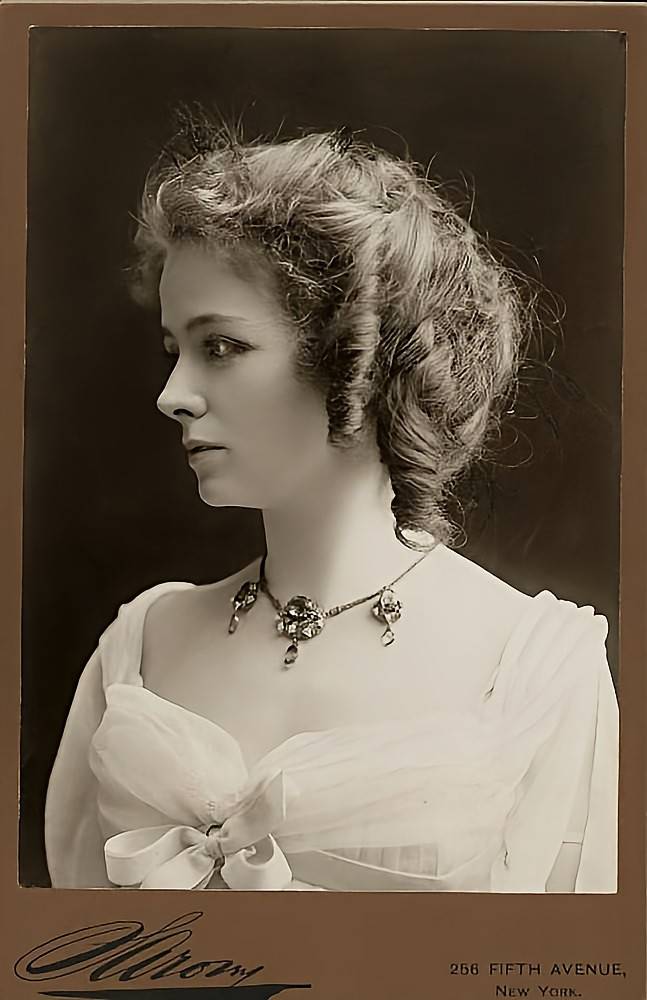
A role already being remade
Adams played Phoebe when Quality Street opened in Toledo in October 1901, before its November arrival on Broadway. Elisabeth Kumm's production history reproduces Barrie's letter to producer Charles Frohman about revising the end of Act III. He was willing to lose laugh-winning lines to make Phoebe's behavior more sincere and bring the act to its conclusion more swiftly.[2]
That exchange complicates the familiar idea of a finished literary original later disturbed by performers. Here, performance exposed a weakness, and the playwright adjusted his text. The audience's affection depended on whether Phoebe remained credible beneath the ingenuity of her predicament.
The printed Act III makes that problem unusually explicit. After enjoying Livvy's triumphs, Phoebe grows tired of the young men and of the person she has been performing. Barrie's stage direction imagines her welcoming the prospect of waking up “slightly middle-aged.”[1] The phrase is funny after all that alarm about thirty. It also lets the actress change inwardly before changing her dress. Youth has become another tiring part to play.
What the screen kept, and what critics noticed
Sidney Franklin's 1927 film cast Marion Davies opposite Conrad Nagel. AFI's synopsis preserves the essential reversal: after assuming the niece's identity, Phoebe returns to her ordinary self and finds that Valentine's affection survives the years.[3] The narrative can offer a spectacular makeover while making its romantic resolution depend on something the makeover cannot establish.
The contemporary response was less settled about how faithfully the film carried Barrie's comic timing. In his November 1927 review, Mordaunt Hall admired Davies's transformation from cap and goggles to ringlets, but objected to changes in the adaptation's construction. The Moving Picture World review praised the transfer of the play's atmosphere and Davies's range of feeling.[5] Their disagreement is useful: preserving a story's premise, its mood, and the order in which it releases information are different achievements.
Ten years later, George Stevens directed Hepburn and Franchot Tone in RKO's version. AFI's production history records that RKO acquired the play as a Hepburn vehicle. Its synopsis retains a crucial piece of sequencing: Valentine tells Livvy that he loves Phoebe before he discovers the impersonation. Recognition of the beloved precedes discovery of the trick.[4]
That order gives the heroine something a triumphant reveal could not. If Valentine learned the secret first, his subsequent declaration could sound like a compliment to her skill or relief that the attractive stranger was available. By choosing Phoebe while believing Livvy is another woman, he answers the fear that produced the disguise. The same distinction organizes the printed play's ballroom conversation.[1][4]
Reviewing the 1937 film, London's Times distinguished Barrie's emotional atmosphere from the theatrical devices that sustained the action. Its critic thought the screen version lost some unity but found ways to preserve the story's lightness. Sydney's Sun singled out Hepburn's ability to make the invented niece differ from the girl Phoebe had been ten years earlier.[5] That is a subtler task than looking young twice: a woman can recover an earlier appearance while carrying experiences her younger self never had.
The niece needs an exit
Barrie's reassurance comes with a restriction. Valentine commends the modest woman while reprimanding the flirt. Phoebe's anger at the years she has lost does not produce a new social arrangement; the comedy directs her toward marriage. An actress can make her renewed pleasure convincing without making that settlement answer every complaint.[1]
The last act still gives Valentine a practical test. He must help the sisters dispose of Livvy while their neighbors watch the house. In the printed play, he wraps up an imaginary patient and carries the bundle away. Having failed to see through a performance, he now stages one himself. He makes the fiction useful to the woman it has trapped.[1]
This is why the story's afterlife offers more than a succession of pretty gowns. Its central role asks an actress to keep the schoolmistress present inside the flirt, and the young woman's appetite for pleasure alive inside the schoolmistress. The happy ending becomes persuasive when Valentine can accommodate both. Phoebe should be able to take off the cap without having to erase the life she lived while wearing it.
Sources
- J. M. Barrie, Quality Street: A Comedy, Charles Scribner's Sons, 1923 edition — Acts I–IV, especially the schoolroom, transformation, ballroom conversation, and final departure; full text at Project Gutenberg.
- Elisabeth Kumm, “Quality Street: Broadway,” Theatre Heritage Australia — original production, Barrie's revision letter, and archival photographs credited to the New York Public Library.
- American Film Institute, Quality Street (1927), AFI Catalog — cast, credits, and synopsis of the Sidney Franklin adaptation starring Marion Davies.
- American Film Institute, Quality Street (1937), AFI Catalog — production history and synopsis of the George Stevens adaptation starring Katharine Hepburn.
- Robert Morrison, “Quality Street: Filmography,” Theatre Heritage Australia — contemporary reviews from the New York Times (6 November 1927), Moving Picture World (12 November 1927), London's Times (26 July 1937), and Sydney's Sun (27 September 1937).