The most famous words in Lu Xun's “A Madman's Diary” are usually reduced to a call to protect the young. Detached from the story, that call sounds almost ceremonial—a clean command, a bright poster pasted over a dark tale.
Lu Xun wrote a more difficult ending. In the Yang Hsien-yi and Gladys Yang translation, the thirteenth and final diary entry reads: “Perhaps there are still children who have not eaten men? Save the children. . . .”[1] The command arrives only after a question. Hope enters not as confidence but as a possibility the speaker can no longer verify.
That first word, “perhaps,” changes the moral shape of the passage. The madman does not divide the world into corrupted adults and naturally innocent children. He fears that the old violence has already passed into the next generation. He asks whether anyone remains outside it—and then, without receiving an answer, demands action anyway.
First published in the 15 May 1918 issue of New Youth, the story helped make the struggle over literary language into narrative form. Its brief preface is written in classical literary Chinese, or wenyan; the diary that follows is written in the new vernacular, baihua. Lena Rydholm describes the arrangement as a contest between languages carrying rival claims about reason, normality, and social order.[3] Xiaobing Tang likewise argues that the story's modernism lies not only in its subject but in its politics of language: the madman's broken perception creates an oppositional way of reading the world.[4]
The final plea is where those formal and ethical pressures become one sentence.
Read from the question mark outward
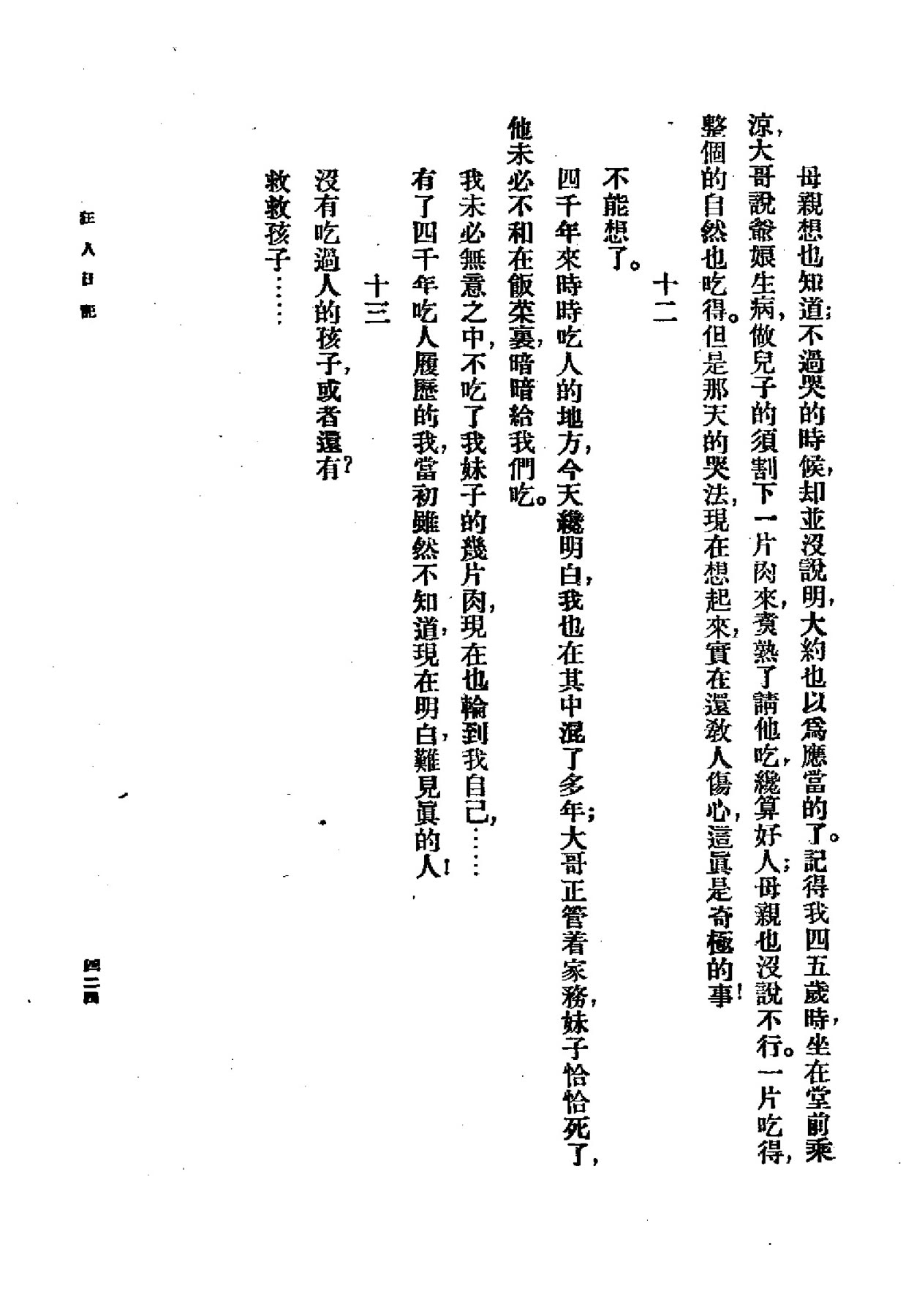
On the 1918 printed page, the last two clauses occupy one narrow vertical column: “沒有吃過人的孩子,或者還有?救救孩子……”[2][6] The line first imagines children who have not eaten people, then asks whether such children perhaps still exist, and only then issues its doubled verb of rescue.
The punctuation matters. A full stop after the question could have sealed the speaker inside uncertainty. Instead, the question mark becomes a hinge. On one side is an unknowable condition: perhaps some children remain untouched. On the other is an imperative that does not wait for proof. The sentence makes uncertainty a reason to act, not a reason to postpone action.
The doubled “save” also carries more strain than a single abstract appeal. It sounds spoken rather than inscribed, urgent rather than programmatic. Yet Lu Xun withholds the consolations that such urgency often receives. No rescuer is named. No method follows. The diary simply stops, leaving the reader in the vacant grammatical place where an addressee should be.
That vacancy is easy to fill sentimentally: adults must protect innocent young people from a cruel past. But the preceding entries make “save” less comfortable. The children need protection not only from being consumed. They need protection from learning to consume.
The children have already been watching
Earlier, the madman confronts a young man about eating people. The young man evades the moral question by appealing to custom; soon the madman worries that parents have already taught their children the same evasions. Even the children in the street look at him fiercely.[1] The story therefore treats culture as a chain of rehearsal. A practice survives because families, teachers, neighbors, books, and polite language make it seem too ordinary to name.
Cannibalism is grotesque enough to expose that process. When the madman looks between the lines of a history book whose pages proclaim “Virtue and Morality,” he sees the hidden instruction: “Eat people!”[1] The revelation begins as an accusation against texts and other people. It does not stay there.
By the twelfth entry, the madman suspects that his elder brother fed the family flesh from their dead little sister. He then considers the unbearable possibility that he ate some unknowingly. Whether this happened inside the story's literal world cannot be settled; the diary is structured through persecution, recollection, rumor, and inference. What can be settled is the direction of the thought. The pronoun of guilt moves inward. The man who detected cannibalism in everyone else discovers that he cannot certify his own innocence.[1]
Only after that self-implication can the final question appear. “Perhaps” is not timidity pasted onto a revolutionary slogan. It is what remains after the speaker gives up the fantasy that recognition makes him pure. He has seen the system and may still have participated in it. The children may not yet have participated—but he cannot know that either.
This is why the passage is more exacting than a contrast between evil tradition and innocent futurity. It imagines rescue as interruption. The chain must be broken somewhere, even though no generation can be assumed to stand cleanly beyond history.
The story frames its prophet as a recovered patient
There is a second reason the ending cannot be read as uncomplicated triumph: chronologically, the reader already knows what happens next.
Before the first diary entry, an unnamed acquaintance explains that one of two brothers once suffered from a persecution disorder. By the time the acquaintance visits, the younger brother has recovered and left to take up an official post. The elder brother hands over two notebooks; the acquaintance decides to copy excerpts for medical research. The diary we read is thus introduced as a document of illness by people who believe its author has returned to normal life.[1]
That preface can be taken at face value. A sick man recovered; the notebooks preserve his delusions. But its language and placement also permit a harsher inference. If “normal” society is precisely what the diary names as cannibalistic, then recovery may look like readmission to the order he attacked. The official post does not prove moral surrender, but it prevents the reader from imagining that the last appeal simply launches a victorious reformer into the future.
Rydholm shows why this pressure is harder to feel in English translations that flatten the stylistic difference between the classical preface and the vernacular diary.[3] In the Chinese text, the frame does not merely disagree with the madman. It speaks in the prestige language associated with institutional judgment, while the supposedly disordered interior speaks in the insurgent medium of the literary future. Sanity and madness are not neutral labels here; they arrive already dressed in competing styles.
The formal paradox is sharp. The frame contains the diary, classifies it, and announces the writer's recovery. Yet it also preserves and circulates the words that its diagnosis is meant to domesticate. The social order gets the man back; the story lets the plea escape.
Tang's account of the work as a modernist act of deconstructive reading helps explain that survival.[4] The madman is unreliable about events but devastatingly alert to euphemism. He hears what moral vocabulary can conceal, notices how appeals to precedent replace moral argument, and recognizes that calling a dissenter ill can protect a community from what he says. His broken narrative does not offer a stable platform outside ideology. It teaches suspicion toward every platform that claims stability.
Hope without an alibi
The story's later canonical status can make its challenge seem inevitable, as though readers in 1918 immediately recognized a founding work. Reception was slower. Eva Shan Chou found that almost nothing was published about Lu Xun during the first five years of his fiction career and argues that a new readership had to learn how to read these stories.[5] That lag suits “A Madman's Diary.” Its final demand is memorable at once; its framing, linguistic conflict, and self-accusation keep disturbing any settled use of it.
Read whole, the last line refuses two alibis. The first is innocence: neither the speaker nor the children are declared untouched. The second is certainty: rescue cannot wait until an uncontaminated subject has been found and a guaranteed future proved.
The sentence offers only a narrowing chance. Perhaps the chain has not closed. Perhaps someone can still be reached before inherited cruelty becomes ordinary conduct. The possibility may be small, but the verb remains imperative.
That is Lu Xun's severe form of hope: not the belief that the future will be better, but the decision that uncertainty does not cancel responsibility.
Sources
- Lu Xun, “A Madman's Diary” (April 1918), translated by Yang Hsien-yi and Gladys Yang in Selected Stories of Lu Hsun—primary English text and numbered diary entries.
- Lu Xun, 狂人日記 (A Madman's Diary), Wikisource transcription of the text as printed in New Youth in 1918—primary Chinese text for the original final sentence.
- Lena Rydholm, “The Worlds of Multiglossia in Modern Chinese Fiction: Lu Xun's ‘A Madman's Diary’ and the ‘Shaky House,’” in Literature and the Making of the World (Bloomsbury Academic, 2022)—study of the classical preface, vernacular diary, and translingual structure.
- Xiaobing Tang, “Lu Xun's ‘Diary of a Madman’ and a Chinese Modernism,” PMLA 107, no. 5 (1992), pp. 1222–1234—modernist reading of temporality, language, and oppositional consciousness.
- Eva Shan Chou, “Learning to Read Lu Xun, 1918–1923: The Emergence of a Readership,” The China Quarterly 172 (2002), pp. 1042–1064—reception study of the delayed critical response to Lu Xun's early fiction.
- Wikimedia Commons, scan of New Youth, volume 4, number 5 (15 May 1918), published by Qunyi Shushe in Shanghai—132-page archival scan containing the first publication of “A Madman's Diary” on scan pages 53–63.