The pleasure of The Country of the Pointed Firs is easy to understate because Sarah Orne Jewett refuses the usual machinery of plot. A summer visitor comes to Dunnet Landing, Maine, boards with Mrs. Almira Todd, rents a schoolhouse room for writing, meets neighbors, hears stories, visits Green Island, attends local rituals, and eventually leaves. That summary sounds almost eventless. The book's actual drama is in the voice: who speaks, who waits, who withholds, who makes room for another person's story, and how a community becomes legible through manners of listening.[1][2]
That is why a theme-and-philosophy reading is more useful than a hunt for missing plot. Britannica calls the 1896 book an acclaimed example of local color and notes its sympathetic but unsentimental portrait of Dunnet Landing and its residents.[2] The Library of America page goes further, describing Jewett's spare, impressionistic prose as a way of bringing a faded Maine trading port to imaginative life.[3] Both descriptions are accurate, but the craft mechanism is more exact: Jewett makes voice carry structure. The book advances when attention deepens.
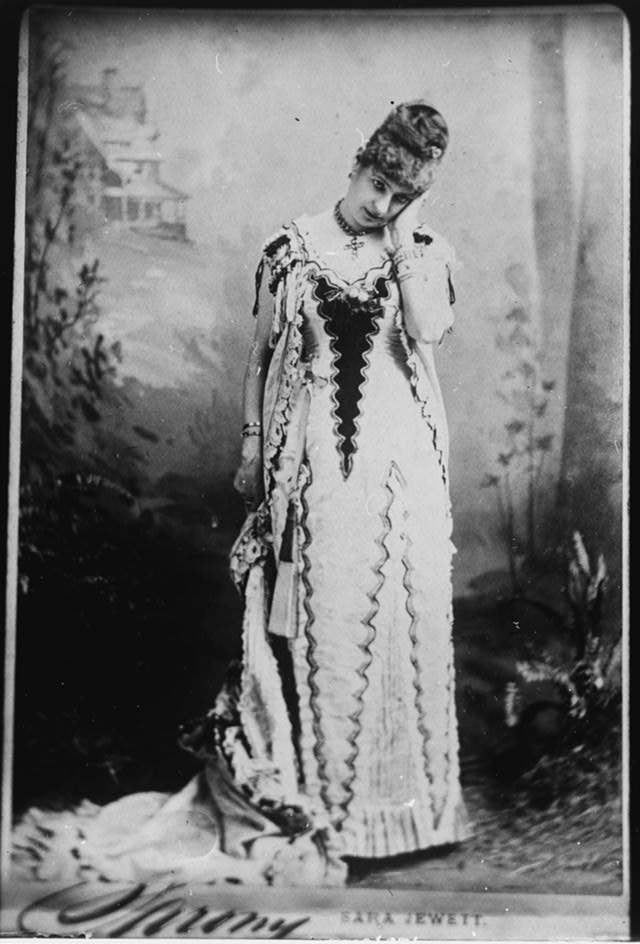
Image context: the lead image is a real archival photograph from the Library of Congress collection, not a generated portrait or typographic book graphic. It is relevant because the article studies Jewett's literary poise: a disciplined public stillness matched by prose that lets other people's voices slowly fill the room.[5]
The Narrator's Restraint Is Not Neutral
Jewett begins with arrival, but the narrator does not conquer the town by explaining it. She is a summer visitor and a writer, which gives her access and distance at once. Her first task is not to decode Dunnet Landing from above. It is to learn the tempo of entering another place without bruising it.[1]
The opening sentence says there was "something about the coast town of Dunnet" that drew the narrator back.[1] The vagueness matters. A louder book would name the attraction immediately: picturesque decay, rustic wisdom, quaint speech, maritime nostalgia. Jewett resists that conversion. "Something" leaves room for a knowledge that has to be earned through time, weather, errands, visits, and small permissions.
This restraint protects the book from becoming tourist prose. The narrator notices, but she also corrects herself by proximity. When she takes the schoolhouse as a writing room, the gesture seems at first like the familiar writer's fantasy of solitude. Yet the schoolhouse does not isolate her from Dunnet. It becomes a listening post. People arrive, sounds travel, views open, and work gives way to relation.[1] The style quietly revises the idea of authorship: writing is not escape from community but a more patient exposure to it.
Mrs. Todd Teaches The Book's Social Grammar
Mrs. Todd is the book's great instrument of transition. She is landlady, herbalist, guide, interruption, social broker, and emotional weather system. Through her, the narrator discovers that Dunnet's life is not organized by dramatic announcements. It is organized by calls, remedies, remembered kinship, local routes, and oblique forms of care.[1][2]
Jewett's prose around Mrs. Todd is wonderfully practical. Herbs are not decorative pastoral tokens; they are work, smell, remedy, business, and conversation. The narrator calls Mrs. Todd a "wise saver of steps," a phrase that compresses body, household management, and temperament into four words.[1] The sentence is funny because it does not inflate her. It honors intelligence as economy.
That economy shapes the whole voice. Jewett rarely pauses to tell readers what to admire. She lets competence show through motion: a kettle, a path, a neighbor at the fence, a plant gathered at the right time. The result is a style of respect without sermon. Mrs. Todd matters because she knows how things connect - people to illnesses, stories to places, seasons to plants, griefs to errands. The novel's structure follows that connective knowledge.
The Library of America description of Jewett's fiction stresses independent, capable women in outwardly quiet coastal towns.[3] Mrs. Todd is the central proof. She does not need a rebellion plot to become powerful. Her authority is social and practical. She keeps knowledge circulating.
Dialect Is Treated As Intelligence, Not Decoration
Jewett's idiomatic speech is central to the book's afterlife, but it needs careful reading. The danger in local-color fiction is that dialect can become display: the page asks readers to enjoy difference from a comfortable distance. Jewett is better than that. Her dialogue often gives Dunnet speakers the tact, timing, and self-protective indirection that standard literary narration cannot supply on its own.[1][2]
The narrator's role is crucial here. She does not translate every local turn into a superior standard meaning. She often lets speech remain socially situated. A character's pause, evasion, courtesy, or remembered phrase can matter as much as the information delivered. The book's deepest conversations are not clean interviews. They are acts of approach.
Captain Littlepage shows how this works. His stories could easily become comic eccentricity or old-sailor folklore. Instead, Jewett lets his wandering talk disclose a loss larger than one man: the old maritime economy, the social dignity attached to seafaring, and the loneliness of carrying obsolete knowledge into a town that half-listens and half-indulges him.[1][2] The voice does not mock him into quaintness. It registers the ache inside his form of speech.
That is the unsentimental part of the book's sympathy. Jewett hears people without pretending that every memory is reliable, every habit noble, or every isolation sweet. Dunnet is intimate, but intimacy does not erase solitude. The style keeps both pressures audible.
The Book Is Episodic Because Community Is Episodic
Readers sometimes describe Pointed Firs as a sequence of sketches rather than a conventional novel. The Library of Congress first-edition record confirms the 1896 book form and its material presence as a Houghton, Mifflin publication designed by Sarah Whitman.[4] The question is not whether the book lacks a heavy plot. It plainly does. The better question is what the looseness makes possible.
An episodic form lets Jewett imitate local knowledge. You do not know Dunnet Landing by following one conflict from inciting incident to climax. You know it by accumulated recognitions: Mrs. Todd's herb business, the schoolhouse, Captain Littlepage's monologue, Mrs. Blackett's island hospitality, the Bowden reunion, Elijah Tilley's widower grief, the late summer departure.[1] Each episode adds a new social relation rather than a new plot complication.
That form is also ethical. A tight plot might force every resident to serve the visitor's development. Jewett's looser design lets people remain partially independent of the narrator's use for them. Mrs. Blackett does not exist only to be learned from. William is not reduced to a symbol of rustic shyness. Elijah Tilley is not only a case study in mourning. The book's style makes room for them, then withdraws before possession becomes too complete.
The Landscape Listens Back
Jewett's descriptive prose is often beautiful, but it is rarely inert scenery. The title image itself turns trees into a maritime presence: "the great army of the pointed firs."[1] That short phrase makes the shore look watchful, collective, and almost ready for departure. Landscape in the book is not background. It is a participant in memory.
Green Island matters for this reason. The trip outward does more than add variety to the setting. It lets Mrs. Todd's world widen through kinship, sea passage, and maternal continuity. Mrs. Blackett's island hospitality has the force of a revelation because Jewett has trained the reader to value small acts of reception.[1][2] A room, a meal, a path, a view, and a local story become parts of one grammar.
The Historic New England information for the Sarah Orne Jewett House fixes the author in South Berwick, Maine, where her house remains a preserved literary site.[6] That biographical anchor is useful, but Pointed Firs is not important simply because Jewett knew Maine. It is important because she found a prose form adequate to local knowledge without reducing locality to postcard atmosphere.
Listening Becomes The Plot
By the end, the narrator's departure feels moving because the book has built attachment without forcing confession. Dunnet Landing has not been solved. It has been heard. The summer visitor leaves with more than picturesque memory; she leaves having learned that a place can be made of voice, route, ritual, silence, and repeated care.[1][2][3]
This is Jewett's strongest stylistic achievement. She turns quietness into narrative force. The sentences do not hurry because the community cannot be honestly known at high speed. The dialogue does not flatten because local speech is treated as a medium of thought. The episodes do not scatter because attention supplies the continuity that plot withholds.
That is why The Country of the Pointed Firs still feels modern in its modesty. It asks readers to give up the demand that significance arrive loudly. It shows that a novel can be built from visits, errands, recollections, and tact, provided the voice knows how to listen. In Jewett's hands, listening is not preparation for the story. Listening is the story.
Sources
- Sarah Orne Jewett, The Country of the Pointed Firs. Project Gutenberg ebook page for the public-domain text used for close reading.
- Encyclopaedia Britannica, "The Country of the Pointed Firs" - publication year, local-color context, episodic structure, and Dunnet Landing overview.
- Library of America, Sarah Orne Jewett: Novels and Stories - editorial context for Jewett's fiction, The Country of the Pointed Firs, and the Dunnet Landing stories.
- Library of Congress, "The country of the pointed firs" - bibliographic record for the 1896 Houghton, Mifflin first-edition book record.
- Wikimedia Commons, "File:Sarah Orne Jewett Arnold Genthe.jpg" - archival portrait source page, with Library of Congress provenance.
- Sarah Orne Jewett House, visitor information - South Berwick location and Historic New England house-museum context.