The Count of Monte Cristo has one of the most adaptable premises in nineteenth-century fiction: an innocent sailor is betrayed, buried alive in an island prison, educated in captivity, released by a grotesque accident, enriched by treasure, and returns under a new identity to punish the men who destroyed him.[1][2] That summary is so clean that it can make the novel sound easier than it is. The plot is built for theater and cinema, but the book's afterlife lasts because revenge never remains a clean pleasure for long.
Dumas and Auguste Maquet made revenge mechanically satisfying. Every betrayal creates a later exposure; every social mask has a weakness; every corrupt household can be entered, bought, overheard, or staged against itself.[1][2] Yet the novel also keeps asking whether Edmond Dantes becomes freer as he becomes more powerful. By the end, the famous counsel to "Wait and hope" does not erase revenge. It survives revenge, and that is why adaptations keep returning to the story.[1]
The first clue is historical. Britannica notes that the novel was published serially in 1844-46, appeared in book form in 1844-45, and quickly moved into stage adaptation by Dumas himself.[2] In other words, Monte Cristo was not later discovered to be adaptable. Adaptation was part of its early life. It was born in installments, structured around suspense, delayed revelations, recognitions, disguises, and moral payoffs. The afterlife was already folded into the form.
The prison makes a role, not just a victim
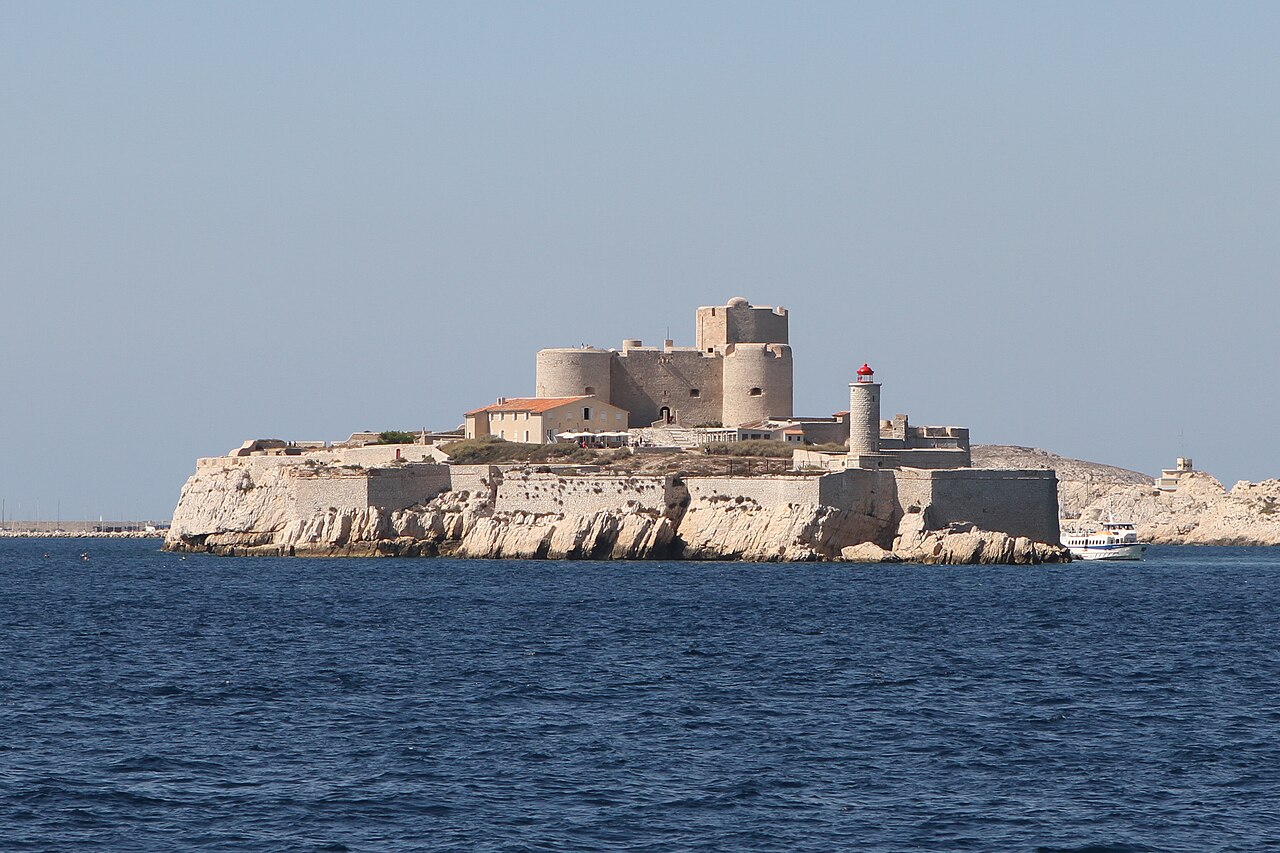
Most versions of Monte Cristo understand that the Chateau d'If is more than scenery. The official history of the monument describes a sixteenth-century fortress that became useful as a prison because isolation made escape nearly impossible; Dumas's novel then turned that real island into one of the most recognizable literary prisons in Europe.[6] The force of the setting comes from that double status. It is a physical fort in the bay of Marseille and a story engine that explains why a young sailor can plausibly return as someone almost unrecognizable.
The prison sequence adapts well because it compresses several transformations into one visible place. Dantes enters as a man with a name, a fiancee, a father, a job, and a future.[1] He leaves with knowledge, money, secrecy, and a role. Abbé Faria's instruction gives him history, languages, science, and a treasure map; confinement gives him the discipline of long resentment; the burial-sack escape gives him symbolic rebirth.[1][2] Adaptation can shorten the details, but it cannot remove the mechanism. Without the prison, revenge is only anger. With the prison, revenge becomes a second identity.
That is also why the Chateau d'If keeps attracting readers and visitors. The monument's own public history now has to account for Dumas as part of the site, not merely as a novelist who borrowed it.[6] Fiction has altered the way the real place is seen. The image of the fortress works in this article because it shows the practical fact behind the myth: stone, water, distance, and the narrow theatricality of an island that seems designed to make return impossible.
The revenge plot is satisfying because it behaves like social engineering
The most portable part of Monte Cristo is not swordplay. It is orchestration. Edmond does not simply confront his enemies. He studies their new lives. Danglars has become money; Villefort has become law; Fernand has become military and aristocratic prestige.[1][2] Each man is punished through the very system he used to prosper. That structure is why the story can move across stage, film, television, and contemporary retellings. It is not only a revenge fantasy. It is a fantasy of perfect social audit.
This is where the novel differs from a simpler wronged-man adventure. Dantes does not merely regain agency; he becomes a director. He arranges rooms, letters, rumors, debts, disclosures, and meetings. He understands that public identity is made of paperwork, reputation, inheritance, marriage, credit, and timing.[1] In adaptation terms, that gives the story a durable visual grammar: masked arrival, lavish interiors, secret knowledge, a society dinner turning into tribunal, a familiar face revealed too late.
But Dumas keeps the pleasure dangerous. The Count's power can look providential, and he often behaves as if he has earned the right to administer fate.[1] The ending refuses to leave that confidence untouched. The final letter's "Wait and hope" matters because it arrives after he has seen the damage done by treating human lives as instruments.[1] It is not a slogan pasted onto an adventure. It is the book's late correction to the intoxication of perfect design.
Adaptations have to choose what kind of Count they want
Because the plot is so strong, every adaptation faces the same temptation: make Edmond simply heroic. Britannica's legacy note lists a long screen afterlife, including versions from 1922, 1954, 1964, 1998, and 2002, and that list only gestures toward the full range of theatrical, television, and film reuse.[2] The basic promise remains legible in every era: injustice, concealment, return, punishment. The harder question is how much moral unease survives the compression.
A two-hour film tends to need momentum. It can foreground escape, treasure, romance, and confrontation. A miniseries can linger over the intermediate machinery: Paris salons, family histories, financial plots, the slow tightening of consequence. A stage version can make identity and recognition do much of the work. None of these choices is neutral. The shorter the form, the more likely revenge becomes clean. The longer the form, the more room there is for Dumas's uncomfortable question: what remains of the injured man after he becomes too good at injury?
The 2024 French film's Cannes framing shows how current that problem remains. In the festival interview, Alexandre de La Patellière says the story still resonates because viewers want revenge with Edmond, even as he "strays off course"; Matthieu Delaporte stresses that the Count is not Robin Hood but a man who keeps treasure to feed revenge.[4] That is a sharp reading of the adaptation problem. Modern viewers do not need the plot softened into moral tidiness. They need the spectacle to carry the danger of wanting punishment too much.
The BFI Player page for the same film underlines the other reason the property keeps renewing itself: scale still sells. It describes the 2024 version as a 178-minute French adaptation whose spectacle and production design helped make it a major French box-office success.[5] The old serialized engine has not lost its public appetite. Viewers still respond to castles, disguises, duels, betrayals, and revelations, provided the adaptation remembers that the Count's glamour is a symptom as well as a reward.
The book object also belongs to the afterlife
The afterlife of Monte Cristo is not only screen history. Open Library's record for an 1888 Routledge volume preserves the novel as a nineteenth-century book object, with Dumas named and the edition tied to the Internet Archive's scanned holdings.[3] That bibliographic detail matters because it reminds us how large and material the story has been: not just a plot summary passed through culture, but a long nineteenth-century reading experience that traveled through serial installments, multi-volume editions, abridgments, translations, theatrical versions, and later visual media.
That thickness is part of the adaptation challenge. The novel is not merely long; it is cumulative. Edmond's revenge works because the reader has lived through his dispossession, education, disguise, and social infiltration at length.[1] Cut too much, and the Count becomes a superhero of grievance. Keep too much, and the pace can collapse. Good adaptations solve this by identifying the moral spine rather than trying to preserve every incident. The spine is not "revenge succeeds." It is "revenge changes the avenger before it finishes changing the world around him."
The novel's final movement is therefore not a detachable moral lesson. It is the afterlife seed. Dantes can sail away because the story has pushed revenge to its limit and found it insufficient.[1] That insufficiency is exactly what later versions inherit. Each new Monte Cristo must decide whether the Count's last act is triumph, withdrawal, repentance, exhaustion, or mercy. The answer changes with medium and era, but the question is built into the book.
Why it keeps coming back
The Count of Monte Cristo keeps adapting because it gives artists a machine that almost runs by itself, then asks whether the machine should be trusted. The wronged man returns. The guilty prosper visibly. Wealth becomes a costume shop. Society becomes a stage. Justice looks possible because one injured person has learned every hidden lever.[1][2]
But Dumas's deeper durability lies in the aftertaste. Revenge is thrilling while it clarifies the world into debt and payment. It becomes frightening when the avenger starts to mistake himself for providence. That is why the last words matter. "Wait and hope" is not passive advice. It is the book's final refusal to let revenge be the only grammar of survival.[1]
As long as audiences recognize betrayal, reinvention, social masks, and the fantasy of perfectly targeted consequence, Monte Cristo will remain adaptable. As long as the story also leaves behind the question of what revenge costs the person who performs it, it will remain literature rather than only a plot machine.
Sources
- Alexandre Dumas and Auguste Maquet, The Count of Monte Cristo. Project Gutenberg text.
- Encyclopaedia Britannica, "The Count of Monte Cristo" - publication history, plot overview, themes, and adaptation legacy.
- Open Library, The Count of Monte-Cristo (Routledge, 1888) - bibliographic record for a scanned nineteenth-century edition.
- Festival de Cannes, "The illustrious Monte Cristo, as seen by Matthieu Delaporte and Alexandre de La Patellière" (May 22, 2024) - interview on the 2024 film's revenge logic and adaptation approach.
- BFI Player, "The Count of Monte Cristo" - listing for the 2024 French film, runtime, directors, premise, and reception note.
- Chateau d'If, "History of the chateau d'If" - official monument history and its connection to Dumas's novel.
- Wikimedia Commons, "File:Marseille Château d'If 26.jpg" - source page for the lead photograph of the Chateau d'If.