Henry David Thoreau's Walden and Okakura Kakuzo's The Book of Tea look, at first, like books with different jobs. One begins from a cabin beside a Massachusetts pond in the 1840s; the other introduces English-language readers to Japanese tea culture in 1906. One is usually shelved with American nature writing and reform-minded self-culture. The other often arrives through art history, aesthetics, and cross-cultural explanation. Put them beside each other, though, and they start asking the same practical literary question: how small can a room become before it turns into a method for remaking attention?[1][2][3]
The comparison works because neither book treats space as mere setting. Thoreau's cabin is not only where he lives while writing about woods, beans, ice, visitors, economy, and solitude. It is a device for testing which needs are real and which have been made noisy by custom.[1][4] Okakura's tea room is not only a backdrop for utensils and manners. It is a disciplined arrangement of emptiness, imperfection, hospitality, and chosen objects, designed to make beauty feel ethical rather than ornamental.[2][3]
That shared concern makes Comparative Reading the right lens. These are not twins. Thoreau often writes as if culture has to be stripped back until a person can hear life again. Okakura writes as if culture has to be refined until gesture, room, and object recover their moral scale. Yet both books distrust bigness. Both ask readers to notice how much a civilization reveals in its smallest daily arrangements.
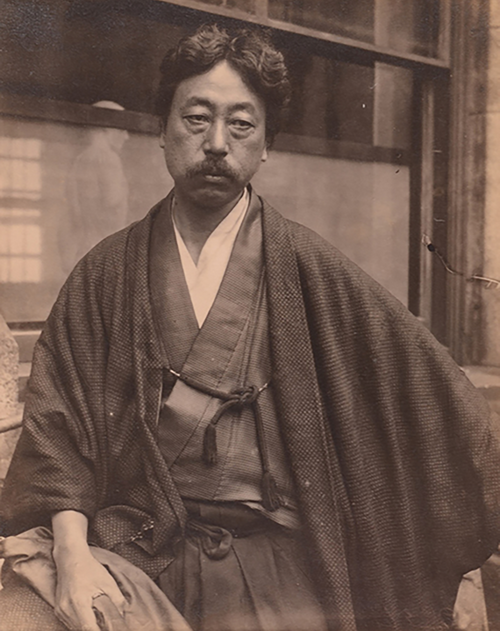
Image context: the cover uses a real archival photograph of Okakura Kakuzo, not a generated scene, diagram, or decorative tea image. It is relevant because the article reads The Book of Tea as a literary argument made by a specific writer in a specific cultural exchange, not as anonymous atmosphere.[5]
Two Rooms, Two Kinds Of Refusal
Thoreau makes refusal sound blunt. In Walden, the cabin begins as an answer to excess: too much work for too little life, too many inherited assumptions, too much secondhand desire. His most famous command is still the clipped "Simplify, simplify."[1] The line can become a lifestyle slogan if isolated, but inside the book it is sharper. Thoreau is not praising rustic decoration. He is asking what happens when shelter, food, clothing, fuel, labor, reading, and companionship are all made visible as choices.
The cabin therefore has an argumentative shape. It is small because a large house would let him hide the cost of living from himself. It is spare because an overfurnished room would confuse comfort with freedom. It is near town but not inside town because Thoreau wants friction: enough distance to test social assumptions, enough proximity to keep the experiment from becoming pure escape.[1][4]
Okakura's tea room refuses a different excess. The Book of Tea is not trying to make life primitive. Its central spaces are deliberately cultured. The tea room contains trained etiquette, selected utensils, flower arrangement, architecture, memory, and the host's tact. Yet the discipline points toward subtraction. Okakura describes tea as a "religion of the art of life," a phrase that makes daily gesture carry spiritual and aesthetic weight without needing a cathedral or palace.[2]
Where Thoreau reduces possessions to expose dependency, Okakura reduces display to expose relation. The tea room is small not because culture has failed, but because culture becomes most exact when it stops shouting. Its emptiness is not poverty. It is room for encounter.
Poverty And Emptiness Are Not The Same Symbol
One danger in comparing the books is to flatten both into an anti-materialist sermon. That would miss the important difference. Thoreau's poverty is polemical. He publishes accounts of boards, nails, food, and labor because he wants the reader to feel the absurdity of a life spent maintaining what has never been examined.[1] Even when the bookkeeping is theatrical, it forces a literary discipline: nothing gets to remain an innocent necessity until it has survived scrutiny.
Okakura's emptiness is more ceremonial. The tea room is not empty because things do not matter. It is empty because each thing matters more when the room does not drown it. His praise of incomplete, asymmetrical, and carefully placed beauty turns absence into an active part of perception.[2][3] A scroll, flower, kettle, cup, or alcove has force because it is allowed to answer the surrounding quiet.
This is where the two books diverge most fruitfully. Walden often imagines the self under pressure from bad economics: mortgage, fashion, status, nervous industry, newspapers, and herd opinion.[1][4] The Book of Tea imagines the self under pressure from bad perception: clutter, vulgar display, cultural arrogance, mechanical perfection, and the failure to treat common acts as forms.[2][3]
The shared lesson is not "own less" in the thin modern sense. It is more demanding: arrange life so the cost of each object, habit, and gesture can be felt. Thoreau makes that cost economic and existential. Okakura makes it aesthetic and relational.
Nature Enters Differently
Nature in Walden arrives as pond, ice, loon, bean-field, winter animal track, thaw, and weather. Thoreau's prose keeps returning to the outside world because the cabin's authority depends on being porous. He is not building a sealed cell for private purity. He is building a listening station. The pond teaches scale; the seasons make time less abstract; animals and plants keep human urgency from becoming the only rhythm in the book.[1][4]
Okakura's nature is more mediated, but not less real. The tea room brings nature indoors through flower arrangement, seasonal awareness, materials, and the cultivated preference for imperfection. He is interested in how art trains perception so that a person can meet transience without trying to conquer it.[2][3] Nature does not merely sit outside the wall. It enters as timing, texture, asymmetry, and restraint.
That difference explains the books' different prose energies. Thoreau's sentences love corrective shock. He likes to wake the reader, scold the reader, tease the reader, and then send the reader out toward pond ice or morning air. Okakura's prose moves more like a guided threshold. He explains, reframes, and often turns Western assumptions back on themselves, especially when he treats tea not as quaint custom but as a philosophy of proportion.[2][3]
Both styles can sound severe. Thoreau can be prickly. Okakura can be grand. But their severity has a common target: inattentive living. Each book assumes that civilization can make people less capable of seeing what is immediately before them.
Hospitality Tests The Self
The cabin and the tea room are both social spaces, which is easy to forget. Walden is famous for solitude, but the book includes visitors, village errands, conversations, and deliberate withdrawals from company.[1] Solitude is not misanthropy. It is a way to return relation to scale. Thoreau wants enough aloneness to stop borrowing other people's measurements of success.
The tea room is more openly built for encounter. Hospitality is its reason for being, but it is not the hospitality of abundance. The host does not overwhelm the guest with proof of wealth. The room asks both people to enter a form where attention, tact, silence, and small differences matter.[2] Okakura's phrase "the art of concealment" appears in his discussion of the tea room's discipline, and it matters because concealment is not evasion here. It is the refusal to spend every effect at once.[2]
Read through Thoreau, Okakura's restraint looks less like elegance alone and more like an ethics of not overclaiming the room. Read through Okakura, Thoreau's cabin looks less like solitary ruggedness and more like a rough American ritual chamber, a place where meals, tools, books, visitors, and weather become tests of proportion.
Neither writer offers a fully democratic room. Thoreau's experiment depends on conditions he does not always make equally available to others. Okakura's tea-room ideal is shaped by trained taste, cultural inheritance, and a hierarchy of knowledge. But literature does not become useful only when its rooms are universally reproducible. It becomes useful when its forms clarify what ordinary life has been hiding.
The Small Room As A Reading Practice
The strongest reason to read the books together is that each changes how its own prose should be read. Walden asks for a reader willing to slow down at the level of practical arrangement. The bean-field is not a rustic interlude; it is labor, economy, metaphor, and comic self-display at once.[1] The winter pond is not scenery; it is a lesson in opacity, measurement, and hidden life. Even the accounting tables matter because Thoreau wants numbers to embarrass vague aspiration.
The Book of Tea asks for a reader willing to treat aesthetic description as argument. The tea room, the flower, the cup, and the unfinished surface are not decorative examples placed around a thesis. They are the thesis in material form.[2][3] Okakura's literary method depends on making readers feel that a culture's seriousness may reside in its controlled smallness.
So the comparison does not end by choosing the cabin over the tea room, or simplicity over ceremony. It ends by seeing both as attacks on careless scale. Thoreau attacks the scale of industrializing desire: more property, more news, more labor, more borrowed ambition. Okakura attacks the scale of cultural vulgarity: more display, more completeness, more explanation, more possession.
Their answer is the deliberately made small space. A cabin can reveal the cost of living. A tea room can reveal the cost of attention. Between them, Walden and The Book of Tea suggest that a room becomes literary when it stops being background and starts judging the life arranged inside it.
Sources
- Henry David Thoreau, Walden. Project Gutenberg ebook page for the public-domain text used for close reading.
- Okakura Kakuzo, The Book of Tea. Project Gutenberg ebook page for the public-domain text used for close reading.
- Encyclopaedia Britannica, "Okakura Kakuzo" - biographical context, art-historical role, and The Book of Tea context.
- Encyclopaedia Britannica, "Walden" - publication context, summary, and framing of Thoreau's Walden Pond experiment.
- Wikimedia Commons, "File:Okakura Kakuzo Portrait c1905.png" - archival portrait source page for the lead image.