The afterlife of The Tale of Peter Rabbit is easy to mistake for cuteness. There is the blue jacket, the garden gate, the nursery shelf, the plush toy, the television version, the shop display, the Lake District pilgrimage. All of that is real, but it is not the reason the story keeps working. Peter survives because Beatrix Potter built a very small book around a very exact machine: warning, appetite, trespass, chase, loss, escape, bedtime. The character can be merchandised because the book first made him instantly readable as a body in trouble.
That body began before the book. The V&A traces Peter's first form to Potter's illustrated letter of 4 September 1893 to Noel Moore, the sick five-year-old son of her former governess Annie Moore.[2] Potter then borrowed back the children's saved letters, copied and reworked them, privately printed 250 copies on 16 December 1901, and watched Frederick Warne take the book public in 1902 after earlier rejection.[2] The Beatrix Potter Society timeline gives the same hinge: first private publication in December 1901, then Hill Top Farm in 1905, then a long life in which the writer, farmer, conservationist, and publisher do not separate cleanly.[3]
The afterlife starts there: not with a brand department, but with a piece of prose designed to fit a child's hands.
The Story Is Built From Portable Signals
Potter's text is short enough to feel inevitable, but it is not simple in the lazy sense. Mrs. Rabbit's warning gives the whole plot its moral geometry: Mr. McGregor's garden is not merely a pretty setting, it is a forbidden adult economy with tools, vegetables, ownership, and consequences.[1] Peter's sisters stay inside the safe circuit of blackberries. Peter enters the risk circuit of cabbages, radishes, parsley, panic, and the shed.
The genius of the book is that nearly every important idea becomes a visible prop. The jacket is disobedience made wearable. The shoes are domestic order lost in the mud. The sieve is hiding place and trap. The watering can is shelter and discomfort. The gate is not an abstract moral boundary; it is a thing Peter must find with his frightened body.[1]
That is why the story adapts so easily. A film, stage reading, toy shelf, classroom worksheet, or picture-book reissue can carry the tale through the same few signals: blue cloth, brass buttons, garden wall, vegetables, old man, chase, exhaustion. The danger is that adaptation can over-sweeten those signals. Peter is charming, but he is also "very naughty"; Mr. McGregor's cry of "Stop thief!" belongs to a story about property, hunger, and fear, not only about a bunny in clothes.[1]
Potter Keeps The Moral Scale Child-Sized
The book's punishment is frightening without becoming grand. Peter does not receive a sermon. He loses his things, gets chased, becomes sick with terror, and comes home unable to eat the supper his sisters enjoy.[1] That is small moral accounting, and it is exactly the scale of childhood. The body learns before the lecture arrives.
This is the craft that later versions often struggle to preserve. If Peter becomes only a mascot, the story loses its nerves. If he becomes a modern rebel hero, the story loses its delicate comedy of consequences. Potter's sentence rhythm makes both impulses unnecessary. Peter's adventure is not an assertion of freedom; it is a practical experiment that goes wrong. He wants what is on the other side of the warning. He learns the cost through damp clothes, missing shoes, and a stomach that ends the day on chamomile tea.[1]
The emotional balance matters because it keeps adults and children reading different books at once. A child can feel the chase. An adult can see the miniature social order: widowed mother, household routine, garden labor, private property, animal appetite, bodily vulnerability. The book does not explain those layers. It lets them sit inside objects a child can name.
The Format Is Part Of The Meaning
Potter's insistence on smallness was not a decorative preference. The V&A notes that she wanted the book to be small enough for children and affordable, with a black-and-white illustration on every page; publishers initially wanted something larger and more expensive.[2] She answered by publishing it herself. That decision matters for the afterlife because it makes the book an object lesson in audience. Potter was not merely writing about a child-sized creature. She was making a child-scaled artifact.
Warne's 1902 edition then turned that artifact into a publishing system. According to the V&A, publication began in October 1902 with 8,000 copies, followed by 12,000 more in November and 8,220 in December.[2] The figures are useful because they show how quickly the private letter became repeatable public form. But repeatability did not mean fixity. Potter edited, cut, designed, colored, adjusted binding suggestions, and later saw the text and images reworked through printings, jackets, authorized editions, and the 2002 centenary redesign that restored removed illustrations.[2]
That revision history should change how we talk about "the original." Peter Rabbit did not become durable by freezing itself. It became durable by establishing a compact set of rules strong enough to survive changes in paper, color, jacket, edition, and market. The core stays legible because the form is economical: one small fugitive, one dangerous garden, one line back home.
The Brand Works Best When It Remembers The Book
The modern Peter Rabbit afterlife can feel enormous compared with the book: editions, translations, toys, exhibitions, screens, heritage tourism. The Beatrix Potter Society records the first official Dutch translation in 1912, and the V&A describes the book as having sold about 40 million copies worldwide.[2][3] Those numbers tell a success story, but numbers alone miss the literary reason for the success. Peter travels well because he is not overexplained.
He is a character with strong silhouette and limited psychology. That limitation is a strength. We know appetite, disobedience, panic, and relief. We do not need a mythology of rabbit society or a grand destiny for him. The book gives just enough family structure to make his transgression matter, just enough garden detail to make danger concrete, and just enough illness at the end to make the escape cost something.[1]
The best afterlives keep that narrowness. A good adaptation does not have to reproduce every sentence, but it should preserve the pressure of trespass. Peter is not interesting because he is generically cute. He is interesting because cuteness and consequence occupy the same little coat. When an adaptation turns the garden into harmless playground, it flattens the book. When it remembers that Peter is frightened, muddy, exposed, and hungry, the old machinery starts again.
Hill Top Turns Afterlife Into Place
Hill Top adds another layer to the story's survival. Potter bought the Lake District farm in 1905, three years after the Warne edition of Peter Rabbit began its public life.[3] The National Trust now presents Hill Top as her home and a place tied to her stories, while the Beatrix Potter Society timeline later records her conservation commitments, including the 1939 sale of redrawn Peter Rabbit illustrations through The Horn Book Magazine to help the National Trust save Cockshott Point from developers.[3][4]
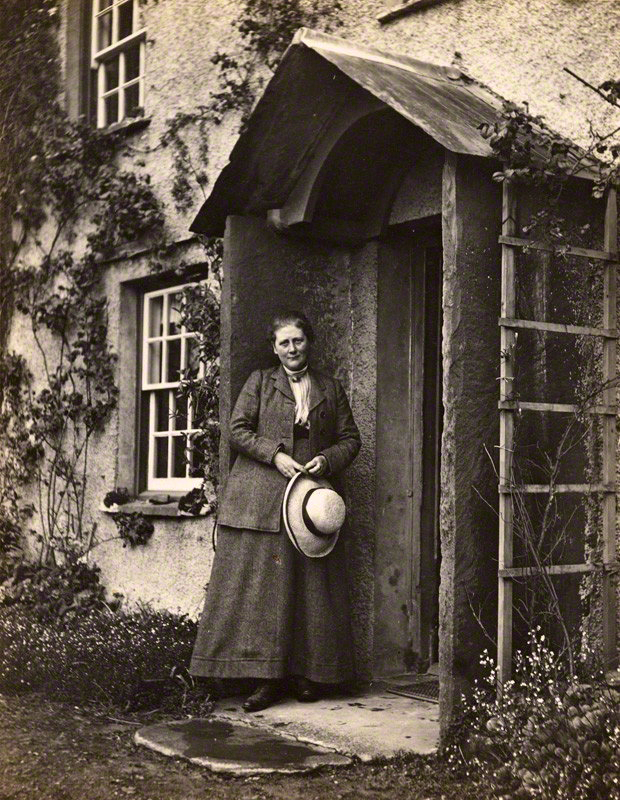
That is a more interesting afterlife than merchandise alone. The little book helped create value that returned to landscape, preservation, and public memory. Hill Top also gives readers a corrective against abstract branding. Potter's animals are not floating mascots. They come out of watched habits, gardens, farms, paths, gates, and rooms. The photograph of Potter at Hill Top is therefore not just author portraiture. It is a reminder that Peter Rabbit's portability depends on local texture: the story can travel because the gate, coat, and garden felt particular first.[5]
This is the paradox. Peter Rabbit became large by staying small. The book's afterlife is vast, but its literary engine remains tiny and exact. A warning is ignored. A garden becomes too real. Clothes fail. A child-sized body learns fear. Home returns not as triumph, but as bed and medicine. Potter gave adaptation a nearly perfect set of portable signs, then kept them sharp enough that the signs still point back to risk. The brand can be cute. The book is better than cute: it is a miniature chase story that understands how disobedience feels from inside the rabbit.
Sources
- Beatrix Potter, The Tale of Peter Rabbit, Project Gutenberg HTML text used for close reading.
- Victoria and Albert Museum, "Peter Rabbit: the tale of 'The Tale'," production and publication history.
- The Beatrix Potter Society, "Timeline," chronology of Potter's life, publishing, translations, Hill Top, and conservation activity.
- National Trust, "Hill Top," visitor and place context for Potter's Lake District home.
- Wikimedia Commons, "File:Beatrix Potter by King.jpg," source page for the archival May 1913 photograph used as the article image.