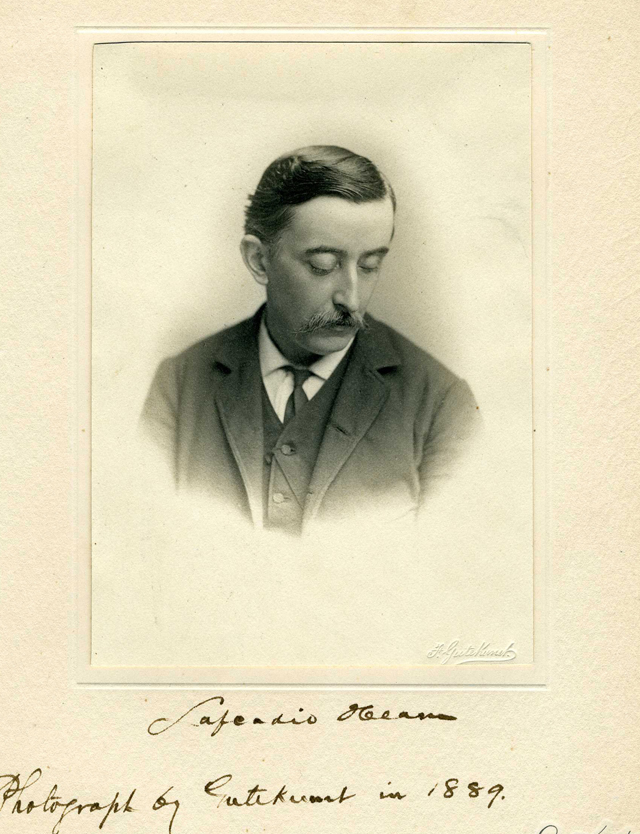
Lafcadio Hearn is easiest to overpraise in exactly the wrong way. Call him a collector of Japanese ghost stories, and the phrase sounds harmless, almost tidy. It makes the stories seem as though they were waiting in a drawer until an English stylist carried them to print. Kwaidan, published in 1904, is more interesting and more unstable than that. It is not a cabinet of curiosities. It is a book about listening under pressure: to books, to household tellers, to Buddhist afterlives, to provincial rumor, to a country Hearn loved without ever becoming transparent to it.[1][2]
That pressure is why the author profile has to stay close to the work. Hearn's life supplies the drama: born on Lefkada in 1850, raised partly in Ireland, formed as a journalist in the United States, drawn to Japan in 1890, later known as Koizumi Yakumo after marriage and naturalization, and dead in Tokyo in the same year Kwaidan appeared.[3][4] But the biographical itinerary can become a distraction if it turns him into a romance of wandering. The better question is what kind of prose such a life made possible, and what it could not safely claim.
The Book Announces Its Own Mediation
The subtitle of Kwaidan already warns the reader not to treat the volume as simple folklore capture: "stories and studies of strange things."[1] It is a mixed book, half narrative atmosphere and half essayistic curiosity. Hearn's prefatory note is even more revealing. He identifies several tales as coming from old Japanese books, one as told to him by a farmer in Musashi Province, and another as drawn from personal experience. He also admits that some retellings have been "recolored and reshaped."[1][2]
That admission is not a flaw to be explained away. It is the method. Hearn is neither invisible translator nor free inventor. He works in the tense middle, where inherited tales, local performance, print sources, memory, and English cadence meet. The result can feel dreamily clear on the surface, but the clarity is never neutral. Every tale arrives through a chain of voices.
This is why Kwaidan still feels alive where many exoticizing books of the same period do not. Hearn often wants to introduce Japanese materials to English-language readers, and that desire carries the asymmetries of its moment. Yet the strongest pages do not simply explain Japan to the West. They preserve obstruction. The ghost does not become a lesson with all the corners sanded off. The tale keeps something back.
Hoichi Is A Story About Listening Before It Is A Ghost Story
"The Story of Mimi-Nashi-Hoichi" is the best doorway into Hearn's art because it dramatizes the very condition of the book. Hoichi is a blind biwa player whose performance of the Heike war tale draws an audience he cannot see. He is summoned night after night to recite before the dead, and the terror depends on hearing before knowledge. The listener, like Hoichi, receives voice, command, procession, grief, and ceremony before the ordinary categories of safety return.[1]
The famous episode works because Hearn lets art become a threshold. Hoichi's gift is not decoration; it is the thing that makes him available to the ghostly court. When the unseen audience asks for the Dan-no-ura passage because "the pity of it is the most deep," the line binds aesthetics to danger.[1] A beautiful performance opens the wrong door.
This is also a miniature of Hearn's own position. He is not Hoichi, and the analogy should not be pushed into melodrama. But the story understands that transmission is risky. To carry an old tale across an audience boundary is to be changed by the audience that asks for it. Hoichi survives because priests write protective text over his body; the missing ears become the cost of an incomplete covering. Hearn's prose, too, is a covering that cannot cover everything.
His Simplicity Is Built, Not Naive
Hearn's best ghost prose often looks simpler than it is. He favors short declarative movement, slow approaches, domestic details, and a final turn that does not overargue. In "Yuki-Onna," the snow woman is first a fatal apparition, then a wife, then a broken promise, then absence again. In "Mujina," terror is stripped to a face that is no face. In "Riki-Baka," pity and eeriness depend on a child's foolishness returning as a sign rather than as a solved doctrine.[1]
The surface restraint matters. Hearn does not thicken these stories with modern psychology. He usually gives the reader just enough social setting to make the supernatural rupture legible: a road, a hut, a ferry, a temple, a marriage, a promise, a name. The emotional force comes from how little explanation is allowed to settle. A ghost story that explains too much becomes a mechanism. Hearn keeps the hinge visible but does not label every gear.
That restraint is also why the book's English matters. Hearn is not merely translating plots. He is building a tone for cultural distance: formal without stiffness, intimate without full possession, lucid without pretending that lucidity equals mastery. The tales sound as though they have already passed through several rooms before reaching the page.
The Outsider Problem Is Part Of The Reading
Any serious profile of Hearn has to resist two opposite simplifications. One makes him the perfect interpreter of Japan, as if affection and labor removed every problem of distance. The other dismisses him as only an exoticizing outsider. Neither response is good enough for Kwaidan.
The biographical record is more complicated. The Lafcadio Hearn Memorial Museum emphasizes his long Japanese residence, teaching, family life, and transformation into Koizumi Yakumo.[3] Library of America frames him through a wider American writing career that includes journalism, essays, translations, and the strange mobility of a writer who did important work before Japan but became internationally identified with it.[4] Later reception keeps returning to that oddness: Hearn is a border figure, a stylist of the eerie whose value lies partly in how difficult he is to classify cleanly.[5]
Read this difficulty into the book rather than around it. Kwaidan should not be treated as transparent access to Japanese tradition. It is access through Hearn: partial, loving, artful, selective, period-bound. But partial does not mean worthless. The book's lasting value comes from the exact shape of that partiality. Hearn lets English prose become a listening device, not a conquering instrument, at least in his best moments. The stories feel most respectful when they do not claim to have exhausted what they carry.
Why The Ghosts Last
The durable Hearn is not the picturesque traveler or the collector with a bag of marvels. It is the writer who understood that a ghost story can be a problem of transmission. Who told this? Who heard it? What changes when it moves from oral telling to book, from Japanese source to English sentence, from belief-world to literary atmosphere, from local dread to international reading?
That is why Kwaidan still reads with such clean unease. Its ghosts are not simply old supernatural figures introduced to new readers. They are tests of relation. Hoichi listens too well. The snow woman depends on a promise that speech breaks. The faceless stranger makes recognition collapse. The dead return not as spectacle but as pressure on ordinary forms of trust: marriage, performance, hospitality, memory, names.
Hearn's late genius was to make that pressure audible. He did not own the voices he borrowed, and the book is strongest when it knows that. It lets each tale feel handed onward rather than captured. A modern reader can see the Meiji-era mediation, the outsider gaze, and the editorial shaping, and still feel the old chill: someone is speaking from another room, and the sentence that brings the voice closer also reminds us that the room is not ours.
Sources
- Lafcadio Hearn, Kwaidan: Stories and Studies of Strange Things, Project Gutenberg HTML text used for close reading.
- Public Domain Review, "Kwaidan: Stories and Studies of Strange Things (1904)," publication and source-context note.
- Lafcadio Hearn Memorial Museum, English site, biographical and Koizumi Yakumo context.
- Library of America, Lafcadio Hearn: American Writings, bibliographic and author-context page.
- Library of America, "The odd, the queer, the strange, the exotic, the monstrous: Christopher Benfey on Lafcadio Hearn," reception and genre-context interview.
- Wikimedia Commons, "File:Lafcadio hearn.jpg," source page for the archival portrait photograph used as the article image.