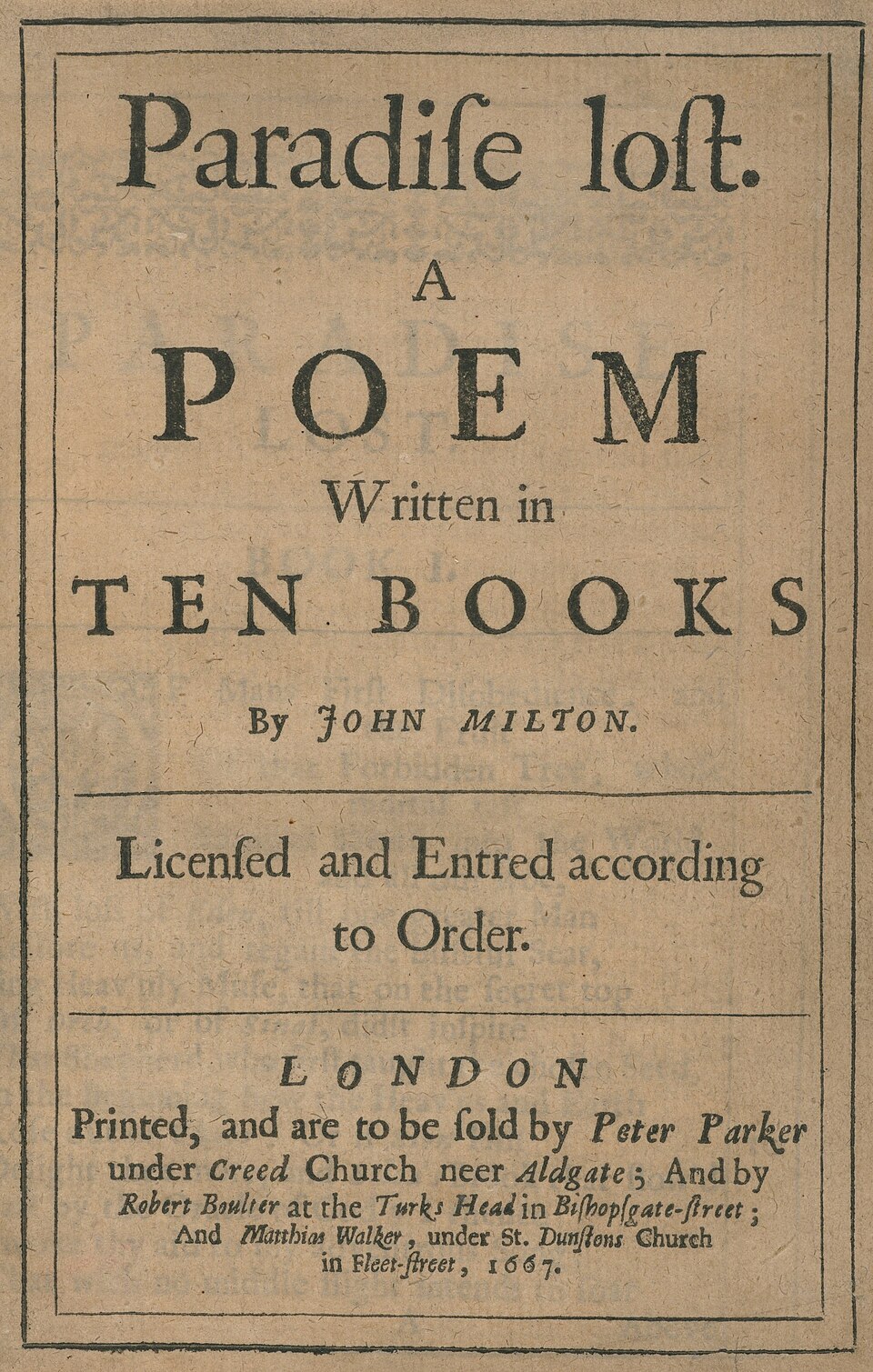
People often remember Paradise Lost as the poem that gave English literature its grandest rebel. Satan gets the swagger lines, the plunging trajectories, the infernal architecture, the rhetoric of injured greatness.[1][2] Yet Milton's real argument about freedom runs in the opposite direction. The poem keeps asking whether movement, refusal, and self-assertion are enough to count as liberty. Its answer is severe. Satan can move constantly and still remain trapped inside his own will; Adam and Eve can be genuinely free only because obedience is meaningful; the Fall does not enlarge consciousness, but makes desire narrower, more reactive, and more suspicious.[1][4]
That is one reason the poem has remained philosophically alive far beyond its seventeenth-century theological setting. First published in 1667, then revised into twelve books in 1674, Paradise Lost is obviously concerned with creation, disobedience, redemption, and political authority.[2][3] But underneath those larger categories lies a more intimate question: what does a free creature feel like from the inside? Milton does not answer with modern language about authenticity or self-expression. He builds a drama in which liberty is tested by alignment, scale, and self-knowledge. The creature who can only oppose is already becoming smaller than he imagines.
Image context: the cover uses a real archival image of the 1667 title page rather than a later illustration of Satanic grandeur. That choice matters because this essay is about the poem's governing logic, not its later Romantic glamour. The physical first edition keeps the argument anchored to Milton's original epic frame and publication moment.[5]
1) Milton gives freedom a difficult definition
The poem's hardest line about liberty arrives from God, not from Satan. In Book III, God says humankind was made "Sufficient to have stood, though free to fall."[1] A few lines later Milton sharpens the claim: "Not free, what proof could they have givn sincere / Of true allegiance?"[1] This is the poem's central condition. Freedom matters because obedience is not automatic. If good beings could only do good, then love, allegiance, praise, and steadfastness would lose moral depth; they would become mechanics instead of choice.[1][4]
That is already a more demanding account of liberty than the one readers often carry into the poem. Milton is not treating freedom as the mere absence of restraint. He is treating it as the capacity to stand rightly without compulsion. In that frame, obedience does not describe servility. It describes a live relation between creaturely reason and the order that sustains it.[1][4]
This matters because the poem's moral world is frequently misread as a simple authoritarian hierarchy with rebellion on one side and submission on the other. The actual pressure is subtler. Milton wants a universe in which obedience is valuable precisely because it can be withheld. The possibility of refusal is what gives fidelity its dignity. Freedom therefore appears at the start of the poem not as theatrical defiance, but as the burden of rightly directed choice.[1][4]
2) Satan confuses motion with freedom and rhetoric with reality
Satan remains compelling because he speaks the language of inward sovereignty better than anyone else in the poem. "The mind is its own place," he declares, and for a moment the line sounds like radical independence.[1] It promises a self so powerful that circumstance cannot finally master it. But Paradise Lost refuses to let that sentence remain triumphant for long. Satan's travels across Chaos, into Eden, and through disguise after disguise do not produce larger freedom. They expose an ever tighter prison made of self-regard, comparison, and wounded appetite.[1][2]
The poem says this openly when Satan admits, "Which way I flie is Hell; my self am Hell."[1] That confession is the hinge of Milton's freedom argument. Satan can cross immense distances, command legions, and improvise new speeches, yet none of that motion alters the basic fact that he carries his condition within him. He has mistaken self-assertion for self-rule. He can reject God, but he cannot govern the will that makes rejection his only available form of being.[1][4]
That is why Satan gets smaller as the poem goes on. His scale remains epic, but his interior range contracts. He becomes less a freedom fighter than a creature condemned to reiterate himself. Even his bravado depends on the superior reality he claims to have escaped: he cannot stop measuring, envying, parodying, and invading.[1][2] Milton gives him velocity without liberation.
3) Obedience in Eden keeps freedom spacious
If Satan shows what counterfeit liberty looks like, Eden shows Milton's positive answer. Adam and Eve are not free because nothing is asked of them. They are free because one command gives shape to the whole field of action. Almost everything in Eden is available; the single prohibition matters less as scarcity than as orientation.[1][2] It marks the boundary where delight, labor, desire, and gratitude remain ordered toward a reality larger than the self.
Milton therefore presents innocent life as active, conversational, and interpretive. Adam and Eve garden, reason, ask questions, remember what they have been told, and continually inhabit a created world whose abundance exceeds them.[1] Their obedience is not blank repetition. It is the condition under which experience stays proportionate. They can enjoy because they are not trying to make themselves the source of what they enjoy.
This is where the poem's theology becomes psychologically sharp. Milton suggests that freedom stays expansive when the self does not have to occupy the center of the universe. The command not to eat from one tree is important because it prevents desire from becoming sovereignty. It keeps creaturely life at a scale the creature can actually bear.[1][4]
4) The Fall delivers knowledge, but it damages judgment
One of Milton's boldest moves is to make the Fall feel immediate not only in cosmic terms, but in the texture of perception. Adam and Eve do gain a kind of knowledge after eating, yet it does not make them clearer, stronger, or more capacious. It makes them ashamed, defensive, and accusatory.[1] The language of enlargement collapses quickly into blame. Their first shared act after the promised expansion of consciousness is not deeper understanding, but mutual recrimination.[1][2]
That sequence matters because it reveals what Milton means by damaged freedom. The fallen pair still choose, but their choices now move through pride, appetite, fear, and self-excuse. In other words, the will remains active while becoming less trustworthy. The self feels more urgent to itself, yet less able to hold reality steadily.[1][4]
So the poem does not oppose obedience to knowledge, as if innocence were merely mental poverty. It opposes rightly ordered knowledge to a self-consuming version of knowledge in which the will seeks elevation and receives distortion. The irony of the Fall is that Adam and Eve grasp at godlike enlargement and arrive instead at narrower consciousness. They become more absorbed in themselves at the exact moment they imagine becoming more than themselves.[1]
5) Why Milton's freedom problem still lasts
This is why Paradise Lost continues to travel outside confessional reading. Its deepest insight is not simply that rebellion fails. It is that a will organized around permanent refusal eventually loses the ability to desire well. Satan dramatizes that truth at infernal scale; Adam and Eve dramatize it domestically, in the speed with which intimacy gives way to blame.[1][2]
Milton's poem remains difficult because it insists that freedom cannot be measured by intensity alone. Strong feeling, bold speech, dramatic motion, and anti-authoritarian posture may all be present, yet the self may still be contracting. The poem asks a harder question: does a choice deepen relation, perception, and proportion, or does it trap the chooser inside a loop of self-reference?[1][4]
Read that way, Paradise Lost does not celebrate obedience as passivity, and it does not flatter rebellion as depth. It stages freedom as a discipline of orientation. The soul is largest when it can move, desire, and praise without pretending to be self-originating. Milton gives Satan the glamour of refusal. He gives the poem's deepest dignity to creatures who can choose and still remain answerable to something beyond the theater of the self.[1][2][4]
Sources
- John Milton, Paradise Lost (Project Gutenberg ebook 20, full text).
- Encyclopaedia Britannica, "Paradise Lost" (epic poem by John Milton).
- Poetry Foundation, "John Milton" (author profile and publication context).
- Benjamin Myers, "Predestination and freedom in Milton's Paradise Lost," Scottish Journal of Theology (Cambridge Core).
- Wikimedia Commons, "File:Houghton EC65.M6427P.1667aa - Paradise Lost, 1667.jpg" (title page of the first edition, Houghton Library / Harvard University).