The quickest way to flatten The Age of Innocence is to call it a novel about repression and stop there. That is not wrong, but it is too blunt for Edith Wharton. What she actually builds is a world where feeling is almost never allowed to arrive raw. It gets translated first into bouquets, stage-managed rooms, social calls, opera rituals, and tiny written messages that do the work of command while pretending merely to transmit news.[1][2][3] Newland Archer suffers not because he cannot feel, but because he keeps treating those codes as if they were detachable from the life around him.
That is why the book stays so alive. Old New York in the 1870s is not presented as a static wall of rules. It is a signaling system. Desire circulates through objects before it reaches speech. Judgment appears in arrangements of chairs, dinner invitations, and open or closed doors before anyone states a principle aloud. The novel's great cruelty is that Archer understands this system well enough to enjoy its elegance and badly enough to believe he can slip past it at the decisive moment.[1][2]
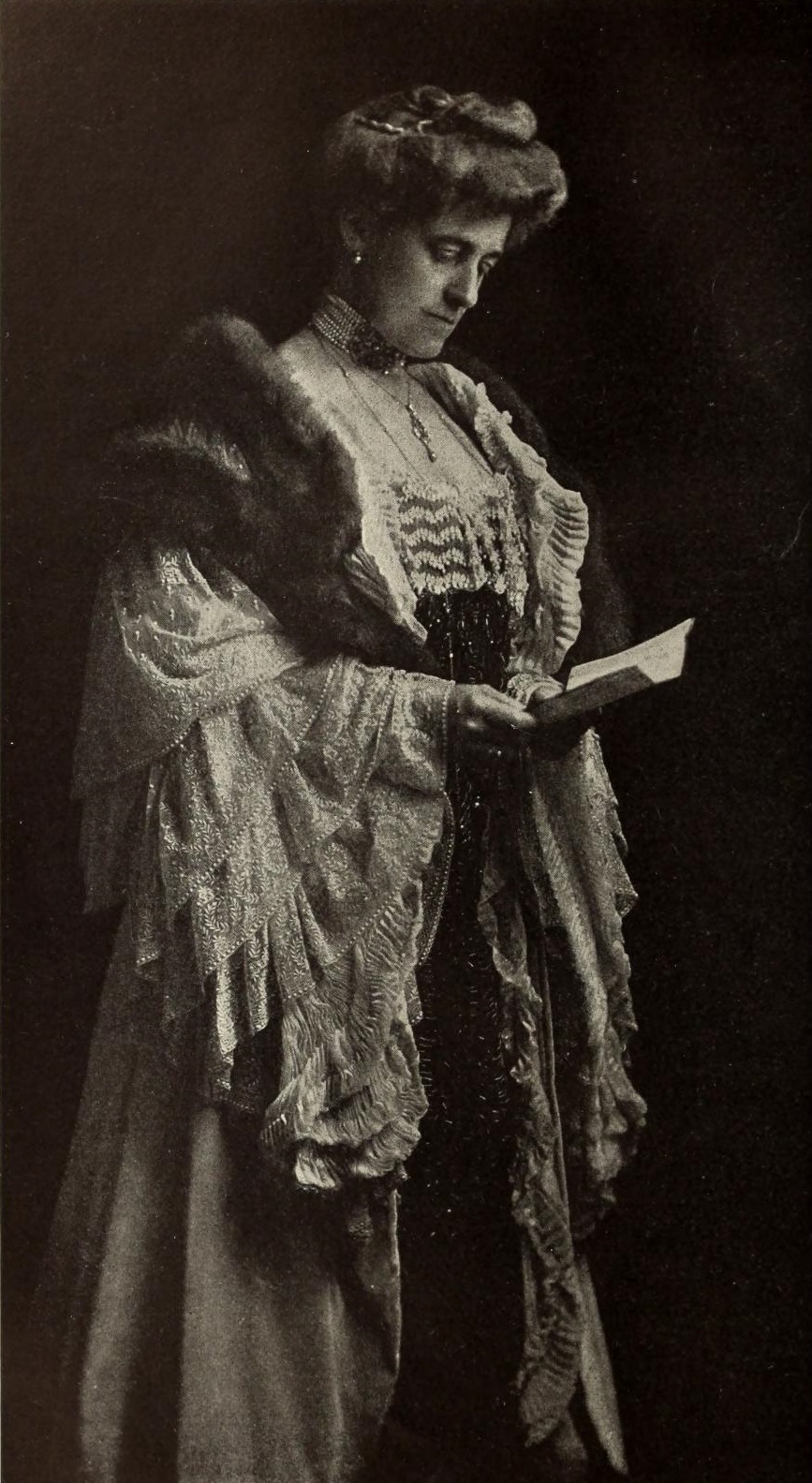
Image context: the cover uses a real photographic portrait of Edith Wharton from Wikimedia Commons. It is not an illustration of Newland Archer or Ellen Olenska, but it suits this piece because the novel's central drama lies in how polished surfaces hold, delay, and redirect emotion. Wharton's own public image of composure belongs to the same visual grammar the novel dissects.[3][5]
1. Bouquets do not decorate the novel. They speak in it.
Wharton teaches the reader early that flowers in this book are not neutral prettiness. They are social language with emotional pressure behind it. May Welland appears at the opera with lilies-of-the-valley and a single gardenia fastening the tulle at her breast.[1] The details matter because they condense the whole May system: whiteness, freshness, correctness, expensive innocence that has already been staged for public reading. Archer looks at those flowers and feels "satisfied vanity," which tells us that he is not simply in love with May as a person. He is also in love with the perfection of the sign.[1]
The counter-movement arrives when Archer goes to the florist and finds himself pulled away from the bouquet meant for May toward Ellen Olenska's yellow roses. Wharton makes him notice that they are "too rich, too strong" for his fiancee.[1] That is one of the novel's sharpest little disclosures. He does not first discover that he loves Ellen in some private chamber of the soul. He discovers difference through color, temperature, and arrangement. May receives the flowers of chastened social fit; Ellen calls forth the flowers of excess, heat, and risk.
Once one sees that system, later details snap into focus. Ellen is surprised by the custom of receiving flowers.[1] Beaufort sends orchids. Henry van der Luyden sends carnations.[1] These are not interchangeable gestures of politeness. They are entries in a competitive economy of attention. Flowers in the novel move ahead of declarations; they prefigure what cannot yet be owned in words. Archer mistakes this coded traffic for refinement, but Wharton keeps showing its harder edge. A bouquet can be an advance, a claim, a display of means, or a warning that private feeling has already become socially legible.[1][2]
2. The opera box is the novel's first machine of surveillance.
The book begins, fittingly, at the Academy of Music during Faust.[1][2] That choice is not accidental atmosphere. Opera gives Wharton a room where looking is formalized. Archer sits among the club-box men who turn their opera-glasses on the ladies in the circle, and he recognizes them as specimens of a system he both belongs to and judges.[1] The phrase "product of the system" lands with unusual force here, because the system is visible before it is explained. Everyone is being watched and sorted while pretending to attend to art.[1]
This is why Ellen's appearance in the Mingotts' box is explosive. She does not merely enter society; she interrupts its sightlines.[1][2] The scandal begins as optics. Who is she with, how is she dressed, who acknowledges her, which relatives shelter her? The opera box becomes a tribunal without openly calling itself one. A whole moral order gets enacted through glances, refusals, and the management of visibility.[1]
Wharton never lets Archer stand outside this. He dislikes the vulgarity of collective scrutiny, yet he is formed by the same habits of reading. He reads May as a white composition; he reads Ellen as a deviation in line and color; he reads rooms as if their arrangement could tell him how far feeling may travel. The novel's title uses "innocence," but the opening pages make innocence look less like purity than like a perfected fluency in coded observation.[1][2][4]
3. Doors, thresholds, and rooms decide what kind of feeling is admissible.
If bouquets are the novel's coded speech and the opera box its public eye, doors are its moral gates. Archer's relation to Ellen repeatedly takes shape at thresholds: her drawing-room door, her rented interiors, the houses where access itself becomes a test.[1] When he first visits her alone, the door is opened by a foreign maid, and the room he enters feels narrower, warmer, less predictable than the social spaces he knows.[1] The difference matters because Archer experiences Ellen through altered interiors before he can formulate any honest account of what he wants from her.
Wharton is brilliant on the fact that a room is never just a room in old New York. The van der Luydens' chambers, Beaufort's enfiladed drawing-rooms, the Archer house, and Ellen's more mixed interiors all distribute permission differently.[1] Social power sits in architecture and furnishing as much as in speech. To be admitted, seated, delayed, or gently turned away is already to receive a verdict.
The novel's later communications make this threshold logic even harsher. Notes and telegrams compress whole structures of family will into a few clean lines.[1] May's telegram near the end feels devastating precisely because it arrives in the impersonal form of pure efficiency: no scene, no plea, no argument, just a message that closes future doors while claiming only to report happiness.[1] Archer has spent the novel imagining that real feeling lives elsewhere, beyond the ornamental shell. Wharton answers by showing how thoroughly the shell controls entrance.
4. Archer's tragedy is not that he feels too little. It is that he reads too sentimentally.
This is what the motif system finally reveals. Archer is often intelligent about society in the abstract. He can see that old New York performs itself. He can mock its complacency and feel the narrowness of its judgments.[1][2] But when the crisis becomes personal, he turns oddly naive. He treats his bond with Ellen as if it belonged to a freer realm than the flowers, boxes, notes, and doors around them. He wants passion without infrastructure, intimacy without public consequence.
Wharton grants him moments of real perception, but she never lets him escape the medium through which perception arrives. Even his revolt is aestheticized. He imagines alternative lives as scenes, rooms, departures, and arrangements rather than durable acts.[1][3] That is why the ending hurts so much. It is not simply the story of a man denied fulfillment. It is the story of a man who has spent years learning how to read a coded world and still fails to understand that his own desire has always been written in that code.
Seen this way, The Age of Innocence is less a museum novel than a novel about transmission. Bouquets move feeling into object form. Opera boxes convert people into visible rank. Doors and telegrams turn intimacy into procedure. Wharton's great achievement is that she makes all of this feel elegant on the sentence level while letting the reader feel the constriction underneath.[1][2][4] The flowers arrive before the feeling because, in this world, social form is not what happens after desire. It is the shape desire is forced to take from the start.
Sources
- Edith Wharton, The Age of Innocence (Project Gutenberg full text).
- Encyclopaedia Britannica, "The Age of Innocence" - overview of the novel, its setting, and its place in Wharton's career.
- Library of America, "Edith Wharton" author page - biographical and career context for Wharton's fiction.
- Encyclopaedia Britannica, "Edith Wharton" - life, major works, and literary standing.
- Wikimedia Commons, "File:Picture of Edith Wharton.jpg" - source page for the archival portrait used as the article image.